Kirjojen hintavertailu. Mukana 12 595 353 kirjaa ja 12 kauppaa.

Kirjailija

Joakim Seiler

Kirjat ja teokset yhdessä paikassa: 4 kirjaa, julkaisuja vuosilta 2018-2022, suosituimpien joukossa Management regimes for lawns and hedges in historic gardens. Vertaile teosten hintoja ja tarkista saatavuus suomalaisista kirjakaupoista.

4 kirjaa

Kirjojen julkaisuhaarukka 2018-2022.

Craft sciences

Craft sciences

Gunnar Almevik; Camilla Groth; Tina Westerlund; Jonathan Westin; Ulrik Hjort-Lassen; Arja Källbom; Lars Eriksson; Ingalill Nyström; Anneli Palmsköld; Johan Knutsson; Harald Bentz Høgseth; Magnús Rannver Rafnsson; Joakim Seiler; Annelie Holmberg; Fredrik Leijonhufvud; Katarina Botwid; Anna Lovisa Holmquist; Birgitta Nordström; Mårten Medbo; Gustav Thane; Bengt Molander

Acta Universitatis Gothoburgensis
2022
nidottu
The ?eld of ‘Craft Sciences’ refers to research conducted across and within di?erent craft subjects and academic contexts. This anthology aims to expose the breadth of topics, source material, methods, perspectives, and results that reside in this ?eld, and to explore what unites the research in such diverse contexts as, for example, the arts, conserva-tion, or vocational craft education. The common thread between each of the chapters in the present book is the augmented attention given to methods—the craft research methods—and to the relationship between the ?eld of inquiry and the ?eld of practice. A common feature is that practice plays an instrumental role in the research found within the chapters, and that the researchers in this publication are also practitioners. The aut-hors are researchers but they are also potters, waiters, carpenters, gardeners, textile artists, boat builders, smiths, building conservators, painting restorers, furniture designers, il-lustrators, and media designers. The researchers contribute from di?erent research ?elds, like craft education, meal sciences, and conservation crafts, and from particular craft subjects, like boat-building and weaving. The main contribution of this book is that it collects together a number of related case studies and presents a re?ection on concepts, perspectives, and methods in the general ?elds of craft research from the point of view of craft practitioners. It adds to the existing academic discussion of crafts through its wider acknowledgement of craftsmanship and extends its borders and its discourse outside the arts and crafts context. This book provides a platform from which to develop context-appropriate research strategies and to associate with the Craft Sciences beyond the bor-ders of faculties and disciplines.
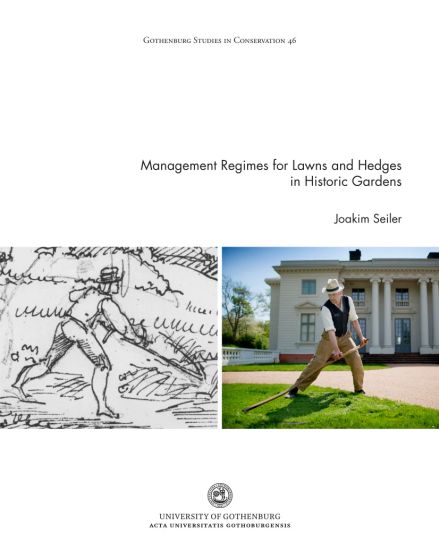
Management regimes for lawns and hedges in historic gardens

Management regimes for lawns and hedges in historic gardens

Joakim Seiler

Acta Universitatis Gothoburgensis
2020
nidottu
This research investigates and compares eighteenth-century and contemporary garden management methods with a focus on the structural elements of lawns and hedges at Gunnebo House, which is used as a craft laboratory. The concept of management regime is utilized for a discourse analysis of the garden through the norms embedded in the management. My research asks not only how did they do it back then? but also how shall we do the work now? The research has consisted in travelling in a hermeneutical circle, from historical sources to craft experiments of historical gardening and onwards, towards an enhanced understanding of the sources through the discoveries made in the experiments. One result of this study is the development of knowledge concerning eighteenth-century management methods for lawns and hedges which has been acquired through the study of historical sources and craft experiments. The craft experiments showed that use of manual tools generally requires a higher degree of skill than is needed when using contemporary tools, which typically secure the quality of the work themselves. The tool used day after day on a particular element of the garden slowly transforms the object. Some historical gardening crafts are living traditions and other vanished methods have been reconstructed in my study. The management affects the garden as a soundscape and this investigation indicates that the contemporary power tools reduce accessibility for visitors due to the noise produced by the tools. The conclusion of the research was that there were several dominant management regimes. The first is a regime that I call the management regime of conspicuous consumption. It developed during the seventeenth century and intended to manifest the social Abstract status of a person, like John Hall at Gunnebo House, by consumption of luxury articles. The pleasure garden at Gunnebo House was an unproductive piece of land that required intense management; it was conspicuous consumption of land. Another dominant regime has been the management regime of the heritage garden at Gunnebo House since the 1990s. The aim for this regime is the revival of the eighteenth century. The conception of time, of what the eighteenth century is, is rhetorical and the regime produced a ‘heritagized’ image of a past time. In this regime, traditional crafts have been an important component and the management has developed into heritage gardening. Both the regime of conspicuous consumption and the regime of the heritage garden strive for the same esthetical ideals, the same expression and, to a large extent, the same craft practices. The major difference between these regimes is that, in the eighteenth century, the ideals, style, and craft were modern and future-oriented while today they are historical enterprises which are oriented to the past. The study has concluded in the suggestion for a new management regime, the regime of meaningful management in the age of the Anthropocene. This regime is not only focused on craft as a means to preserve historic gardens and on looking back over history and defining values based on measurements of preservation of tangible and intangible cultural historical qualities; it also highlights craft as meaningful activity in its own right for people of today. It is a regime which encourages quality and sustainability that comprises and combines good practices from different pasts with contemporary concerns for biodiversity and sustainability as well as people’s sense of heritage and interest in learning from the past. Parts of work Article I: “The Time-space of Craftsmanship” Craft Research (Journal). (2019). Volume 10:1. pp. 17-39. Reproduced with permission of publisher. Copyright © 2019 Intellect Ltd Article II: “Gardening Craft Reconstruction” Manuscript under review in the anthology Craft + Science. Article III: “Ways of Tacit Knowing” Manuscript (film) submitted to Journal of Video Ethnography.
Skötsel av historiska trädgårdar : grusgångar

Skötsel av historiska trädgårdar : grusgångar

Joakim Seiler; Daniel Lundberg

Riksantikvarieämbetet
2018
nidottu
En grusgång är i huvudsak uppbyggd av ett bärlager, som skall ge gången hållfasthet och avgöra hur mycket tyngd den klarar av, samt ett ytskikt, eller slitlager, som ger gången dess karaktär och i viss mån avgör dess funktion. I denna skrift uppmärksammas grusytor som element i historiska trädgårdar. Målsättningen är att sprida kunskap om historisk anläggning, historiska materialval och historisk skötsel samt bidra till medvetna val av skötselmetoder. Skriften redogör främst för skötsel och anläggning av grusgångar i historiska trädgårdar i Sverige från 1650 och framåt, men skötselmetoderna är desamma även för vägar, större grusytor och grusplaner. Modern anläggningsteknik för grusgångar och nutida skötselmetoder i andra länder lämnas dock därhän.
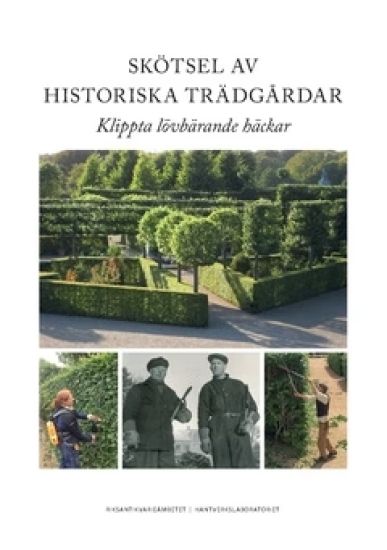
Skötsel av historiska trädgårdar : klippta lövbärande häckar

Skötsel av historiska trädgårdar : klippta lövbärande häckar

Sara utter; Joakim Seiler; Maria Nyman-Nilsson

Riksantikvarieämbetet
2018
nidottu
Skriften handlar om hur man kan tänka vid val av skötselmetod för att tillvarata kulturhistoriska värden i historiska trädgårdar, med fokus på den lövbärande rumsbildande klippta häcken. Här redovisas inte växtval, arter, sorter, planteringsanvisningar eller beskärningstidpunkter. Den som söker sådan information hänvisas till befintlig facklitteratur och kataloger från trädplantskolor.