Kirjojen hintavertailu. Mukana 12 256 877 kirjaa ja 12 kauppaa.

Kirjailija

Johan Redström

Kirjat ja teokset yhdessä paikassa: 4 kirjaa, julkaisuja vuosilta 2011-2020, suosituimpien joukossa Design Research Through Practice. Vertaile teosten hintoja ja tarkista saatavuus suomalaisista kirjakaupoista.

Mukana myös kirjoitusasut: Johan Redstrom

4 kirjaa

Kirjojen julkaisuhaarukka 2011-2020.

Changing Things

Changing Things

Johan Redström; Heather Wiltse

Bloomsbury Visual Arts
2020
nidottu
Many of the things we now live with do not take a purely physical form. Objects such as smart phones, laptops and wearable fitness trackers are different from our things of the past. These new digital forms are networked, dynamic and contextually configured. They can be changeable and unpredictable, even inscrutable when it comes to understanding what they actually do and whom they really serve.In Changing Things, Johan Redstrom and Heather Wiltse address critical questions that have assumed a fresh urgency in the context of these rapidly-developing forms. Drawing on critical traditions from a range of disciplines that have been used to understand the nature of things, they develop a new vocabulary and a theoretical approach that allows us to account for and address the multi-faceted, dynamic, constantly evolving forms and functions of contemporary things. In doing so, the book prototypes a new design discourse around everyday things, and describes them as 'fluid assemblages'.Redstrom and Wiltse explore how a new theoretical framework could enable a richer understanding of things as fluid and networked, with a case study of the evolution of music players culminating in an in-depth discussion of Spotify. Other contemporary 'things' touched on in their analysis include smart phones and watches, as well as digital platforms and applications such as Google, Facebook and Twitter.
Changing Things

Changing Things

Johan Redström; Heather Wiltse

Bloomsbury Visual Arts
2018
sidottu
Many of the things we now live with do not take a purely physical form. Objects such as smart phones, laptops and wearable fitness trackers are different from our things of the past. These new digital forms are networked, dynamic and contextually configured. They can be changeable and unpredictable, even inscrutable when it comes to understanding what they actually do and whom they really serve.In this compelling new volume, Johan Redstrom and Heather Wiltse address critical questions that have assumed a fresh urgency in the context of these rapidly-developing forms. Drawing on critical traditions from a range of disciplines that have been used to understand the nature of things, they develop a new vocabulary and a theoretical approach that allows us to account for and address the multi-faceted, dynamic, constantly evolving forms and functions of contemporary things. In doing so, the book prototypes a new design discourse around everyday things, and describes them as fluid assemblages.Redstrom and Wiltse explore how a new theoretical framework could enable a richer understanding of things as fluid and networked, with a case study of the evolution of music players culminating in an in-depth discussion of Spotify. Other contemporary 'things' touched on in their analysis include smart phones and watches, as well as digital platforms and applications such as Google, Facebook and Twitter.
Making Design Theory

Making Design Theory

Johan Redström

MIT Press
2017
sidottu
A new approach to theory development for practice-driven research, proposing that theory is something made in and through design.Tendencies toward "academization" of traditionally practice-based fields have forced design to articulate itself as an academic discipline, in theoretical terms. In this book, Johan Redstroem offers a new approach to theory development in design research-one that is driven by practice, experimentation, and making. Redstroem does not theorize from the outside, but explores the idea that, just as design research engages in the making of many different kinds of things, theory might well be one of those things it is making.Redstroem proposes that we consider theory not as stable and constant but as something unfolding-something acted as much as articulated, inherently fluid and transitional. Redstroem describes three ways in which theory, in particular formulating basic definitions, is made through design: the use of combinations of fluid terms to articulate issues; the definition of more complex concepts through practice; and combining sets of definitions made through design into "programs." These are the building blocks for creating conceptual structures to support design. Design seems to thrive on the complexities arising from dichotomies: form and function, freedom and method, art and science. With his idea of transitional theory, Redstroem departs from the traditional academic imperative to pick a side-theory or practice, art or science. Doing so, he opens up something like a design space for theory development within design research.
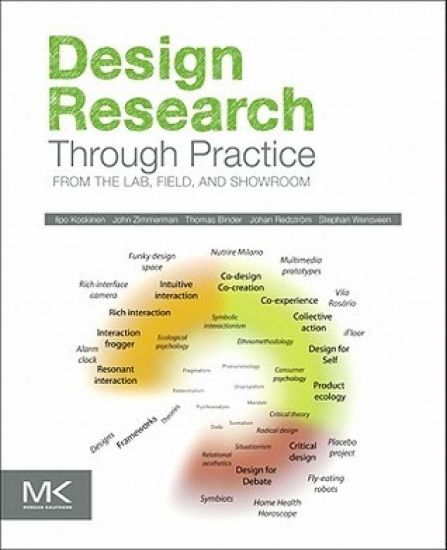
Design Research Through Practice

Design Research Through Practice

Ilpo Koskinen; John Zimmerman; Thomas Binder; Johan Redstrom; Stephan Wensveen

Morgan Kaufmann Publishers In
2011
nidottu
Design Research Through Practice: From the Lab, Field, and Showroom focuses on one type of contemporary design research known as constructive design research. It looks at three approaches to constructive design research: Lab, Field, and Showroom. The book shows how theory, research practice, and the social environment create commonalities between these approaches. It illustrates how one can successfully integrate design and research based on work carried out in industrial design and interaction design. The book begins with an overview of the rise of constructive design research, as well as constructive research programs and methodologies. It then describes the logic of studying design in the laboratory, design ethnography and field work, and the origins of the Showroom and its foundation on art and design rather than on science or the social sciences. It also discusses the theoretical background of constructive design research, along with modeling and prototyping of design items. Finally, it considers recent work in Lab that focuses on action and the body instead of thinking and knowing. Many kinds of designers and people interested in design will find this book extremely helpful.