
Kirjailija
Johannes Bronkhorst
Kirjat ja teokset yhdessä paikassa: 10 kirjaa, julkaisuja vuosilta 1985-2026, suosituimpien joukossa Buddhism in the Shadow of Brahmanism. Vertaile teosten hintoja ja tarkista saatavuus suomalaisista kirjakaupoista.
10 kirjaa
Kirjojen julkaisuhaarukka 1985-2026.

Certain religious behaviours clearly reduce biological fitness. These behaviours include celibacy along with various forms of asceticism, and rituals that harm the performer. Such behaviours are found in widely different cultures. How is this possible? This book shows that these behaviours (as is religion in general) are by-products of features of the human mind whose evolutionary fitness is beyond doubt and explores those features. Which are those features? This book proposes a twofold answer. It draws attention to the layered nature of human consciousness, in which different manners of experience are superimposed on each other. This goes a long way toward accounting for the universal religious belief in some kind of transcendental world, a "higher" reality, different from "ordinary" reality. The layering of consciousness comes about in childhood and gains in prominence with the acquisition of a first language, which is the second feature highlighted in this book. Together, these features explain a variety of "normal" religious behaviours and beliefs, and account for the possibility of mystical experience. They also explain the occurrence of behaviours that do not augment evolutionary fitness.
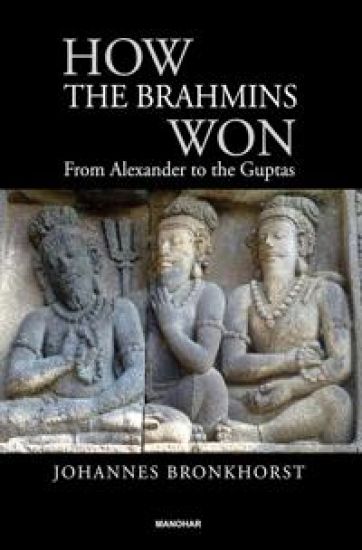
This is the ?rst study to systematically confront the question how Brahmanism, which was geographically limited and under threat during the ?nal centuries BCE, transformed itself and spread all over South and Southeast Asia. Brahmanism spread over this vast area without the support of an empire, without the help of conquering armies, and without the intermediary of religious missionaries.
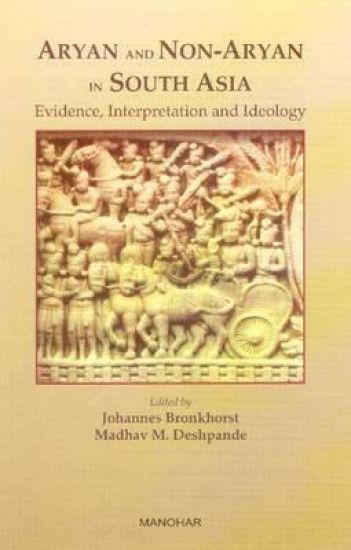
AryanNon-Aryan in South Asia
Johannes Bronkhorst; Madhav M Deshpande
Manohar Publishers And Distrib
2012
sidottu
The volume deals with the history of the concept of Arya and Aryans in East and West, with the linguistic, textual and archaeological evidence in South Asia and beyond. The terms Aryan and Non-Aryan, corresponding to Sanskrit arya and anarya, can readily be shown that among the literary traditions indigenous to South Asia have always evoked strong responses, both positive and negative, as they continue to do even today; but it can also be shown that while they designate a boundary that is in some sense an ethnic one in the Veda, in other literatures the distinction has a religious or moral character. There have been reconsiderations and reinterpretations of the terms within and outside of the academy. There is on the one hand the established view of a migration of Aryans into South Asia; on the other hand there are new voices calling the whole endeavour fanciful, motivated by colonialism, "Orientalism", nationalism, or something else. What is startling is that the criticism of the status quo comes from completely different directions.
This book was written as a doctoral thesis. It was submitted to and accepted by the University of Poona in 1979. Several people contributed to the creation of this book, in various ways. Prof. S. D. Joshi, my supervisor, introduced me to the study of the Sanskrit grammatical tradition. His unfailing skepticism towards and disagreement with the ideas worked out in this book contributed more to their development than he may have been aware. Prof. Paul Kiparsky gave encouragement when this was badly needed. In the years following 1979 Dr. Dominik Wujastyk was kind enough to read the manuscript and suggest improvements in language and style. To all of these lowe a debt of gratitude, but most of all lowe such a debt to Pandit Shivarama Krishna Shastri. In the course of several years he read with me many portions of Nagesa's grammatical and other works, and much besides. His ability to understand difficult grammatical and philosophical texts in Sanskrit was unequalled, and without his help it would have taken far longer to write this book and indeed might very well have proved impossible. Shivarama Krishna Shastri never saw the result of our reading; he died before this book could appear in print. I dedicate it to his memory. J. BRONKHORST Xl INTRODUCTION In the following pages an attempt will be made to establish that the part of Nagesa's Paribha$endusekhara (PS) which deals with Par.

Karma has become a household word in the modern world, where it is associated with the belief in rebirth determined by one’s deeds in earlier lives. This belief was and is widespread in the Indian subcontinent as is the word “karma” itself. In lucid and accessible prose, this book presents karma in its historical, cultural, and religious context.Initially, karma manifested itself in a number of religious movements?most notably Jainism and Buddhism?and was subsequently absorbed into Brahmanism in spite of opposition until the end of the first millennium C.E. Philosophers of all three traditions were confronted with the challenge of explaining by what process rebirth and karmic retribution take place. Some took the drastic step of accepting the participation of a supreme god who acted as a cosmic accountant, others of opting for radical idealism. The doctrine of karma was confronted with alternative explanations of human destiny, among them the belief in the transfer of merit. It also had to accommodate itself to devotional movements that exerted a major influence on Indian religions.The book concludes with some general reflections on the significance of rebirth and karmic retribution, drawing attention to similarities between early Christian and Indian ascetical practices and philosophical notions that in India draw their inspiration from the doctrine of karma.

Karma has become a household word in the modern world, where it is associated with the belief in rebirth determined by one’s deeds in earlier lives. This belief was and is widespread in the Indian subcontinent as is the word “karma” itself. In lucid and accessible prose, this book presents karma in its historical, cultural, and religious context.Initially, karma manifested itself in a number of religious movements?most notably Jainism and Buddhism?and was subsequently absorbed into Brahmanism in spite of opposition until the end of the first millennium C.E. Philosophers of all three traditions were confronted with the challenge of explaining by what process rebirth and karmic retribution take place. Some took the drastic step of accepting the participation of a supreme god who acted as a cosmic accountant, others of opting for radical idealism. The doctrine of karma was confronted with alternative explanations of human destiny, among them the belief in the transfer of merit. It also had to accommodate itself to devotional movements that exerted a major influence on Indian religions.The book concludes with some general reflections on the significance of rebirth and karmic retribution, drawing attention to similarities between early Christian and Indian ascetical practices and philosophical notions that in India draw their inspiration from the doctrine of karma.
Tradition and Argument in Classical Indian Linguistics
Johannes Bronkhorst
Kluwer Academic Publishers
1985
sidottu
This book was written as a doctoral thesis. It was submitted to and accepted by the University of Poona in 1979. Several people contributed to the creation of this book, in various ways. Prof. S. D. Joshi, my supervisor, introduced me to the study of the Sanskrit grammatical tradition. His unfailing skepticism towards and disagreement with the ideas worked out in this book contributed more to their development than he may have been aware. Prof. Paul Kiparsky gave encouragement when this was badly needed. In the years following 1979 Dr. Dominik Wujastyk was kind enough to read the manuscript and suggest improvements in language and style. To all of these lowe a debt of gratitude, but most of all lowe such a debt to Pandit Shivarama Krishna Shastri. In the course of several years he read with me many portions of Nagesa's grammatical and other works, and much besides. His ability to understand difficult grammatical and philosophical texts in Sanskrit was unequalled, and without his help it would have taken far longer to write this book and indeed might very well have proved impossible. Shivarama Krishna Shastri never saw the result of our reading; he died before this book could appear in print. I dedicate it to his memory. J. BRONKHORST Xl INTRODUCTION In the following pages an attempt will be made to establish that the part of Nagesa's Paribha$endusekhara (PS) which deals with Par.