Kirjojen hintavertailu. Mukana 12 595 353 kirjaa ja 12 kauppaa.

Kirjailija

Johannes Haubold

Kirjat ja teokset yhdessä paikassa: 5 kirjaa, julkaisuja vuosilta 2000-2020, suosituimpien joukossa Greece and Mesopotamia. Vertaile teosten hintoja ja tarkista saatavuus suomalaisista kirjakaupoista.

5 kirjaa

Kirjojen julkaisuhaarukka 2000-2020.

Greece and Mesopotamia

Greece and Mesopotamia

Johannes Haubold

Cambridge University Press
2020
pokkari
This book proposes a new approach to the study of ancient Greek and Mesopotamian literature. Ranging from Homer and Gilgamesh to Herodotus and the Babylonian-Greek author Berossos, it paints a picture of two literary cultures that, over the course of time, became profoundly entwined. Along the way, the book addresses many questions of crucial importance to the student of the ancient world: how did the literature of Greece relate to that of its eastern neighbours? What did ancient readers from different cultures think it meant to be human? Who invented the writing of universal history as we know it? How did the Greeks come to divide the world into Greeks and 'barbarians', and what happened when they came to live alongside those 'barbarians' after the conquests of Alexander the Great? In addressing these questions, the book draws on cutting-edge research in comparative literature, postcolonial studies and archive theory.
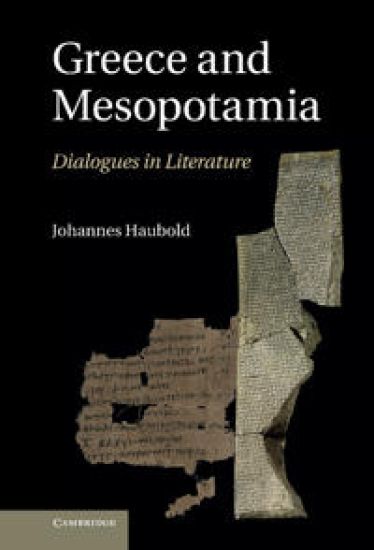
Greece and Mesopotamia

Greece and Mesopotamia

Johannes Haubold

Cambridge University Press
2013
sidottu
This book proposes a new approach to the study of ancient Greek and Mesopotamian literature. Ranging from Homer and Gilgamesh to Herodotus and the Babylonian-Greek author Berossos, it paints a picture of two literary cultures that, over the course of time, became profoundly entwined. Along the way, the book addresses many questions of crucial importance to the student of the ancient world: how did the literature of Greece relate to that of its eastern neighbours? What did ancient readers from different cultures think it meant to be human? Who invented the writing of universal history as we know it? How did the Greeks come to divide the world into Greeks and 'barbarians', and what happened when they came to live alongside those 'barbarians' after the conquests of Alexander the Great? In addressing these questions, the book draws on cutting-edge research in comparative literature, postcolonial studies and archive theory.
Homer's People

Homer's People

Johannes Haubold

Cambridge University Press
2008
pokkari
This book examines the role and character of Homer's people, laoi, in Homeric story-telling, arguing that Homeric poetry is crucially concerned with the people as a basis for communal life. Both The Iliad and The Odyssey are read as sustained meditations on the processes involved in protecting and destroying the people. The investigation draws on a wide range of approaches from formulaic analysis to the study of early performance contexts. From a close reading of the Homeric epics, Homer's people emerge as a community without effective social structures. When this is viewed from the perspective of Homeric performances in the polis, a contrast between Homer's laoi and the founding people of ritual emerges. While the former typically perish, the survival of the latter is secured by the establishment of successful institutions.
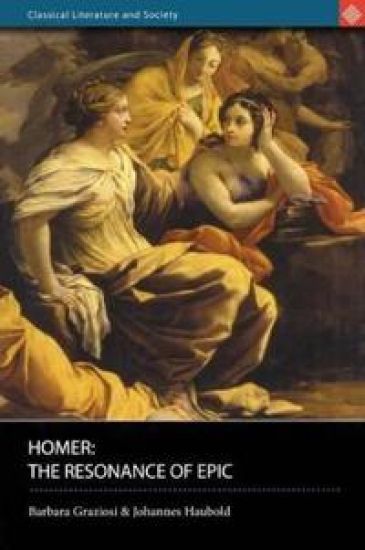
Homer

Homer

Barbara Graziosi; Johannes Haubold

Bristol Classical Press
2005
pokkari
This book offers a new approach to the study of Homeric epic by combining ancient Greek perceptions of Homer with up-to-date scholarship on traditional poetry. Part I argues that, in the archaic period, the Greeks saw the lliad and Odyssey neither as literary works in the modern sense nor as the products of oral poetry. Instead, they regarded them as belonging to a much wider history of the divine cosmos, whose structures and themes are reflected in the resonant patterns of Homer's traditional language and narrative techniques. Part II illustrates this claim by looking at some central aspects of the Homeric poems: the gods and fate, gender and society, death, fame and poetry. Each section shows how the patterns and preoccupations of Homeric storytelling reflect a historical vision that encompasses the making of the universe, from its beginnings when Heaven mated with Earth, to the present day.
Homer's People

Homer's People

Johannes Haubold

Cambridge University Press
2000
sidottu
This book examines the role and character of Homer's people, laoi, in Homeric story-telling, arguing that Homeric poetry is crucially concerned with the people as a basis for communal life. Both The Iliad and The Odyssey are read as sustained meditations on the processes involved in protecting and destroying the people. The investigation draws on a wide range of approaches from formulaic analysis to the study of early performance contexts. From a close reading of the Homeric epics, Homer's people emerge as a community without effective social structures. When this is viewed from the perspective of Homeric performances in the polis, a contrast between Homer's laoi and the founding people of ritual emerges. While the former typically perish, the survival of the latter is secured by the establishment of successful institutions.