Kirjojen hintavertailu. Mukana 12 595 353 kirjaa ja 12 kauppaa.

Kirjailija

John A. Adam

Kirjat ja teokset yhdessä paikassa: 7 kirjaa, julkaisuja vuosilta 1996-2026, suosituimpien joukossa Mathematics in Nature, Revised Edition. Vertaile teosten hintoja ja tarkista saatavuus suomalaisista kirjakaupoista.

Mukana myös kirjoitusasut: John A Adam

7 kirjaa

Kirjojen julkaisuhaarukka 1996-2026.

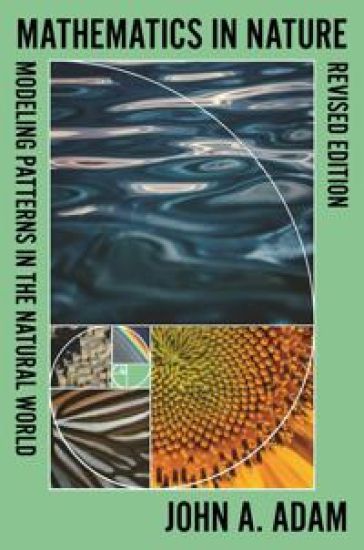
Mathematics in Nature, Revised Edition

Mathematics in Nature, Revised Edition

John A. Adam

PRINCETON UNIVERSITY PRESS
2026
sidottu
How mathematics unveils the beauty of the natural world Mathematics in Nature reveals how mathematics provides a unifying language for understanding the hidden order of nature. In this richly illustrated book, John Adam guides readers from basic models using everyday arithmetic to the modeling of intricate, ever-evolving patterns, showing how even simple equations can illuminate the structure and behavior of complex systems. Adam introduces arithmetic and algebraic models that capture essential ideas of population growth, resource consumption, and environmental feedbacks. Through discussions of shape, size, and scale, he explains why proportions and dimensions matter across biology and physics. He delves into the physics of light and air to reveal the mathematical patterns behind atmospheric beauty—from rainbows, halos, and glories to mirages and cloud formations—and demonstrates how equations can be used to describe ripples on water, sound in air, and the dramatic surges of tidal bores. Adam progresses from Fibonacci sequences, metallic ratios, and natural spirals to pattern formation and self-organization in living and nonliving systems. With new chapters on the dynamics of climate change and pandemics, this fully revised edition reveals how mathematical modeling brings coherence and clarity to our understanding of nature’s complexity and the forces that shape our environment.
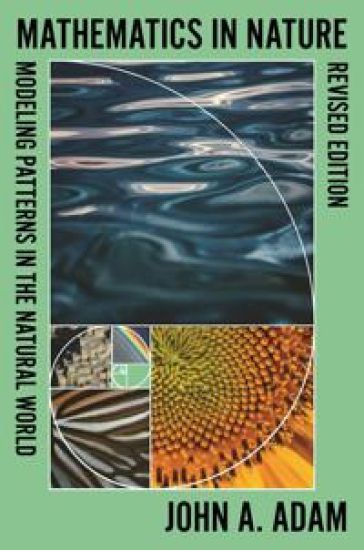
Mathematics in Nature, Revised Edition

Mathematics in Nature, Revised Edition

John A. Adam

PRINCETON UNIVERSITY PRESS
2026
pokkari
How mathematics unveils the beauty of the natural world Mathematics in Nature reveals how mathematics provides a unifying language for understanding the hidden order of nature. In this richly illustrated book, John Adam guides readers from basic models using everyday arithmetic to the modeling of intricate, ever-evolving patterns, showing how even simple equations can illuminate the structure and behavior of complex systems. Adam introduces arithmetic and algebraic models that capture essential ideas of population growth, resource consumption, and environmental feedbacks. Through discussions of shape, size, and scale, he explains why proportions and dimensions matter across biology and physics. He delves into the physics of light and air to reveal the mathematical patterns behind atmospheric beauty—from rainbows, halos, and glories to mirages and cloud formations—and demonstrates how equations can be used to describe ripples on water, sound in air, and the dramatic surges of tidal bores. Adam progresses from Fibonacci sequences, metallic ratios, and natural spirals to pattern formation and self-organization in living and nonliving systems. With new chapters on the dynamics of climate change and pandemics, this fully revised edition reveals how mathematical modeling brings coherence and clarity to our understanding of nature’s complexity and the forces that shape our environment.
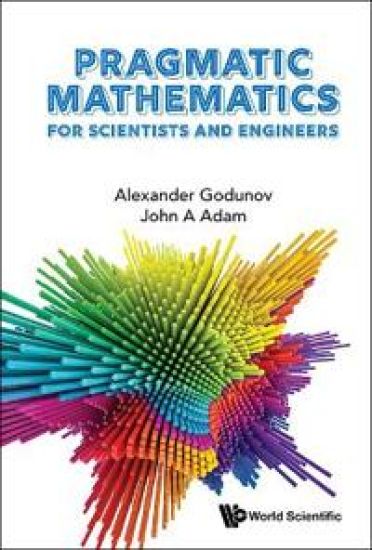
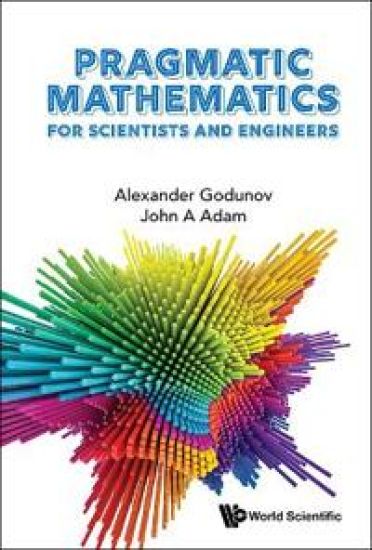
Pragmatic Mathematics For Scientists And Engineers

Pragmatic Mathematics For Scientists And Engineers

Alexander L Godunov; John A Adam

WORLD SCIENTIFIC PUBLISHING CO PTE LTD
2024
sidottu
This is a textbook on basic to intermediate mathematics for undergraduate students majoring in the physical sciences and engineering. Many chapters, covering topics like Green's functions, calculus of variations, and functions of a complex variable, are well-suited for graduate classes. Additionally, researchers can benefit from the book as a mathematical refresher for their professional work.The book provides readers with a fundamental understanding of underlying principles, using derivations based more on mathematical intuition rather than exposing them to multiple theorems, proofs, and lemmas. Each chapter includes highly relevant examples with detailed solutions and explanations, promoting a practical application of knowledge to real problems in the physical sciences. For the convenience of both students and instructors, there are end-of-chapter exercises with answers that can be easily utilized for assignments.The book is not a replacement for calculus textbooks, but rather a guide to the mathematics most relevant to the physical sciences and engineering.In conclusion, this book can be readily adapted for upper-level undergraduate and graduate classes, particularly those focusing on mathematical methods for students in physical sciences, applied mathematics, and engineering majors.
Pragmatic Mathematics For Scientists And Engineers

Pragmatic Mathematics For Scientists And Engineers

Alexander L Godunov; John A Adam

WORLD SCIENTIFIC PUBLISHING CO PTE LTD
2024
nidottu
This is a textbook on basic to intermediate mathematics for undergraduate students majoring in the physical sciences and engineering. Many chapters, covering topics like Green's functions, calculus of variations, and functions of a complex variable, are well-suited for graduate classes. Additionally, researchers can benefit from the book as a mathematical refresher for their professional work.The book provides readers with a fundamental understanding of underlying principles, using derivations based more on mathematical intuition rather than exposing them to multiple theorems, proofs, and lemmas. Each chapter includes highly relevant examples with detailed solutions and explanations, promoting a practical application of knowledge to real problems in the physical sciences. For the convenience of both students and instructors, there are end-of-chapter exercises with answers that can be easily utilized for assignments.The book is not a replacement for calculus textbooks, but rather a guide to the mathematics most relevant to the physical sciences and engineering.In conclusion, this book can be readily adapted for upper-level undergraduate and graduate classes, particularly those focusing on mathematical methods for students in physical sciences, applied mathematics, and engineering majors.
A Survey of Models for Tumor-Immune System Dynamics

A Survey of Models for Tumor-Immune System Dynamics

John A. Adam; Nicola Bellomo

Springer-Verlag New York Inc.
2012
nidottu
Mathematical Modeling and Immunology An enormous amount of human effort and economic resources has been directed in this century to the fight against cancer. The purpose, of course, has been to find strategies to overcome this hard, challenging and seemingly endless struggle. We can readily imagine that even greater efforts will be required in the next century. The hope is that ultimately humanity will be successful; success will have been achieved when it is possible to activate and control the immune system in its competition against neoplastic cells. Dealing with the above-mentioned problem requires the fullest pos­ sible cooperation among scientists working in different fields: biology, im­ munology, medicine, physics and, we believe, mathematics. Certainly, bi­ ologists and immunologists will make the greatest contribution to the re­ search. However, it is now increasingly recognized that mathematics and computer science may well able to make major contributions to such prob­ lems. We cannot expect mathematicians alone to solve fundamental prob­ lems in immunology and (in particular) cancer research, but valuable sup­ port, however modest, can be provided by mathematicians to the research aspirations of biologists and immunologists working in this field.
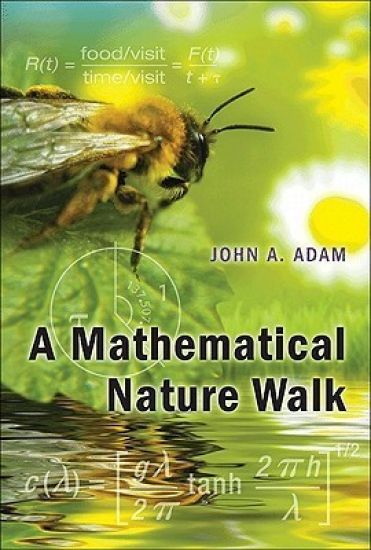
A Mathematical Nature Walk

A Mathematical Nature Walk

John A. Adam

Princeton University Press
2011
pokkari
How heavy is that cloud? Why can you see farther in rain than in fog? Why are the droplets on that spider web spaced apart so evenly? If you have ever asked questions like these while outdoors, and wondered how you might figure out the answers, this is a book for you. An entertaining and informative collection of fascinating puzzles from the natural world around us, A Mathematical Nature Walk will delight anyone who loves nature or math or both. John Adam presents ninety-six questions about many common natural phenomena--and a few uncommon ones--and then shows how to answer them using mostly basic mathematics. Can you weigh a pumpkin just by carefully looking at it? Why can you see farther in rain than in fog? What causes the variations in the colors of butterfly wings, bird feathers, and oil slicks? And why are large haystacks prone to spontaneous combustion? These are just a few of the questions you'll find inside. Many of the problems are illustrated with photos and drawings, and the book also has answers, a glossary of terms, and a list of some of the patterns found in nature. About a quarter of the questions can be answered with arithmetic, and many of the rest require only precalculus. But regardless of math background, readers will learn from the informal descriptions of the problems and gain a new appreciation of the beauty of nature and the mathematics that lies behind it.
A Survey of Models for Tumor-Immune System Dynamics

A Survey of Models for Tumor-Immune System Dynamics

John A. Adam; Nicola Bellomo

Birkhauser Boston Inc
1996
sidottu
Mathematical Modeling and Immunology An enormous amount of human effort and economic resources has been directed in this century to the fight against cancer. The purpose, of course, has been to find strategies to overcome this hard, challenging and seemingly endless struggle. We can readily imagine that even greater efforts will be required in the next century. The hope is that ultimately humanity will be successful; success will have been achieved when it is possible to activate and control the immune system in its competition against neoplastic cells. Dealing with the above-mentioned problem requires the fullest pos­ sible cooperation among scientists working in different fields: biology, im­ munology, medicine, physics and, we believe, mathematics. Certainly, bi­ ologists and immunologists will make the greatest contribution to the re­ search. However, it is now increasingly recognized that mathematics and computer science may well able to make major contributions to such prob­ lems. We cannot expect mathematicians alone to solve fundamental prob­ lems in immunology and (in particular) cancer research, but valuable sup­ port, however modest, can be provided by mathematicians to the research aspirations of biologists and immunologists working in this field.