Kirjojen hintavertailu. Mukana 12 595 353 kirjaa ja 12 kauppaa.

Kirjailija

John A. Beekman

Kirjat ja teokset yhdessä paikassa: 2 kirjaa, julkaisuja vuosilta 1984-2010, suosituimpien joukossa Demography Through Problems. Vertaile teosten hintoja ja tarkista saatavuus suomalaisista kirjakaupoista.

2 kirjaa

Kirjojen julkaisuhaarukka 1984-2010.

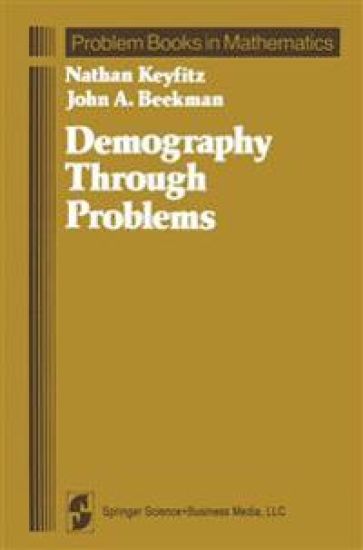
Demography Through Problems

Demography Through Problems

Nathan Keyfitz; John A. Beekman

Springer-Verlag New York Inc.
2010
nidottu
The book that follows is an experiment in the teaching of population theory and analysis. A sequence of problems where each is a self-contained puzzle, and the successful solution of each which puts the student in a position to tackle the next, is a means of securing the active participation of the learner and so the mastery of a technical subject. How far our questions are the exciting puzzles at which we aimed, and how far the sequence constitutes a rounded course in demography, must be left to the user to judge. One test of a good problem is whether a solution, that may take hours of cogitation, is immediately recognizable once it comes to mind. While algebraic manipulation is required throughout, we have tried to emphasize problems in which there is some substantive point-a conclusion regarding population that can be put into words. Our title, Demography Through Problems, reflects our intention of leading the reader who will actively commit him-or herself through a sequence that will not only teach definitions-in itself a trivial matter-but sharpen intuition on the way that populations behave.
Demography Through Problems

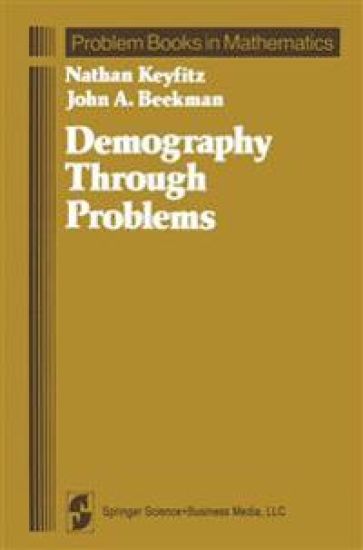
Demography Through Problems

Nathan Keyfitz; John A. Beekman

Springer-Verlag New York Inc.
1984
sidottu
The book that follows is an experiment in the teaching of population theory and analysis. A sequence of problems where each is a self-contained puzzle, and the successful solution of each which puts the student in a position to tackle the next, is a means of securing the active participation of the learner and so the mastery of a technical subject. How far our questions are the exciting puzzles at which we aimed, and how far the sequence constitutes a rounded course in demography, must be left to the user to judge. One test of a good problem is whether a solution, that may take hours of cogitation, is immediately recognizable once it comes to mind. While algebraic manipulation is required throughout, we have tried to emphasize problems in which there is some substantive point-a conclusion regarding population that can be put into words. Our title, Demography Through Problems, reflects our intention of leading the reader who will actively commit him-or herself through a sequence that will not only teach definitions-in itself a trivial matter-but sharpen intuition on the way that populations behave.