Kirjojen hintavertailu. Mukana 12 390 323 kirjaa ja 12 kauppaa.

Kirjailija

John A. Cornell

Kirjat ja teokset yhdessä paikassa: 6 kirjaa, julkaisuja vuosilta 1996-2019, suosituimpien joukossa The First Church Of Beverly. Vertaile teosten hintoja ja tarkista saatavuus suomalaisista kirjakaupoista.

6 kirjaa

Kirjojen julkaisuhaarukka 1996-2019.

Response Surfaces: Designs and Analyses

Response Surfaces: Designs and Analyses

Andre I. Khuri; John A. Cornell

CRC Press
2019
nidottu
Response Surfaces: Designs and Analyses; Second Edition presents techniques for designing experiments that yield adequate and reliable measurements of one or several responses of interest, fitting and testing the suitability of empirical models used for acquiring information from the experiments, and for utilizing the experimental results to make decisions concerning the system under investigation. This edition contains chapters on response surface models with block effects and on Taguchi's robust parameter design, additional details on transformation of response variable, more material on modified ridge analysis, and new design criteria, including rotatability for multiresponse experiments. It also presents an innovative technique for displaying correlation among several response. Numerical examples throughout the book plus exercises--with worked solutions to selected problems--complement the text.
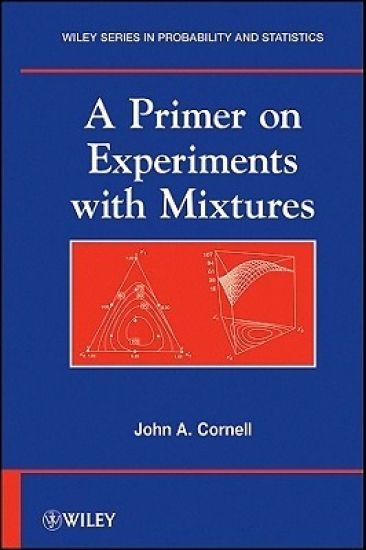
A Primer on Experiments with Mixtures

A Primer on Experiments with Mixtures

John A. Cornell

John Wiley Sons Inc
2011
sidottu
The concise yet authoritative presentation of key techniques for basic mixtures experiments Inspired by the author's bestselling advanced book on the topic, A Primer on Experiments with Mixtures provides an introductory presentation of the key principles behind experimenting with mixtures. Outlining useful techniques through an applied approach with examples from real research situations, the book supplies a comprehensive discussion of how to design and set up basic mixture experiments, then analyze the data and draw inferences from results. Drawing from his extensive experience teaching the topic at various levels, the author presents the mixture experiments in an easy-to-follow manner that is void of unnecessary formulas and theory. Succinct presentations explore key methods and techniques for carrying out basic mixture experiments, including: Designs and models for exploring the entire simplex factor space, with coverage of simplex-lattice and simplex-centroid designs, canonical polynomials, the plotting of individual residuals, and axial designs Multiple constraints on the component proportions in the form of lower and/or upper bounds, introducing L-Pseudocomponents, multicomponent constraints, and multiple lattice designs for major and minor component classifications Techniques for analyzing mixture data such as model reduction and screening components, as well as additional topics such as measuring the leverage of certain design points Models containing ratios of the components, Cox's mixture polynomials, and the fitting of a slack variable model A review of least squares and the analysis of variance for fitting data Each chapter concludes with a summary and appendices with details on the technical aspects of the material. Throughout the book, exercise sets with selected answers allow readers to test their comprehension of the material, and References and Recommended Reading sections outline further resources for study of the presented topics. A Primer on Experiments with Mixtures is an excellent book for one-semester courses on mixture designs and can also serve as a supplement for design of experiments courses at the upper-undergraduate and graduate levels. It is also a suitable reference for practitioners and researchers who have an interest in experiments with mixtures and would like to learn more about the related mixture designs and models.
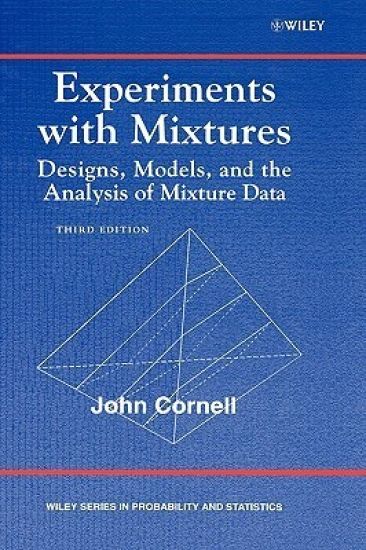
Experiments with Mixtures

Experiments with Mixtures

John A. Cornell

John Wiley Sons Inc
2002
sidottu
The most comprehensive, single-volume guide to conducting experiments with mixtures "If one is involved, or heavily interested, in experiments on mixtures of ingredients, one must obtain this book. It is, as was the first edition, the definitive work." –Short Book Reviews (Publication of the International Statistical Institute) "The text contains many examples with worked solutions and with its extensive coverage of the subject matter will prove invaluable to those in the industrial and educational sectors whose work involves the design and analysis of mixture experiments." –Journal of the Royal Statistical Society "The author has done a great job in presenting the vital information on experiments with mixtures in a lucid and readable style. . . . A very informative, interesting, and useful book on an important statistical topic." –Zentralblatt fur Mathematik und Ihre Grenzgebiete Experiments with Mixtures shows researchers and students how to design and set up mixture experiments, then analyze the data and draw inferences from the results. Virtually every technique that has appeared in the literature of mixtures can be found here, and computing formulas for each method are provided with completely worked examples. Almost all of the numerical examples are taken from real experiments. Coverage begins with Scheffe lattice designs, introducing the use of independent variables, and ends with the most current methods. New material includes: *Multiple response cases *Residuals and least-squares estimates *Categories of components: Mixtures of mixtures *Fixed as well as variable values for the major component proportions *Leverage and the Hat Matrix *Fitting a slack-variable model *Estimating components of variances in a mixed model using ANOVA table entries *Clarification of blocking mates and choice of mates *Optimizing several responses simultaneously *Biplots for multiple responses
Response Surfaces: Designs and Analyses

Response Surfaces: Designs and Analyses

Andre I. Khuri; John A. Cornell

CRC Press Inc
1996
sidottu
Response Surfaces: Designs and Analyses; Second Edition presents techniques for designing experiments that yield adequate and reliable measurements of one or several responses of interest, fitting and testing the suitability of empirical models used for acquiring information from the experiments, and for utilizing the experimental results to make decisions concerning the system under investigation. This edition contains chapters on response surface models with block effects and on Taguchi's robust parameter design, additional details on transformation of response variable, more material on modified ridge analysis, and new design criteria, including rotatability for multiresponse experiments. It also presents an innovative technique for displaying correlation among several response. Numerical examples throughout the book plus exercises--with worked solutions to selected problems--complement the text.