Kirjojen hintavertailu. Mukana 12 474 174 kirjaa ja 12 kauppaa.

Kirjailija

John A. Hawkins

Kirjat ja teokset yhdessä paikassa: 8 kirjaa, julkaisuja vuosilta 1990-2026, suosituimpien joukossa The English Language on Trial. Vertaile teosten hintoja ja tarkista saatavuus suomalaisista kirjakaupoista.

8 kirjaa

Kirjojen julkaisuhaarukka 1990-2026.

The English Language on Trial

The English Language on Trial

John A. Hawkins

Cambridge University Press
2026
pokkari
Many lawsuits arise over disagreements about language and about the meanings of everyday words, phrases, and sentences. This book draws on over fifty cases involving disputed meanings in the American legal system where the author served as an expert witness or consultant, to explore the interaction between language and law. Stepping back from the legal specifics and their outcomes, it analyzes the disputes from the perspective of the language sciences, especially semantics and pragmatics, and language comprehension. It seeks to understand why, and in what areas of English grammar, lexis, and usage, they have arisen among speakers who do not normally miscommunicate and disagree like this. The cases involve contracts, patents, advertising, trademarks, libel, and defamation, and descriptive insights and methods from the language sciences are applied to each case to make explicit the meanings that speakers would normally assign to English.

The English Language on Trial

The English Language on Trial

John A. Hawkins

Cambridge University Press
2026
sidottu
Many lawsuits arise over disagreements about language and about the meanings of everyday words, phrases, and sentences. This book draws on over fifty cases involving disputed meanings in the American legal system where the author served as an expert witness or consultant, to explore the interaction between language and law. Stepping back from the legal specifics and their outcomes, it analyzes the disputes from the perspective of the language sciences, especially semantics and pragmatics, and language comprehension. It seeks to understand why, and in what areas of English grammar, lexis, and usage, they have arisen among speakers who do not normally miscommunicate and disagree like this. The cases involve contracts, patents, advertising, trademarks, libel, and defamation, and descriptive insights and methods from the language sciences are applied to each case to make explicit the meanings that speakers would normally assign to English.
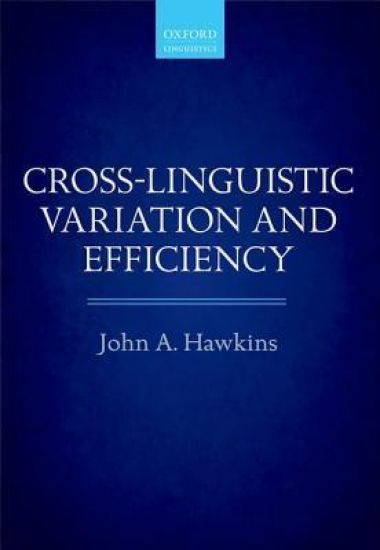
Cross-Linguistic Variation and Efficiency

Cross-Linguistic Variation and Efficiency

John A. Hawkins

Oxford University Press
2014
nidottu
In this book John A. Hawkins argues that major patterns of variation across languages are structured by general principles of efficiency in language use and communication. Evidence for these comes from languages permitting structural options from which selections are made in performance, e.g. between competing word orders and between relative clauses with a resumptive pronoun versus a gap. The preferences and patterns of performance within languages are reflected, he shows, in the fixed conventions and variation patterns across grammars, leading to a 'Performance-Grammar Correspondence Hypothesis'. Hawkins extends and updates the general theory that he laid out in Efficiency and Complexity in Grammars (OUP 2004): new areas of grammar and performance are discussed, new research findings are incorporated that test his earlier predictions, and new advances in the contributing fields of language processing, linguistic theory, historical linguistics, and typology are addressed. This efficiency approach to variation has far-reaching theoretical consequences relevant to many current issues in the language sciences. These include the notion of ease of processing and how to measure it, the role of processing in language change, the nature of language universals and their explanation, the theory of complexity, the relative strength of competing and cooperating principles, and the proper definition of fundamental grammatical notions such as 'dependency'. The book also offers a new typology of VO and OV languages and their correlating properties seen from this perspective, and a new typology of the noun phrase and of argument structure.
Cross-Linguistic Variation and Efficiency

Cross-Linguistic Variation and Efficiency

John A. Hawkins

Oxford University Press
2014
sidottu
In this book John A. Hawkins argues that major patterns of variation across languages are structured by general principles of efficiency in language use and communication. Evidence for these comes from languages permitting structural options from which selections are made in performance, e.g. between competing word orders and between relative clauses with a resumptive pronoun versus a gap. The preferences and patterns of performance within languages are reflected, he shows, in the fixed conventions and variation patterns across grammars, leading to a 'Performance-Grammar Correspondence Hypothesis'. Hawkins extends and updates the general theory that he laid out in Efficiency and Complexity in Grammars (OUP 2004): new areas of grammar and performance are discussed, new research findings are incorporated that test his earlier predictions, and new advances in the contributing fields of language processing, linguistic theory, historical linguistics, and typology are addressed. This efficiency approach to variation has far-reaching theoretical consequences relevant to many current issues in the language sciences. These include the notion of ease of processing and how to measure it, the role of processing in language change, the nature of language universals and their explanation, the theory of complexity, the relative strength of competing and cooperating principles, and the proper definition of fundamental grammatical notions such as 'dependency'. The book also offers a new typology of VO and OV languages and their correlating properties seen from this perspective, and a new typology of the noun phrase and of argument structure.
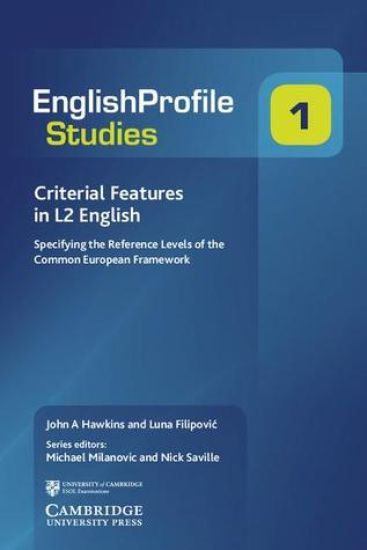
Criterial Features in L2 English

Criterial Features in L2 English

John A. Hawkins; Luna Filipovic

Cambridge University Press
2012
pokkari
This volume introduces a new concept, 'criterial features', for the learning, teaching and testing of English as a second language. The work is based on research conducted within the English Profile Programme at Cambridge University, using the Cambridge Learner Corpus. The authors address the extent to which learners know the grammar, lexicon and usage conventions of English at each level of the Common European Framework of Reference (CEFR). These levels are currently illustrated in functional terms with 'Can Do' statements. Greater specificity and precision can be achieved by using the tagged and parsed corpus, which enables researchers to identify criterial features of the CEFR levels, i.e. properties that are characteristic and indicative of L2 proficiency at each level. In practical terms, once criterial features have been identified, the grammatical and lexical properties of English can be presented to learners more efficiently and in ways that are appropriate to their levels.
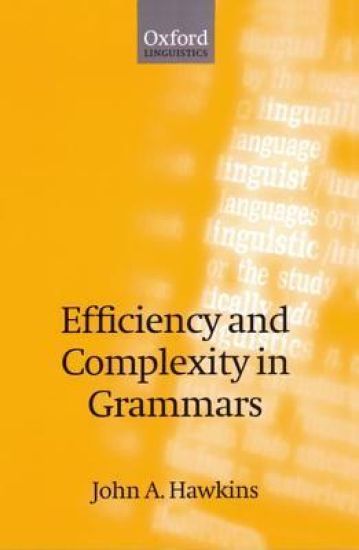
Efficiency and Complexity in Grammars

Efficiency and Complexity in Grammars

John A. Hawkins

Oxford University Press
2004
sidottu
This book addresses a question fundamental to any discussion of grammatical theory and grammatical variation: to what extent can principles of grammar be explained through language use? John A. Hawkins argues that there is a profound correspondence between performance data and the fixed conventions of grammars. Preferences and patterns found in the one, he shows, are reflected in constraints and variation patterns in the other. The theoretical consequences of the proposed 'performance-grammar correspondence hypothesis' are far-reaching -- for current grammatical formalisms, for the innateness hypothesis, and for psycholinguistic models of performance and learning. Drawing on empirical generalizations and insights from language typology, generative grammar, psycholinguistics, and historical linguistics, Professor Hawkins demonstrates that the assumption that grammars are immune to performance is false.
Efficiency and Complexity in Grammars

Efficiency and Complexity in Grammars

John A. Hawkins

Oxford University Press
2004
nidottu
This book addresses a question fundamental to any discussion of grammatical theory and grammatical variation: to what extent can principles of grammar be explained through language use? John A. Hawkins argues that there is a profound correspondence between performance data and the fixed conventions of grammars. Preferences and patterns found in the one, he shows, are reflected in constraints and variation patterns in the other. The theoretical consequences of the proposed 'performance-grammar correspondence hypothesis' are far-reaching -- for current grammatical formalisms, for the innateness hypothesis, and for psycholinguistic models of performance and learning. Drawing on empirical generalizations and insights from language typology, generative grammar, psycholinguistics, and historical linguistics, Professor Hawkins demonstrates that the assumption that grammars are immune to performance is false. He presents detailed empirical case studies and arguments for an alternative theory in which performance has shaped the conventions of grammars and thus the variation patterns found in the world's languages. The innateness of language, he argues, resides primarily in the mechanisms human beings have for processing and learning it. This important book will interest researchers in linguistics (including typology and universals, syntax, grammatical theory, historical linguistics, functional linguistics, and corpus linguistics), psycholinguistics (including parsing, production, and acquisition), computational linguistics (including language-evolution modelling and electronic corpus development); and cognitive science (including the modeling of the performance-competence relationship, pragmatics, and relevance theory).
Explaining Language Universals

Explaining Language Universals

John A. Hawkins

Blackwell Publishers
1990
nidottu
This book addresses one of the most fundamental questions that can be asked about language: how can we explain language universals? There are currently many different views of this question. Some argue for the innateness of general linguistic principles within the human species. Others see a more social foundation to language, with linguistic structure reflecting various communicative functions. Yet others appleal to the psychological demands placed upon language-users in producing and comprehending language in real time. Language is also seen as a reflection of our human perceptual and cognitive apparatus. And there are also more grammar-internal explanations, whereby one part of the grammar (such as some aspect of surface form) is explained by another (such as the semantics of that form). This book is a state-of-the-art vollume which brings together all of these different views. The contributors have each benn asked to offer some general explanation for which they see evidence, and to provide illustrative universal data supporting it.