Kirjojen hintavertailu. Mukana 12 501 324 kirjaa ja 12 kauppaa.
Kirjailija
John A. Salmond
Kirjat ja teokset yhdessä paikassa: 6 kirjaa, julkaisuja vuosilta 1987-2020, suosituimpien joukossa After the Dream. Vertaile teosten hintoja ja tarkista saatavuus suomalaisista kirjakaupoista.
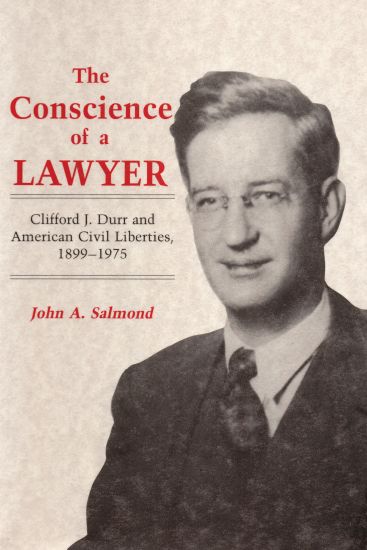
Clifford Judkins Durr was an Alabama lawyer who played an important role in defending activists and other accused of disloyalty during the New Deal and McCarthy eras. His uncompromising commitment to civil liberties and civic decency caused him to often take unpopular positions. In 1933, Durr moved to Washington to work as a lawyer for the Reconstruction Finance Corporation, a creation of Roosevelt's new Democratic administration, becoming a dedicated New Dealer in the process. He was then appointed by President Franklin D. Roosevelt to the Federal Communications Commission (FCC), a politically sensitive position as FDR sought to counter the increasing power and concentration of broadcasters, many of whom were opponents of the New Deal. Durr resigned from the FCC in 1948 and after brief employment with the National Farmers Union in Colorado, the Durrs eventually returned to Montgomery, Alabama in the hope of returning to a more prosperous, less controversial life. Durr continued to practice in Montgomery as counsel for black citizens whose rights had been violated and ultimately, in December, 1955, when police arrested Rosa Parks for refusing to give her bus seat to a white man he stepped in and lent his extensive legal prowess to her case and the continuing quest for civil rights. Closing his firm in 1964 Durr began to lecture in the United States and abroad. He died at his grandfather's farm in 1975.
Martin Luther King's 1965 address from Montgomery, Alabama, the center of much racial conflict at the time and the location of the well-publicized bus boycott a decade earlier, is often considered by historians to be the culmination of the civil rights era in American history. In his momentous speech, King declared that segregation was "on its deathbed" and that the movement had already achieved significant milestones. Although the civil rights movement had won many battles in the struggle for racial equality by the mid-1960s, including legislation to guarantee black voting rights and to desegregate public accommodations, the fight to implement the new laws was just starting. In reality, King's speech in Montgomery represented a new beginning rather than a conclusion to the movement, a fact that King acknowledged in the address. After the Dream: Black and White Southerners since 1965 begins where many histories of the civil rights movement end, with King's triumphant march from the iconic battleground of Selma to Montgomery. Timothy J. Minchin and John Salmond focus on events in the South following the passage of the 1964 Civil Rights Act and the 1965 Voting Rights Act. After the Dream examines the social, economic, and political implications of these laws in the decades following their passage, discussing the empowerment of black southerners, white resistance, accommodation and acceptance, and the nation's political will. The book also provides a fascinating history of the often-overlooked period of race relations during the presidential administrations of Ford, Carter, Reagan, and both George H. W. and George W. Bush. Ending with the election of President Barack Obama, this study will influence contemporary historiography on the civil rights movement.
"A splendid sampler of the very latest and best of scholarship in the field of southern women's history."--Thomas Appleton, Eastern Kentucky UniversitySpanning the sweep of southern women's history from colonial times to the late 20th century, this collection represents the best scholarship on the lives and experiences of black and white southern women. Through topics as diverse as the rise of the United Daughters of the Confederacy and the organization of labor in the apparel industry, these essays explore how southern women constantly moved beyond the traditional confines of race, class, and gender to resist the restrictions of a patriarchal society and assert themselves through organizations and institutions in their communities and personal lives.ContentsIntroduction, by Anne Firor ScottPart I. The Private World1. "The Empire of My Heart" The Marriage of William Byrd II and Lucy Parke Byrd, by Paula A. Treckel2. The New Andromeda: Sarah Morgan and the Post-Civil War Domestic Ideal, by Giselle Roberts3. "The Worst Results in Mississippi May Prove the Best for Us" Blanche Butler Ames and Reconstruction, by Warren Ellem4. "College Girls" The Female Academy and Female Identity in the Old South, by Anya JabourPart II. The Civil War Era5. "'Tis True That Our Southern Ladies Have Done and Are Still Acting a Conspicuous Part in This War" Women on the Confederate Home Front in Edgefield County, South Carolina, by Orville Vernon Burton6. Ministries in Black and White: The Catholic Nuns of St. Augustine, 1859-1869, by Barbara E. Mattick7. The Rise of the United Daughters of the Confederacy, 1894-1914, by Karen L. CoxPart III. The Segregation Era8. Keepers of the Hearth: Women, the Klan, and Traditional Family Values, by Glenn Feldman9. Warm Personal Friend, or Worse Than Hitler? How Southern Women Viewed Eleanor Roosevelt, 1933-1945, by Pamela TylerPart IV. The Era of Social Change10. Esther Cooper Jackson: A Life in the Whirlwind, by Sarah Hart Brown11. From Sharecropper to Schoolteacher: Thelma McGee's Mississippi Girlhood, by Kathi Kern12. "Bridges Burned to a Privileged Past" Anne Braden and the Southern Freedom Movement, by Catherine Fosl13. Vivion Brewer of Arkansas: A Ladylike Assault on the "Southern Way of Life," by Elizabeth Jacoway14. After the Wives Went to Work: Organizing Women in the Southern Apparel Industry, by Michelle HaberlandBruce Clayton is Harry A. Logan Professor of History at Allegheny College, Meadville, Pennsylvania. He is the author of a biography of W. J. Cash and has co-authored a previous book with John Salmond, Debating Southern History: Ideas and Actions in the Twentieth Century South.John A. Salmond is professor of American history at La Trobe University, Melbourne, Australia. He is the author of Gastonia 1929: The Story of the Loray Mill Strike; "My Mind Set on Freedom" A History of the Civil Rights Movement, 1954-1968; and The General Textile Strike of 1934: From Maine to Alabama (2002).
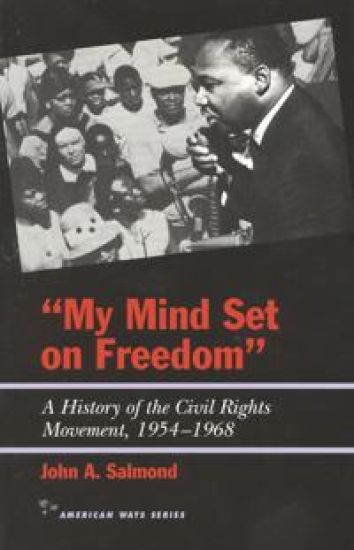
This is the story of the drive to free the American South from the shackles of legally sanctioned racial segregation. In a lively and compact narrative, John Salmond sets the scene with the first stirrings of revolt prompted by the New Deal and the experiences of blacks in World War II. He then concentrates on the years between the 1954 Supreme Court decision overturning segregated public schools and the Fair Housing Act of 1968, the last of the civil rights statutes. Martin Luther King, Jr., plays a central role in the book, for as Mr. Salmond notes, he came to symbolize the moral trajectory of the “movement.” Yet there were many players in this drama, not all of them in agreement with King’s philosophy or tactics, and the author expertly assesses their contributions. “My Mind Set on Freedom” traces the hesitant reaction of the federal government to growing pressures, and the eventual passage of the Civil Rights Act of 1964. Mr. Salmond explains why the movement finally collapsed and, in a concluding chapter, shows how the civil rights revolution transformed the American South. His book brings a new clarity to our understanding of this momentous struggle.
This book reflects the best of contemporary scholarship on the history of the American South. Each contributor is an authority—one a Pulitzer Prize winner. The essays examine what life was like for the slaves; for the victims of terror and lynchings; for workers who dared strike and demand fairness; and for dissenters who challenged the accepted truths. The essays are grouped around three major research areas: history and the social sciences, history and biography, and the new labor history.This is a unique collection of essays by some of the world's leading historians of the South, together with work by younger scholars. All contributors, however, are working at the cutting edge of their particular methodological approaches. The book, for example, includes both an essay by Pulitzer Prize winner Rhys Isaac, and one by Rutgers University graduate student Beth Hale. Yet, both have a common concern to explore the reaches of the Southern past through the dimension of ethnography.The essays in the book are grouped according to theme. The largest section, the social sciences and Southern history, includes essays drawing heavily on the insights of anthropology of ethnography and of statistical analysis. Each essay in the second section is designed to illustrate how life history can be used to illuminate much larger histoical themes and processes. The essays in the last section on labor in the new South all illustrate, among other things, the importance of drawing on the insights of historians of women in order to redress the masculinist presuppositons of labor historians. All the essays in the book, in fact, reflect current concerns with gender and race in the re-interpretation of the Southern past.
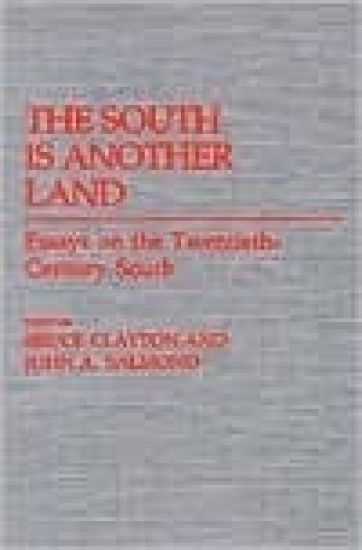
One might argue as to whether `the South is another land' or only a separate verse in the American song. There should be little argument over the usefulness of this collection of ten essays. They find their common ground in a loose schema--the 20th-century South with subsections on politics, `the world of work,' religious affairs, and the `search for the South.' All the work is most competently done. It may appear to some that the essays on the southern politicians are generic stories now thrice told; however, they show the individual differences and the uniqueness of personality that always make the biographical approach worthwhile. For sheer relevance to contemporary concerns it would be hard to surpass Willard B. Gatewood's `After Scopes: Evolution in the South.' The expected questions of the southern nature, character, identity, and mind make their due appearances. Full notes with each essay, and a useful bibliographical essay on the major works. There is something here for professor, student, and general reader; university, college, and public libraries should have this volume. ChoiceThe South is another land--different from the rest of the nation in its identity and its self-perception. This was the conclusion reached by ten outstanding historians after completing the research collected in this essay collection. Every recognized topic of importance in Southern and American history--politics, race, religion, women's role, social, economic, and intellectual history--is incorporated in this collection of essays.