Kirjojen hintavertailu. Mukana 12 595 353 kirjaa ja 12 kauppaa.

Kirjailija

John A. Smith

Kirjat ja teokset yhdessä paikassa: 11 kirjaa, julkaisuja vuosilta 2003-2026, suosituimpien joukossa Social Construction as a Complex Attractor. Vertaile teosten hintoja ja tarkista saatavuus suomalaisista kirjakaupoista.

Mukana myös kirjoitusasut: John A Smith

11 kirjaa

Kirjojen julkaisuhaarukka 2003-2026.

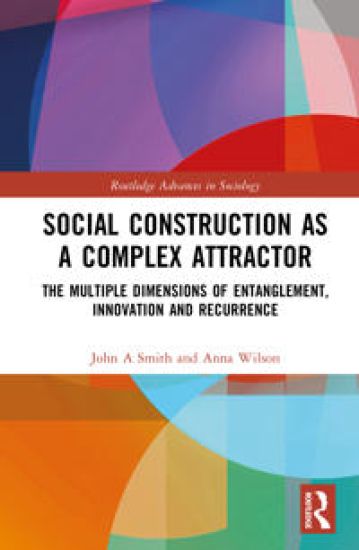
Social Construction as a Complex Attractor

Social Construction as a Complex Attractor

John A. Smith; Anna Wilson

TAYLOR FRANCIS LTD
2026
sidottu
This book examines the dominance of social construction within sociology while shedding light on what social construction looks like in practice beyond the realm of sociological thought. The idea that reality is socially constructed has dominated sociological thinking since Berger and Luckmann’s seminal work in the 1960s, but it has also been widely accepted across society and the media as the explanation of a wide range of phenomena including conceptions of beauty, the value of money, moral standards, religion, nationality and race. By analysing a selection of key twentieth and twenty-first century movements, Smith and Wilson show that the space of possible outcomes is always materially as well as socially constrained and identify path-dependent patterns of conservation and innovation. Exploring questions of power, stratification, solidarity and freedom, it is an essential read for those who want to go beyond description and critique, and instead actively seek to understand why these are recurring patterns in human society, what kinds of alternatives might be possible, and what futures are open to us. As such it will appeal to scholars and students interested in complex approaches across a wide range of fields, in particular to those working within sociology, social theory, philosophy, anthropology and geography.
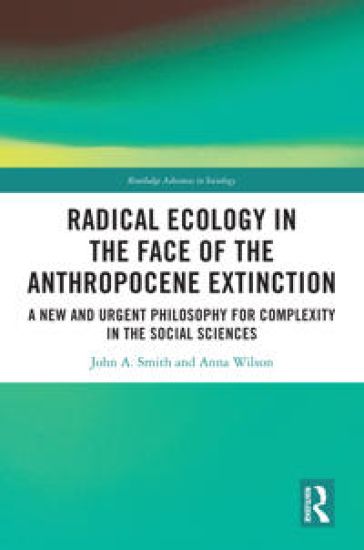
Radical Ecology in the Face of the Anthropocene Extinction

Radical Ecology in the Face of the Anthropocene Extinction

John A. Smith; Anna Wilson

TAYLOR FRANCIS LTD
2025
nidottu
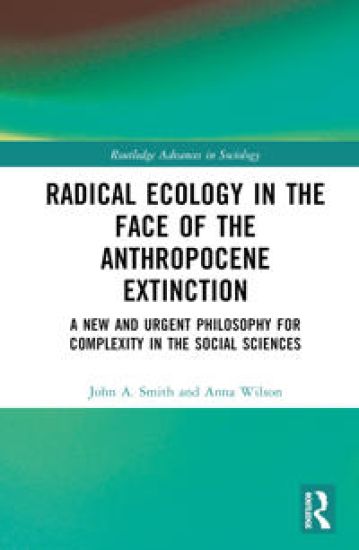
This book has two interlocking ambitions. The first is to steer what we purposefully call the idioms of critical philosophy towards a more ecologically informed paradigm. The second is to recognise that what has rightly come to be called The Anthropocene extinction is not and cannot be treated as simply a scientific fact but rather a socio-political and ecological dispute of immense complexity. We start with an exploration of the consequences of a critical tradition which, under the name Enlightenment, has placed humanity at its centre and chance as its most general – and problematic – characteristic. We argue that this leads to a schizophrenic relationship between radical critique and science which can be avoided if we take the implications of biosemiotics seriously and develop a new, ecologically informed social science. We argue that in practice this means that for science to be practical in addressing the Anthropocene extinction, we have to recognise that it operates in a historically emergent, highly differentiated technopolitical ecology. Science, as it is currently commonly understood and used, is not ecological enough. This book will interest social scientists interested in not only describing and critiquing but also understanding and responding to the complex problems facing humanity; scientists wanting to make sense of social phenomena; those educating the next generation of social scientists; and climate activists and policy-makers.
Radical Ecology in the Face of the Anthropocene Extinction

Radical Ecology in the Face of the Anthropocene Extinction

John A. Smith; Anna Wilson

TAYLOR FRANCIS LTD
2024
sidottu
This book has two interlocking ambitions. The first is to steer what we purposefully call the idioms of critical philosophy towards a more ecologically informed paradigm. The second is to recognise that what has rightly come to be called The Anthropocene extinction is not and cannot be treated as simply a scientific fact but rather a socio-political and ecological dispute of immense complexity.We start with an exploration of the consequences of a critical tradition which, under the name Enlightenment, has placed humanity at its centre and chance as its most general – and problematic – characteristic. We argue that this leads to a schizophrenic relationship between radical critique and science which can be avoided if we take the implications of biosemiotics seriously and develop a new, ecologically informed social science. We argue that in practice this means that for science to be practical in addressing the Anthropocene extinction, we have to recognise that it operates in a historically emergent, highly differentiated technopolitical ecology. Science, as it is currently commonly understood and used, is not ecological enough.This book will interest social scientists interested in not only describing and critiquing but also understanding and responding to the complex problems facing humanity; scientists wanting to make sense of social phenomena; those educating the next generation of social scientists; and climate activists and policy-makers.
Emotions, Embodied Cognition and the Adaptive Unconscious
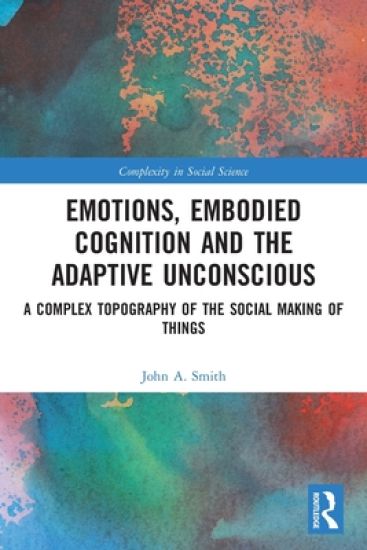
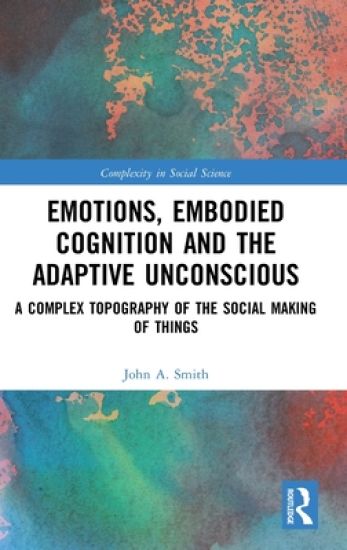
Emotions, Embodied Cognition and the Adaptive Unconscious argues for the need to consider many other factors, drawn from disciplines such as socio-biology, evolutionary psychology, the study of the emotions, the adaptive unconscious, the senses and conscious deliberation in analysing the complex topography of social action and the making of things.These factors are taken as ecological conditions that shape the contemporary expression of complex societies, not as constraints on human plasticity. Without ‘foundations’, complex society cannot exist nor less evolve. This is the familiar pairing from complexity theory: path dependency and dynamic emergence. Inter-disciplinary and complexity perspectives need to be incorporated into the social sciences. Routinely, sociologists think of social phenomena as a distinct field, expressed in the term: the ‘social construction of’ without apparent need to refer to other material, biological, psychological, material or ecological conditions or agents.This book shows how the familiar sociological dynamics of identity, solidarity, differentiation and communication are shaped through the persistent interaction of unconscious and affective processing with conscious deliberation in newly emergent contexts. It is this re-expression, not the surpassing, of human characteristics in contemporary social action that needs to re-inform a complex, ecological approach to the theory and methodologies of the social sciences. The book is intended for a postgraduate/research audience and doctoral students to introduce and synthesise inter-disciplinary contributions to research into complexity theory in the social sciences.
Emotions, Embodied Cognition and the Adaptive Unconscious
Emotions, Embodied Cognition and the Adaptive Unconscious argues for the need to consider many other factors, drawn from disciplines such as socio-biology, evolutionary psychology, the study of the emotions, the adaptive unconscious, the senses and conscious deliberation in analysing the complex topography of social action and the making of things.These factors are taken as ecological conditions that shape the contemporary expression of complex societies, not as constraints on human plasticity. Without ‘foundations’, complex society cannot exist nor less evolve. This is the familiar pairing from complexity theory: path dependency and dynamic emergence. Inter-disciplinary and complexity perspectives need to be incorporated into the social sciences. Routinely, sociologists think of social phenomena as a distinct field, expressed in the term: the ‘social construction of’ without apparent need to refer to other material, biological, psychological, material or ecological conditions or agents.This book shows how the familiar sociological dynamics of identity, solidarity, differentiation and communication are shaped through the persistent interaction of unconscious and affective processing with conscious deliberation in newly emergent contexts. It is this re-expression, not the surpassing, of human characteristics in contemporary social action that needs to re-inform a complex, ecological approach to the theory and methodologies of the social sciences. The book is intended for a postgraduate/research audience and doctoral students to introduce and synthesise inter-disciplinary contributions to research into complexity theory in the social sciences.
Uncle John upon His Travels

Uncle John upon His Travels

John a Smith

Hansebooks
2017
pokkari
Uncle John upon His Travels - Letters from Europe to the Children is an unchanged, high-quality reprint of the original edition of 1870. Hansebooks is editor of the literature on different topic areas such as research and science, travel and expeditions, cooking and nutrition, medicine, and other genres. As a publisher we focus on the preservation of historical literature. Many works of historical writers and scientists are available today as antiques only. Hansebooks newly publishes these books and contributes to the preservation of literature which has become rare and historical knowledge for the future.