Kirjojen hintavertailu. Mukana 12 290 406 kirjaa ja 12 kauppaa.

Kirjailija

John Bellamy

Kirjat ja teokset yhdessä paikassa: 24 kirjaa, julkaisuja vuosilta 1997-2025, suosituimpien joukossa The History of All Religions, Comprehending the Different Doctrines, Customs, and Order of Worship in the Churches ... the Accomplishment of the Prophecies of the Person of Christ ... the Origin and Cause of Idolatrous Worship ... Being a Brief.... Vertaile teosten hintoja ja tarkista saatavuus suomalaisista kirjakaupoista.

24 kirjaa

Kirjojen julkaisuhaarukka 1997-2025.

Women Behaving Badly: Cleveland's Most Ferocious Female Killers: An Anthology
Women who murder ... Why are they so much more fascinating than their male counterparts? For evidence, dip into any of the sixteen strange-but-true tales collected in this anthology by Cleveland's leading historical crime writer. You'll meet: Ill-fated Catherine Manz, the "Bad Cinderella" who poisoned her step-sister in revenge for years of mistreatment, then made her getaway wearing her victim's most fetching outfit, a red dress and an enormous feathered hat ... Velma West, the big-city girl who scandalized rural Lake County in the 1920s with her "unnatural passions"--and ended her marriage-made-in-hell with a swift hammer's blow to the skull of her dull husband, Eddie ... Eva Kaber, "Lakewood's Lady Borgia," who, along with her mother and daughter, conspired to dispose of an inconvenient husband with arsenic and knife-wielding hired killers ... Martha Wise, Medina's not-so-merry widow, who poisoned a dozen relatives--including her husband, mother, and brother--because she enjoyed going to funerals ... And a cast of other, equally fascinating women who behaved very, very badly. This is wickedly entertaining reading "Bellamy once again masterfully brings to life decades-old tales that won't let you look away." -- Cleveland Magazine
Jesus Christ the Only God. Being a Defence of That Fundamental Doctrine of the Christian Religion, Against Arianism and Socinianism. Addressed to the Reverend Dr. Priestley. ... By J. Bellamy
The 18th century was a wealth of knowledge, exploration and rapidly growing technology and expanding record-keeping made possible by advances in the printing press. In its determination to preserve the century of revolution, Gale initiated a revolution of its own: digitization of epic proportions to preserve these invaluable works in the largest archive of its kind. Now for the first time these high-quality digital copies of original 18th century manuscripts are available in print, making them highly accessible to libraries, undergraduate students, and independent scholars.The Age of Enlightenment profoundly enriched religious and philosophical understanding and continues to influence present-day thinking. Works collected here include masterpieces by David Hume, Immanuel Kant, and Jean-Jacques Rousseau, as well as religious sermons and moral debates on the issues of the day, such as the slave trade. The Age of Reason saw conflict between Protestantism and Catholicism transformed into one between faith and logic -- a debate that continues in the twenty-first century.]+++The below data was compiled from various identification fields in the bibliographic record of this title. This data is provided as an additional tool in helping to insure edition identification: ++++British LibraryT064676London: sold by W. Otridge; M. Sibly; Wood, Birmingham; Clark, Manchester; Milner, Halifax; Mills, Bristol; Gales, Sheffield; Crane, Liverpool; Greenwood, Leeds; Southern, York, 1792. 3], vi-viii, 2],119, 1]p.; 8
Bastard Feudalism and the Law (Routledge Revivals)
This title, first published in 1989, was one of the first to directly address the legal dimension of bastard feudalism. John Bellamy explores the role and vulnerability of local officials and juries, the nature of the endemic land wars and the interference in the justice system by those at the top of the social chain. What emerges is a focus on the role of land in disputes, the importance of royal favour and political advantage and the attempt to suppress disruption. This is an interesting title, which will be of particular value to students researching the nature of late medieval and early Tudor feudalism, royal patronage and legal procedure.
The Tudor Law of Treason (Routledge Revivals)
This title, first published in 1979, was ground-breaking in its exploration of the understudied area of the Tudor law of treason. Bellamy first examines the scope of that law, noting the inheritance from the Middle Ages, the effectiveness of the new statutes and interpretation of the law by the judiciary. Mining the archives for official, legal and literary accounts, the following parts consider how the government came to hear of traitors, the use of evidence and witnesses in trials and finally the fate of the traitor at the gallows and beyond. This is a full, useful and interesting title, which will be of great value to students researching Tudor and late medieval statute law, the Tudor concept of treason and the mores of Tudor society.
The Tudor Law of Treason (Routledge Revivals)
This title, first published in 1979, was ground-breaking in its exploration of the understudied area of the Tudor law of treason. Bellamy first examines the scope of that law, noting the inheritance from the Middle Ages, the effectiveness of the new statutes and interpretation of the law by the judiciary. Mining the archives for official, legal and literary accounts, the following parts consider how the government came to hear of traitors, the use of evidence and witnesses in trials and finally the fate of the traitor at the gallows and beyond. This is a full, useful and interesting title, which will be of great value to students researching Tudor and late medieval statute law, the Tudor concept of treason and the mores of Tudor society.
Bastard Feudalism and the Law (Routledge Revivals)
This title, first published in 1989, was one of the first to directly address the legal dimension of bastard feudalism. John Bellamy explores the role and vulnerability of local officials and juries, the nature of the endemic land wars and the interference in the justice system by those at the top of the social chain. What emerges is a focus on the role of land in disputes, the importance of royal favour and political advantage and the attempt to suppress disruption. This is an interesting title, which will be of particular value to students researching the nature of late medieval and early Tudor feudalism, royal patronage and legal procedure.
The Last Days of Cleveland: And More True Tales of Crime and Disaster from Cleveland's Past
"Heroes and rogues fill the pages of this book. The stories will hold your attention and chill you to the bone." -- Crime Shadow News Cleveland's master of historical crime and disaster returns with 15 more true tales in this sixth volume of his popular series, including ... West Park sisters Helen, 11, and Marguerite, 10, who died after eating Rough-on-Rats brand poison in their grandmother's basement--victims of a genetic "suicide mania," or driven to death by the cruelest caretaker since Hansel and Gretel's stepmom? Joseph "Specs" Russell, who vaulted to fame in the summer of 1927 by staging as many as 52 stick-ups and making fools of Cleveland lawmen with his "impossible" escapes from their dragnets; Jeanette McAdams--just unlucky, or the Lucretia Borgia of Ashtabula County? After the suspiciously similar deaths of her five siblings, neighbors began to take note of the crowded family graveyard; Salty and ageless George Wallace, who served the city as a fireman for 62 years, 30 of them as chief, and endured to become the oldest fire chief in the world--with a mastery of incessant profanity that could be heard for four city blocks and made mule skinners blush; And more true stories of courage, fear, deception, and villainy--including a disaster caused by the author himself Sometimes gruesome, often surprising, John Stark Bellamy's tales are meticulously researched and delivered in a literate and entertaining style.
Cleveland's Greatest Disasters!: Sixteen Tragic Tales of Death and Destruction--An Anthology
Fifteen incredible true disaster stories from Cleveland history, including ... The apocalyptic East Ohio Gas Company explosion and fire of 1944, which destroyed an entire east side neighborhood; Genius inventor Garrett A. Morgan's daring underground rescue efforts (using his recently invented gas mask) during the gruesome 1916 waterworks collapse; The unspeakably horrible Collinwood school fire of 1908, in which 172 schoolchildren perished in panic because of obstructed exits; The Cleveland Clinic disaster of 1929, in which thousands of pounds of X-ray film exploded in flames, causing 123 deaths; The grisly drama of two doomed workmen buried alive in the very concrete that became Cleveland's celebrated landmark--the Terminal Tower. This anthology collects the very best disaster tales from John Stark Bellamy's five-book Cleveland crime and disaster series.
Building Stronger Communities

Building Stronger Communities

Phillip Hughes; Alan Black; Peter Kaldor; John Bellamy; Keith Castle

UNSW Press
2007
nidottu
Based on recent Australian research as well as years of hands-on experience by the authors in working with different types of communities, ""Building Stronger Communities"" is a very readable book that examines in a lucid and practical way means by which communities can be strengthened. The book differs from comparable volumes in that it includes extensive material on communities of interest, as well as those based on locality. The book includes useful principles and pointers for students, community workers, designated community leaders, policy makers and ordinary citizens. Each chapter includes a brief introductory overview and concludes with a set of review questions for reflection that will be useful for the individual readers and those using the work as a textbook.
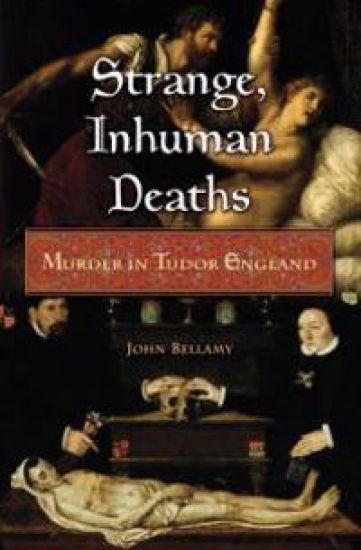
Strange, Inhuman Deaths

Strange, Inhuman Deaths

John Bellamy

Praeger Publishers Inc
2006
sidottu
In 1573 there occurred a murder which would leave today's tabloid editors salivating. George Saunders, a respected merchant tailor, was killed by his wife's lover. Involved in the conspiracy were Saunders' wife, her best friend, and a servant. All were found guilty and hanged, but not before a suspended clergyman fell in love with Mrs. Saunders and sought to have her pardoned. Murder was relatively rare in Tudor times. When it did occur, especially if it involved a female perpetrator and a love affair, it generated widespread interest. The rise of Protestantism, and its accompanying rise in literacy, had provided a strong impetus to read about crime and to ponder the spiritual consequences of breaking both the civil and the divine law. The English system of criminal justice was open and popular, and familiar elements—detection, investigation, the laying of charges, the trial, verdict, sentence—were all well understood and closely followed in the 16th century. Today, people are riveted by crime and violence. But the obsession is not new, as this book shows in vivid and exciting detail.John Bellamy's new book provides a fascinating view of life in Tudor England and offers a new angle on our love affair with murder as a literary form. It was in the Tudor period, he argues, that popular attention was focused on the crime of murder, for edification as well as entertainment. A 16th-century murder inquiry was in many ways a community affair, capable of arousing the interest of a substantial local audience, with the members of the inquest often collecting evidence and statements for twenty or thirty days. Detection, investigation, the laying of charges, the trial, verdict, sentence—all of these familiar elements were established in the 16th century. Strange, Inhuman Deaths describes four well-documented cases that occurred between 1538 and 1573. Each of them is deeply rooted in source material, whether legal records or pamphlets, plays or ballads, giving a rich background and a wealth of local colour. The human stories they contain are powerful and lively, and the motivations and personalities that are revealed speak to us directly across the centuries. Murder most foul, murder most English—the tradition begins.