Kirjojen hintavertailu. Mukana 12 152 606 kirjaa ja 12 kauppaa.

Kirjailija

John C. Baker

Kirjat ja teokset yhdessä paikassa: 6 kirjaa, julkaisuja vuosilta 2001-2013, suosituimpien joukossa Mapping the Risks. Vertaile teosten hintoja ja tarkista saatavuus suomalaisista kirjakaupoista.

Mukana myös kirjoitusasut: John C Baker

6 kirjaa

Kirjojen julkaisuhaarukka 2001-2013.

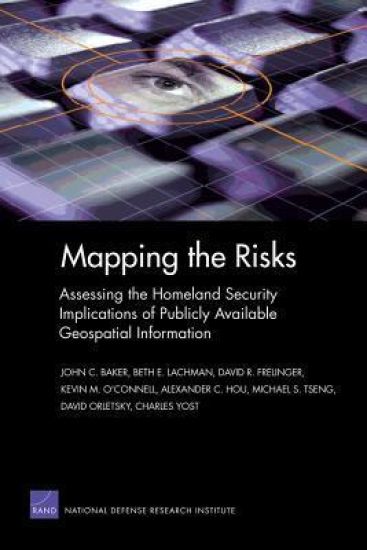
Mapping the Risks

Mapping the Risks

John C. Baker; Beth E. Lachman; Dave R. Frelinger; Kevin M. O'Connell; Alexander Hou; Michael S. Tseng; David T. Orletsky; Charles Yost

RAND
2004
pokkari
Assesses the homeland security implications of publicly available geospatial data and information. Following the attacks of September 11, 2001, many agencies within the federal government began restricting some of their publicly available geospatial data and information from such sources as the World Wide Web. As time passes, however, decisionmakers have begun to ask whether and how such information specifically helps potential attackers, including terrorists, to select U.S. homeland sites and prepare for better attacks. The research detailed in this book aims to assist decisionmakers tasked with the responsibility of choosing which geospatial information to make available and which to restrict.
U.S.Commercial Remote Sensing Satellite Industry

U.S.Commercial Remote Sensing Satellite Industry

Kevin M. O'Connell; John C. Baker; Beth E. Lachman; Steven Berner; David R. Frelinger; Kim E. Gavin

RAND
2001
pokkari
Assesses the risks facing U.S. commercial remote sensing satellite firms and explores the U.S. policy and regulatory environment for these firms. American firms have begun to operate their own imaging satellite systems, aiming to become an important part of the U.S. commercial remote sensing industry. To succeed over the long run, these new U.S. commercial remote sensing satellite firms need a combination of reliable technologies, government policies that encourage U.S. industry competitiveness, a strong international presence, and sound business plans to ensure their competitiveness in both the domestic and international marketplaces. The greatest risks for the these firms come from the challenge of transforming themselves from imagery data providers to strong competitors as information age companies; the need to master the technical risks of building and operating sophisticated imaging satellite systems; and the requirement to operate effectively in a complex international business environment.In addition, the government's policymaking process has yet to achieve the degree of predictability, timeliness, and transparency that the firms need if they are expected to operate effectively in a highly competitive and rapidly changing global marketplace. The authors conclude with six recommendations that the U.S. Department of Commerce should adopt to best fulfill its responsibilities for promoting the U.S. commercial remote sensing industry and for encouraging the competitiveness of new private imaging satellite firms. (MP)
Aptitude for Destruction

Aptitude for Destruction

Brian A. Jackson; John C. Baker; Peter Chalk; Kim Cragin; John V. Parachini; Horacio R. Trujillo

RAND
2005
pokkari
Understanding how terrorist groups learn may aid in developing strategies to combat terrorist activities Better ways are needed to understand how terrorist groups become more effective and dangerous. Learning is the link between what a group wants to do and its ability to actually do it; therefore, a better understanding of group learning might contribute to the design of better measures for combating terrorism. This study analyzes current understanding of group learning and the factors that influence it and outlines a framework that should be useful in present analytical efforts and for identifying areas requiring further study.
Aptitude for Destruction

Aptitude for Destruction

Brian A. Jackson; John C. Baker; Peter Chalk; Kim Cragin; John V. Parachini; Horacio R. Trujillo

RAND
2005
pokkari
This book includes case studies of the organizational learning activities of five major terrorist groups and a methodology for ascertaining what and why they learned.
Non-Proliferation Incentives for Russia and Ukraine

Non-Proliferation Incentives for Russia and Ukraine

John C Baker

Oxford University Press Inc
2005
nidottu
Given their protracted economic difficulties, the nuclear and aerospace industries in Russia and Ukraine are tempted to export dual-use technologies that can contribute to the proliferation of weapons of mass destruction and missile systems. John C. Baker proposes using international incentives to discourage irresponsible export behaviour while seeking long-term changes in the non-proliferation attitudes of their managers and government leaders.