Kirjojen hintavertailu. Mukana 12 469 061 kirjaa ja 12 kauppaa.

Kirjailija

John C. Coffee Jr.

Kirjat ja teokset yhdessä paikassa: 5 kirjaa, julkaisuja vuosilta 2006-2020, suosituimpien joukossa The Wolf at the Door. Vertaile teosten hintoja ja tarkista saatavuus suomalaisista kirjakaupoista.

5 kirjaa

Kirjojen julkaisuhaarukka 2006-2020.

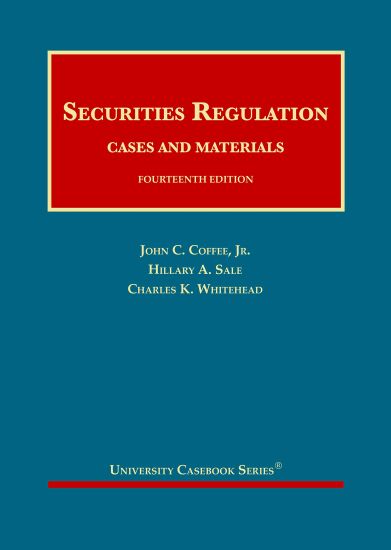
Securities Regulation

Securities Regulation

John C. Coffee Jr.; Hillary A. Sale; Charles K. Whitehead

Foundation Press
2020
sidottu
This is the nation’s first and oldest casebook on securities regulation. This edition has been streamlined for easier use, but it continues to provide instructors and students with the full range of tools for the in-depth study of securities regulation. It has been revised and updated to take into account the following:Initial coin offerings and sales of other crypto-assetsChanges in the primary and secondary capital markets, including high frequency tradingCertain amendments to the public disclosure requirementsAmendments to the limited offering exemptionsThe ongoing debate around elements of Rule 10b–5Regulation Best InterestRecent Supreme Court cases, including their implications for certain civil litigation and the SEC’s continued reliance on administrative proceedings
Corporate Crime and Punishment

Corporate Crime and Punishment

John C. Coffee Jr.

Berrett-Koehler Publishers
2020
sidottu
"Professor Coffee's compelling new approach to holding fraudsters to account is indispensable reading for any lawmaker serious about deterring corporate crime."--Robert Jackson, former Commissioner, Securities and Exchange Commission In the early 2000s, federal enforcement efforts sent white collar criminals at Enron and WorldCom to prison. But since the 2008 financial collapse, this famously hasn't happened. Corporations have been permitted to enter into deferred prosecution agreements and avoid criminal convictions, in part due to a mistaken assumption that leniency would encourage cooperation and because enforcement agencies don't have the funding or staff to pursue lengthy prosecutions, says distinguished Columbia Law Professor John C. Coffee. "We are moving from a system of justice for organizational crime that mixed carrots and sticks to one that is all carrots and no sticks," he says. He offers a series of bold proposals for ensuring that corporate malfeasance can once again be punished. For example, he describes incentives that could be offered to both corporate executives to turn in their corporations and to corporations to turn in their executives, allowing prosecutors to play them off against each other. Whistleblowers should be offered cash bounties to come forward because, Coffee writes, "it is easier and cheaper to buy information than seek to discover it in adversarial proceedings." All federal enforcement agencies should be able to hire outside counsel on a contingency fee basis, which would cost the public nothing and provide access to discovery and litigation expertise the agencies don't have. Through these and other equally controversial ideas, Coffee intends to rebalance the scales of justice.
Gatekeepers

Gatekeepers

John C. Coffee Jr.

Oxford University Press
2019
nidottu
In the wake of a series of corporate governance disasters in the US and Europe which have gained almost mythic status - Enron, WorldCom, Tyco, Adelphia, HealthSouth, Parmalat - one question has not yet been addressed. A number of 'gatekeeping' professions - auditors, attorneys, securities analysts, credit-rating agencies - exist to guard against these governance failures. Yet clearly these watchdogs did not bark while corporations were looted and destroyed. But why not? To answer these questions, a more detailed investigation is necessary that moves beyond journalism and easy scapegoating, and examines the evolution, responsibilities, and standards of these professions. John C. Coffee Jr, world-renowned Professor of Corporate Law, examines how these gatekeeping professions developed, to what degree they failed, and what reforms are feasible. Above all, this book examines the institutional changes and pressures that caused gatekeepers to underperform or neglect their responsibilities, and focuses on those feasible changes that can restore gatekeepers as the loyal agents of investors. This informed and readable view of the players on the contemporary business stage will be essential reading for investors, professionals, executives and business academics concerned with issues of good governance.
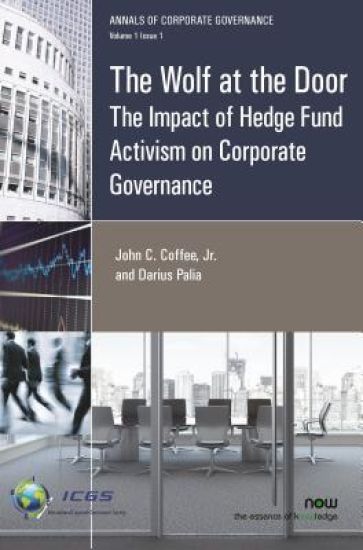
The Wolf at the Door

The Wolf at the Door

John C. Coffee Jr.; Darius Palia

now publishers Inc
2016
nidottu
The Wolf at the Door: The Impact of Hedge Fund Activism on Corporate Governance has three basic aims: (1) to understand and explain the factors that have caused the recent explosion in hedge fund activism; (2) to examine the impact of this activism, including whether it is shortening investment horizons and discouraging investment in research and development; and (3) to survey and evaluate possible legal interventions with an emphasis on the least restrictive alternative.Although there have been other lengthy surveys, the landscape of activism is rapidly changing and this brings into doubt the relevance of empirical papers that study hedge fund activism in earlier decades. The authors suspect that the recent success of such activism may be fueling a current “hedge fund bubble” under which an increasing number of activist funds are pursuing a decreasing, or at least static, number of companies that have overinvested. This monograph is particularly focused on those markets and the legal forces that may be driving this bubble.After an introduction, Section 2 begins with an analysis of those factors that have spurred greater activism on the part of hedge funds. Section 3 considers evidence suggesting that as the composition of a firm’s shareholder population shift towards more “transient” holders, its investment horizon shortens. Section 4 surveys recent studies to reach assessments about who the targets of hedge fund activism are; the stock price returns from hedge fund activism and the distribution of those returns; the degree to which wealth transfers explain the positive stock price returns to activism; the post-intervention evidence about changes in operating performance of hedge fund targets; and the holding periods and exit strategies of hedge fund activists. Section 5 evaluates some policy options looking for the least drastic means of accomplishing policy goals. Finally, Section 6 offers a brief conclusion that surveys how the changing structure of shareholder ownership and the recent appearance of temporary shareholder majorities complicate corporate governance, both empirically and normatively.
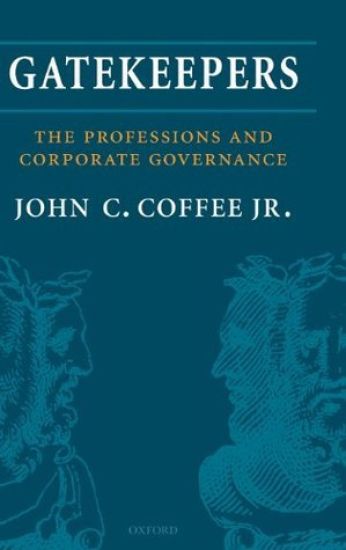
Gatekeepers

Gatekeepers

John C. Coffee Jr.

Oxford University Press
2006
sidottu
In the wake of a series of corporate governance disasters in the US and Europe which have gained almost mythic status - Enron, WorldCom, Tyco, Adelphia, HealthSouth, Parmalat - one question has not yet been addressed. A number of 'gatekeeping' professions - auditors, attorneys, securities analysts, credit-rating agencies - exist to guard against these governance failures. Yet clearly these watchdogs did not bark while corporations were looted and destroyed. But why not? To answer these questions, a more detailed investigation is necessary that moves beyond journalism and easy scapegoating, and examines the evolution, responsibilities, and standards of these professions. John Coffee, world-renowned Professor of Corporate Law, examines how these gatekeeping professions developed, to what degree they failed, and what reforms are feasible. Above all, this book examines the institutional changes and pressures that caused gatekeepers to underperform or neglect their responsibilities, and focuses on those feasible changes that can restore gatekeepers as the loyal agents of investors. This informed and readable view of the players on the contemporary business stage will be essential reading for investors, professionals, executives and business academics concerned with issues of good governance.