Kirjojen hintavertailu. Mukana 12 595 353 kirjaa ja 12 kauppaa.

Kirjailija

John Craig Hammond

Kirjat ja teokset yhdessä paikassa: 4 kirjaa, julkaisuja vuosilta 2007-2025, suosituimpien joukossa A Fire Bell in the Past. Vertaile teosten hintoja ja tarkista saatavuus suomalaisista kirjakaupoista.

4 kirjaa

Kirjojen julkaisuhaarukka 2007-2025.

The Centrality of Slavery

The Centrality of Slavery

John Craig Hammond

UNIVERSITY OF PENNSYLVANIA PRESS
2025
sidottu
How French and American colonizers created systems of enslavement in the Middle Mississippi Valley The Centrality of Slavery examines how French and American colonizers used the powers of various imperial regimes to create slave societies in present-day Missouri and Illinois from the 1720s through the 1820s. The first book-length study of slavery and empire in both Illinois and Missouri, it begins with the origins of Native American and African American enslavement in the region. It then traces how successive French, Spanish, British, and American regimes shaped the development of slavery over the course of a century, examines the significance of the Northwest Ordinance's ban on slavery in Illinois, and then analyzes the diverging histories of slavery in Illinois and Missouri in the early 1800s. The book concludes with an analysis of the Missouri Crisis and the compromise of 1820, along with the Middle Mississippi Valley's significance in the road towards disunion and civil war in the late 1850s. More broadly, The Centrality of Slavery argues that the Middle Mississippi Valley sat astride the crossroads of imperial North America. The practices of empire and enslavement forged and fought over there exerted an outsized influence on the history of slavery in North America and the United States. Rather than treating the region's eighteenth-century past as a prologue to the rise of the United States, John Craig Hammond analyzes the colonial history of the region on its own terms, through the European colonizers, American settlers, and enslaved people of Indigenous and African descent who shaped the development of slavery in the Middle Mississippi Valley.
Slavery, Freedom, and Expansion in the Early American West

Slavery, Freedom, and Expansion in the Early American West

John Craig Hammond

UNIVERSITY OF VIRGINIA PRESS
2024
pokkari
Most treatments of slavery, politics, and expansion in the early American republic focus narrowly on congressional debates and the inaction of elite "founding fathers" such as Thomas Jefferson and James Madison. In Slavery, Freedom, and Expansion in the Early American West, John Craig Hammond looks beyond elite leadership and examines how the demands of western settlers, the potential of western disunion, and local, popular politics determined the fate of slavery and freedom in the West between 1790 and 1820. By shifting focus away from high politics in Philadelphia and Washington, Hammond demonstrates that local political contests and geopolitical realities were more responsible for determining slavery’s fate in the West than were the clashing proslavery and antislavery proclivities of Founding Fathers and politicians in the East. When efforts to prohibit slavery revived in 1819 with the Missouri Controversy it was not because of a sudden awakening to the problem on the part of northern Republicans, but because the threat of western secession no longer seemed credible. Including detailed studies of popular political contests in Ohio, Indiana, Illinois, Mississippi, Louisiana, and Missouri that shed light on the western and popular character of conflicts over slavery, Hammond also provides a thorough analysis of the Missouri Controversy, revealing how the problem of slavery expansion shifted from a local and western problem to a sectional and national dilemma that would ultimately lead to disunion and civil war.
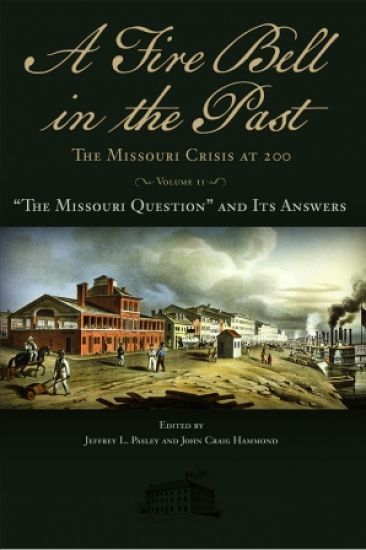
A Fire Bell in the Past

A Fire Bell in the Past

Jeffrey L. Pasley; John Craig Hammond

University of Missouri Press
2021
sidottu
Many new states entered the United States around 200 years ago, but only Missouri almost killed the nation it was trying to join. When the House of Representatives passed the Tallmadge Amendment banning slavery from the prospective new state in February 1819, it set off a two-year political crisis in which growing northern antislavery sentiment confronted the aggressive westward expansion of the peculiar institution by southerners. The Missouri Crisis divided the U.S. into slave and free states for the first time and crystallized many of the arguments and conflicts that would later be settled violently during the Civil War. The episode was, as Thomas Jefferson put it, “a fire bell in the night” that terrified him as the possible “knell of the Union.” Drawn from the of participants in two landmark conferences held at the University of Missouri and the City University of New York, those who contributed original essays to this second of two volumes—a group that includes young scholars and foremost authorities in the field—answer the Missouri “Question,” in bold fashion, challenging assumptions both old and new in the long historiography by approaching the event on its own terms, rather than as the inevitable sequel of the flawed founding of the republic or a prequel to its near destruction. This second volume of A Fire Bell in the Past features a foreword by Daive Dunkley. Contributors include Dianne Mutti Burke, Christopher Childers, Edward P. Green, Zachary Dowdle, David J. Gary, Peter Kastor, Miriam Liebman, Matthew Mason, Kate Masur, Mike McManus, Richard Newman, and Nicholas Wood.
Slavery, Freedom, and Expansion in the Early American West

Slavery, Freedom, and Expansion in the Early American West

John Craig Hammond

University of Virginia Press
2007
sidottu
Most treatments of slavery, politics, and expansion in the early American republic focus narrowly on congressional debates and the inaction of elite ""founding fathers"" such as Thomas Jefferson and James Madison. In ""Slavery, Freedom, and Expansion in the Early American West"", John Craig Hammond looks beyond elite leadership and examines how the demands of western settlers, the potential of western disunion, and local, popular politics determined the fate of slavery and freedom in the West between 1790 and 1820.By shifting focus away from high politics in Philadelphia and Washington, Hammond demonstrates that local political contests and geopolitical realities were more responsible for determining slavery's fate in the West than were the clashing proslavery and antislavery proclivities of Founding Fathers and politicians in the East. When efforts to prohibit slavery revived in 1819 with the Missouri Controversy, it was not because of a sudden awakening to the problem on the part of northern Republicans, but because the threat of western secession no longer seemed credible.Including detailed studies of popular political contests in Ohio, Indiana, Illinois, Mississippi, Louisiana, and Missouri that shed light on the western and popular character of conflicts over slavery, Hammond also provides a thorough analysis of the Missouri Controversy, revealing how the problem of slavery expansion shifted from a local and western problem to a sectional and national dilemma that would ultimately lead to disunion and civil war.