Kirjojen hintavertailu. Mukana 12 657 676 kirjaa ja 12 kauppaa.

Kirjailija

John DiIulio

Kirjat ja teokset yhdessä paikassa: 4 kirjaa, julkaisuja vuosilta 2002-2014, suosituimpien joukossa Bring Back the Bureaucrats. Vertaile teosten hintoja ja tarkista saatavuus suomalaisista kirjakaupoista.

4 kirjaa

Kirjojen julkaisuhaarukka 2002-2014.

Bring Back the Bureaucrats

Bring Back the Bureaucrats

John DiIulio

TEMPLETON FOUNDATION PRESS,U.S.
2014
pokkari
In Bring Back the Bureaucrats, John J. DiIulio Jr., one of America’s most respected political scientists and an adviser to presidents in both parties, summons the facts and statistics to show us how America’s big government works and why reforms that include adding a million more people to the federal workforce by 2035 might help to slow government’s growth while improving its performance. Starting from the underreported reality that the size of the federal workforce hasn’t increased since the early 1960s, even though the federal budget has skyrocketed. The number of federal programs has ballooned; Bring Back the Bureaucrats tells us what our elected leaders won’t: there are not enough federal workers to work for our democracy effectively. DiIulio reveals that the government in America is Leviathan by Proxy, a grotesque form of debt-financed big government that guarantees terrible government. Washington relies on state and local governments, for-profit firms, and nonprofit organizations to implement federal policies and programs. Big-city mayors, defense industry contractors, nonprofit executives, and other national proxies lobby incessantly for more federal spending. This proxy system chokes on chores such as cleaning up toxic waste sites, caring for hospitalized veterans, collecting taxes, handling plutonium, and policing more than $100 billion annually in “improper payments.” The lack of competent, well-trained federal civil servants resulted in the failed federal response to Hurricane Katrina and the troubled launch of Obamacare’s “health exchanges.” Bring Back the Bureaucrats is further distinguished by the presence of E. J. Dionne Jr. and Charles Murray, two of the most astute voices from the political left and right, respectively, who offer their candid responses to DiIulio at the end of the book.

Just Generosity

Just Generosity

Ronald J. Sider; Charles W. Colson; Eugene Rivers; John DiIulio

Baker Books, a division of Baker Publishing Group
2007
nidottu
Just Generosity calls Christians to examine their priorities and their pocketbooks in the face of a scandalous tendency to overlook those among us who suffer while we live in practical opulence. This holistic approach to helping the poor goes far beyond donating clothes or money, envisioning a world in which faith-based groups work with businesses, the media, and the government to help end poverty in the world's richest nation. This updated edition includes current statistics, policy recommendations, and discussions covering everything from welfare reform, changes to Medicade, and the Social Security debate."Sider's most important book since Rich Christians in an Age of Hunger."--Jim Wallis, author, God's Politics "Sider knows how to lift up people in need.... [An] important and challenging book."--John Ashcroft, former Attorney General of the United States
The Invisible Caring Hand

The Invisible Caring Hand

Ram Cnaan; John DiIulio

New York University Press
2002
pokkari
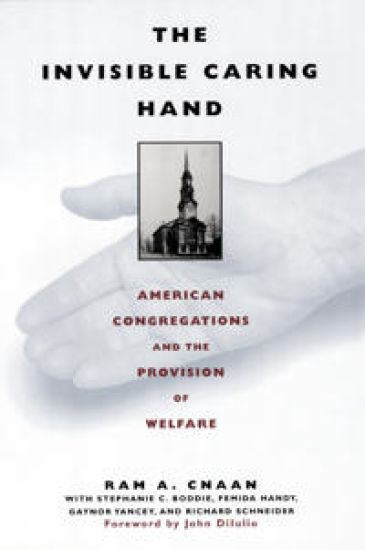
Popular calls to transform our current welfare system and supplant it with effective and inexpensive faith-based providers are gaining political support and engendering heated debate about the separation of church and state. Yet we lack concrete information from which to anticipate how such initiatives might actually work if adopted. Despite the assumption that congregations can help many needy people in our society, it remains to be seen how extensive they wish their involvement to be, or if they have the necessary tools to become significant providers in the social service arena. Moreover, how will such practices, which will move faith-based organizations towards professionalization, ultimately affect the spirit of volunteerism now prevalent in America's religious institutions? We lack sufficient knowledge about congregational life and its ability to play a key role in social service provision. The Invisible Caring Hand attempts to fill that void. Based on in-depth interviews with clergy and lay leaders in 251 congregations nationwide, it reveals the many ways in which congregations are already working, beneath the radar, to care for people in need. This ground-breaking volume will provide much-sought empirical data to social scientists, religious studies scholars, and those involved in the debates over the role of faith-based organizations in faith-based services, as well as to clergy and congregation members themselves.
The Invisible Caring Hand

The Invisible Caring Hand

Ram Cnaan; John DiIulio

New York University Press
2002
sidottu
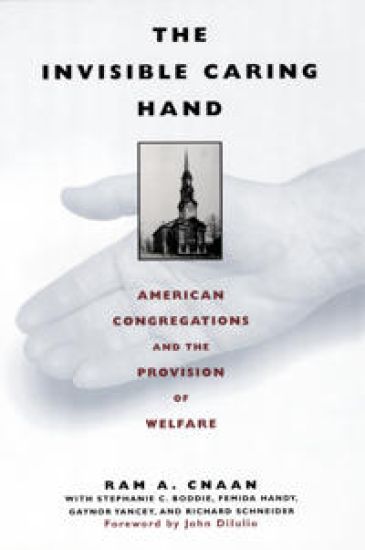
Popular calls to transform our current welfare system and supplant it with effective and inexpensive faith-based providers are gaining political support and engendering heated debate about the separation of church and state. Yet we lack concrete information from which to anticipate how such initiatives might actually work if adopted. Despite the assumption that congregations can help many needy people in our society, it remains to be seen how extensive they wish their involvement to be, or if they have the necessary tools to become significant providers in the social service arena. Moreover, how will such practices, which will move faith-based organizations towards professionalization, ultimately affect the spirit of volunteerism now prevalent in America's religious institutions? We lack sufficient knowledge about congregational life and its ability to play a key role in social service provision. The Invisible Caring Hand attempts to fill that void. Based on in-depth interviews with clergy and lay leaders in 251 congregations nationwide, it reveals the many ways in which congregations are already working, beneath the radar, to care for people in need. This ground-breaking volume will provide much-sought empirical data to social scientists, religious studies scholars, and those involved in the debates over the role of faith-based organizations in faith-based services, as well as to clergy and congregation members themselves.