Kirjojen hintavertailu. Mukana 12 657 676 kirjaa ja 12 kauppaa.

Kirjailija

John E. Peters

Kirjat ja teokset yhdessä paikassa: 18 kirjaa, julkaisuja vuosilta 2000-2019, suosituimpien joukossa Army Network-Enabled Operations. Vertaile teosten hintoja ja tarkista saatavuus suomalaisista kirjakaupoista.

Mukana myös kirjoitusasut: John E Peters

18 kirjaa

Kirjojen julkaisuhaarukka 2000-2019.

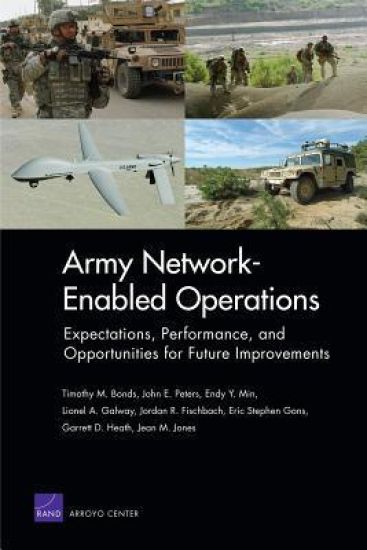
Army Network-Enabled Operations

Army Network-Enabled Operations

Timothy M. Bonds; John E. Peters; Endy Y. Min; Lionel A. Galway; Jordan R. Fischbach; Eric Stephen Gons; Garrett D. Heath; Jean M. Jones

RAND
2012
pokkari
The Army expects that the performance of ground forces can be enhanced by improving the networks that tie them together and taking advantage of their special properties. Army networks are used for command and control, intelligence, maneuver, fires, and logistics; they process, store, and transport the information used by the Army. Ultimately these networks extend into the minds of soldiers and leaders and into their interactions with each other.
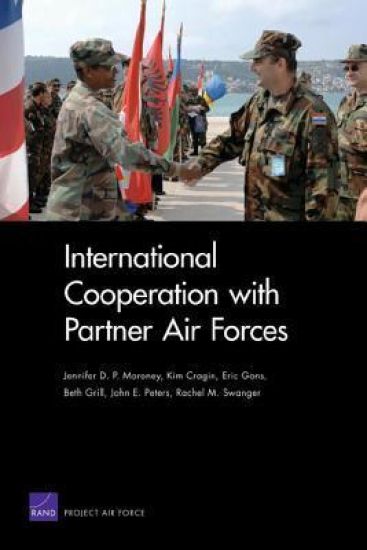
International Cooperation with Partner Air Forces

International Cooperation with Partner Air Forces

Jennifer D P Moroney; Kim Cragin; Eric Gons; Beth Grill; John E Peters

RAND
2009
pokkari
The Air Force faces a challenging environment as it devises an approach to managing security cooperation with partner countries. The important mission of countering terrorist and insurgent groups abroad requires working closely with allies and partner countries to strengthen security. Accordingly, current U.S. defense strategy emphasizes that the U.S. armed forces should do more to work "by, with, and through partners" to accomplish missions.
Quality of Life at Contingency Bases

Quality of Life at Contingency Bases

John E Peters; Elvira N Loredo; Mary E Chenoweth

RAND
2019
nidottu
Quality-of-life goods and services for soldiers operating from contingency bases are key for morale and physical and emotional well-being but also a substantial logistics burden, especially in austere theaters, such as Afghanistan, where roads are few and the terrain is difficult. This report evaluates factors that contribute to and detract from soldier quality of life and recommends improvements in the face of a range of constraints.
Restoring America's Military Prowess

Restoring America's Military Prowess

John E. Peters

Rowman Littlefield
2016
sidottu
The U.S. military spends more than 14 countries combined and possesses state-of-the art weapons and equipment, yet after 13 years of effort, $1.4 trillion, and some 6,000 casualties, it still has been unable to defeat its enemies in Afghanistan and Iraq. The book explains why and how it can be remedied. It first demonstrates the negative effects of four factors that are prerequisites for military success and that have undermined U.S. military performance since the end of the Cold War. These include uneven civil-military relations; an inability to formulate and execute sound campaign plans; a mistaken approach to counter-insurgency, irregular warfare, and stability operations; and inattention to military options other than regime change. It also acknowledges that other factors often also intervene, and that the enemy plays a decisive role in military outcomes. Still, if the United States is to preserve the use of military force as a reasonable (albeit last resort) policy option, it must develop the means to maintain healthy, reliable civil-military relations, design and execute sound campaign plans appropriate to the adversary in question and the threat it poses to U.S. interests, conduct effective counter-insurgency and irregular warfare campaigns suitable given the size and capabilities of today’s all volunteer armed forces, and develop a menu of military options beyond regime change. The intent is to bring attention to the under-performance of the U.S. armed forces in Afghanistan, Iraq, and elsewhere and prescribe remedies. These solutions cannot be left solely in the hands of the Department of Defense and congressional action and oversight will be essential to favorable outcomes. This is a timely survey as the military is facing downsizing in response to budget pressure that will constrain defense and counter-terrorism spending.
Toward Operational Art in Special Warfare

Toward Operational Art in Special Warfare

Dan Madden; Dick Hoffmann; Michael Johnson; Fred T. Krawchuk; Bruce R. Nardulli; John E. Peters; Linda Robinson; Abby Doll

RAND
2016
pokkari
Hybrid irregular and conventional military operations are playing an increasingly prominent role in international conflict, exploited by countries such as Russia and Iran. To counter this trend, the United States should adopt a new form of operational art for special warfare. This report proposes a framework for the design and execution of special warfare campaigns.
Authorities and Options for Funding Ussocom Operations

Authorities and Options for Funding Ussocom Operations

Elvira N. Loredo; John E. Peters; Karlyn D. Stanley; Matthew E. Boyer; William Welser; Thomas S. Szayna

RAND
2014
pokkari
This report examines mechanisms, sources, and inter-Service agreements for funding special operations forces (SOF) operations and provides recommendations to reduce the frequency and duration of disputes between the United States Special Operations Command, the Military Departments, and Geographic Combatant Commands over their respective funding responsibilities for SOF.
Readiness Reporting for an Adaptive Army

Readiness Reporting for an Adaptive Army

Christopher G. Pernin; Dwayne M. Butler; Louay Constant; Lily Geyer; Duncan Long; Dan Madden; John E. Peters; Jim Powers; Michael Shurkin

RAND
2013
pokkari
This study examines the readiness reporting system in light of changes experienced by Army units in the past decade, a period in which the Army learned to adapt to emerging requirements by adding new capabilities quickly and flexibly. The current readiness reporting system captures only a portion of those changes in capabilities and has some important limitations. The study recommends ways to improve the reporting system for an adaptive Army.
Unmanned Aircraft Systems for Logistics Applications

Unmanned Aircraft Systems for Logistics Applications

John E. Peters; Somi Seong; Aimee Bower; Harun Dogo; Aaron L. Martin; Christopher G. Pernin

RAND
2011
pokkari
RAND Arroyo Center evaluated potential logistics applications for unmanned aircraft systems (UAS) to determine whether they are technically feasible, operationally feasible, and more cost-effective than other options. The study identified six factors that could be used to compare UAS and non-UAS based solutions to logistics tasks. The study uncovered significant potential for logistics applications of these systems in the near- and long-term future.
Developing an Assessment Framework for U.S. Air Force Building Partnerships Programs

Developing an Assessment Framework for U.S. Air Force Building Partnerships Programs

Jennifer D. P. Moroney; Joe Hogler; Jefferson P. Marquis; Christoher Paul; John E. Peters

RAND
2010
pokkari
Working with allies to build their defense capacity, acquire access to their territories for potential operations, and strengthen relationships with their air forces is an important U.S. Air Force activity. To determine the value of this activity, the authors outline an assessment framework that planners, strategists, and policymakers can use to see whether Air Force security cooperation activities are achieving the desired effects.
A Methodology for Developing Army Acquisition Strategies for an Uncertain Future
This monograph proposes adaptation of a RAND tool called Assumption-Based Planning to help Army personnel maintain proper alignment between strategic guidance and the Army acquisition program and budget. It uses this tool to create a model that recommends acquisition investments across a broad range of capabilities. The model works toward the goal of satisfying the complex and evolving requirements specified in the national security guidance.
War and Escalation in South Asia

War and Escalation in South Asia

John E. Peters; James Dickens; Derek Eaton; Christine Fair; Nina Hachigian; Theodore W. Karasik; Rollie Lal; Rachel Swanger; Gregory F. Treverton; Charles Wolf

RAND
2005
pokkari
Highlights key factors in South Asia imperiling U.S. interests, and suggests how and where the U.S. military might play an expanded, influential role. It suggests steps the military might take to better advance and defend U.S. interests in the area. This monograph highlights key factors in South Asia imperiling U.S. interests, and suggests how and where the U.S. military might play an expanded, influential role. It suggests seven steps the military might take to better advance and defend U.S. interests in South Asia, the Middle East, and Asia at large. Washington should intensify involvement in South Asia and become more influential with the governments there. Given the area's potential for violence, it should also shape part of the U.S. military to meet potential crises.
Disposal Options for Ships

Disposal Options for Ships

Ronald W. Hess; Denis Rushworth; Michael V. Hynes; John E. Peters

RAND
2001
pokkari
This book identifies and evaluates options for the disposal of U.S. Navy and U.S. Maritime Administration (MARAD) ships. Four options are considered: long-term storage, domestic recycling, overseas recycling, and reefing (i.e., the sinking of ships to build artificial reefs). The authors examined the use of private and public U.S. shipyards, international organizations, and partnerships between U.S. and foreign companies. The study took applicable environmental and worker health and safety regulations into account to arrive at estimates of the costs, benefits, capacities, capabilities, feasibility, and risks associated with each option. It found that the Navy and MARAD should exploit the experience gained in the Navy's ongoing Ship Disposal Program and the recently initiated MARAD program to dispose of poor-condition ships in the inventory. Such a strategy would reduce the current risk of ship sinking or other notable environmental damage.,At the same time, this study also found that both agencies should initiate coordinated discussions with the Environmental Protection Agency (EPA) and other coastal regulatory authorities to develop standards for reefing that will make it a viable, long-term option for disposing of as many of the 358 ships in the current inactive fleet as possible. The Navy and MARAD should not opt for overseas recycling; such a program would involve many impediments and difficulties. Neither should they opt for long-term storage, which entails high and uncertain costs and only defers, rather than solves, the problem of disposing of the ships.
Preparing the U.S. Army for Homeland Security

Preparing the U.S. Army for Homeland Security

Eric V. Larson; John E. Peters

RAND
2001
pokkari
Although military policy seems focused on overseas threats, defending the homeland is, of course, the ultimate objective. This guide examines emergent threats to the USA homeland such as speciality weapons, cyber attacks and ballistic missiles and delineates the army's responsibilities.