Kirjojen hintavertailu. Mukana 12 390 323 kirjaa ja 12 kauppaa.

Kirjailija

John Eekelaar

Kirjat ja teokset yhdessä paikassa: 18 kirjaa, julkaisuja vuosilta 1990-2020, suosituimpien joukossa The Parental Obligation. Vertaile teosten hintoja ja tarkista saatavuus suomalaisista kirjakaupoista.

18 kirjaa

Kirjojen julkaisuhaarukka 1990-2020.

After the Act

After the Act

Mavis Maclean; John Eekelaar

Hart Publishing
2020
nidottu
After the Act describes the aftermath of the recent removal under LASPO of public funding from legal services in family matters other than in defined cases such as child protection and domestic abuse. Through analysis of the policy context, interviews with key players, observation of services provided by lawyers, students, lay support workers and the advice sector, the authors outline the work being done and the skills being used in a range of settings.The book raises questions not only about access to family justice, but about the role of law in family matters in an increasingly post-legal society. Fragmentation of the market in the new services offering information, initial advice, online or alternative dispute resolution – but rarely ongoing casework – raises questions about where costs fall and how quality can be assured. Many of these services are forms of private ordering, where outcomes are hard to assess.If neither the state nor the individual can afford full legal services where the best interests of any child involved are of paramount importance, and lawyers negotiate to make best use of the resources available, perhaps it is time to consider using lawyers differently, with lay support, to solve problems before they become disputes.
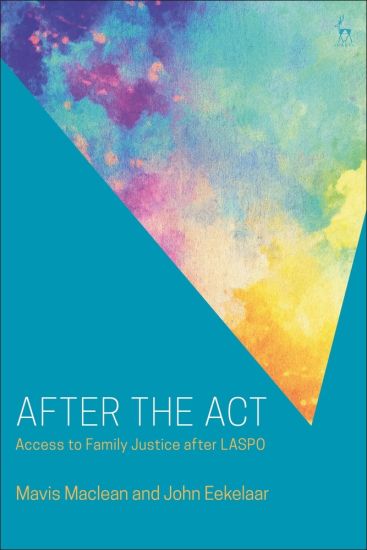
After the Act

After the Act

Mavis Maclean; John Eekelaar

Hart Publishing
2019
sidottu
After the Act describes the aftermath of the recent removal under LASPO of public funding from legal services in family matters other than in defined cases such as child protection and domestic abuse. Through analysis of the policy context, interviews with key players, observation of services provided by lawyers, students, lay support workers and the advice sector, the authors outline the work being done and the skills being used in a range of settings.The book raises questions not only about access to family justice, but about the role of law in family matters in an increasingly post-legal society. Fragmentation of the market in the new services offering information, initial advice, online or alternative dispute resolution – but rarely ongoing casework – raises questions about where costs fall and how quality can be assured. Many of these services are forms of private ordering, where outcomes are hard to assess.If neither the state nor the individual can afford full legal services where the best interests of any child involved are of paramount importance, and lawyers negotiate to make best use of the resources available, perhaps it is time to consider using lawyers differently, with lay support, to solve problems before they become disputes.

Lawyers and Mediators

Lawyers and Mediators

Mavis Maclean; John Eekelaar

Hart Publishing
2018
nidottu
Do lawyers make matters worse, or do they provide information, advice and support which can help to prevent disputes arising or manage them when they do? Do mediators enable parties to communicate and reach agreements tailor-made to their needs? Or working outside the legal framework, do they find it difficult to protect weaker parties and access expert advice? What happens when lawyers become mediators? This book will describe the structure of service provision and the day-to-day work of lawyers, mediators, and lawyer mediators, drawing on empirical work carried out between 2013 and 2015 immediately after the recent changes to the management of divorce and separation within the family justice system. The reduction in legal aided help in 2013 and the failure of mediation to fill the gap in 2014–15 have given rise to a difficult debate. This book aims to provide an account of some of the practical effects of these policies through a description of the daily work of practitioners in the sector. It raises the question of whether we need to choose between traditional legal services and the new processes of private ordering or whether intermediate positions might be possible.
The Reform of Child Care Law

The Reform of Child Care Law

John Eekelaar; Robert Dingwall

Routledge
2017
sidottu
Children Act 1989 introduced the most radical changes to child care law for a generation. Eekelaar and Dingwall provide a concise, practical guide to the legislation for all professionals practising in this area.
Family Law and Personal Life

Family Law and Personal Life

John Eekelaar

Oxford University Press
2017
sidottu
Developments in the law, scholarship, and research since 2006 form a substantial part of the second edition of this book which sets the governance of personal relationships in the context of the exercise of social and personal power. Its central argument is that this power is counterbalanced by the presence of individual rights. This entails an analysis of the nature and deployment of rights, including human rights, and children's rights. Against that background, the book examines the values of friendship, truth, respect, and responsibility, and how the values of individualism co-exist with those of the community in an open society. It argues that central to these values is respecting the role of intimacy in personal relationships. In doing this, a variety of issues are examined, including the legal regulation of married and unmarried relationships, same-sex marriage, state supervision over the inception and exercise of parenthood (including surrogacy and assisted reproductive technology), the role of fault and responsibility in divorce law, children's rights and welfare, religion and family rights, the rights of separated partners regarding property and of separated parents regarding their children, and how states should respond to cultural diversity.
Family Rights and Religion

Family Rights and Religion

John Eekelaar

Routledge
2017
sidottu
The interaction between individual rights, which are often seen in secular terms, and religion is becoming an important and complex topic not only for academic study but for practical policy. This volume collects a range of writings from journals, edited collections and individual books which deal with different aspects of the interaction within the context of family life, and which appear with their original pagination. These studies have been selected because they throw a sharp light on central elements of the role of religion in determining the structure of the rights of family members in relation to one another, both from an historical and contemporary perspective. While many of the writings are focused on US and European systems, selected writings covering other systems illustrate the universal nature of the topic. The studies are accompanied by a reflective commentary from the editor which sets the writings in a broad context of social, constitutional and philosophical thought, with the aim of stimulating critical thought and discussion.
Lawyers and Mediators

Lawyers and Mediators

Mavis Maclean; John Eekelaar

Hart Publishing
2016
sidottu
Do lawyers make matters worse, or do they provide information, advice and support which can help to prevent disputes arising or manage them when they do? Do mediators enable parties to communicate and reach agreements tailor-made to their needs? Or working outside the legal framework, do they find it difficult to protect weaker parties and access expert advice? What happens when lawyers become mediators? This book will describe the structure of service provision and the day-to-day work of lawyers, mediators, and lawyer mediators, drawing on empirical work carried out between 2013 and 2015 immediately after the recent changes to the management of divorce and separation within the family justice system. The reduction in legal aided help in 2013 and the failure of mediation to fill the gap in 2014–15 have given rise to a difficult debate. This book aims to provide an account of some of the practical effects of these policies through a description of the daily work of practitioners in the sector. It raises the question of whether we need to choose between traditional legal services and the new processes of private ordering or whether intermediate positions might be possible.
Family Justice

Family Justice

John Eekelaar; Mavis Maclean

Hart Publishing
2013
sidottu
This book is about the delivery of family justice in England and Wales, focusing on the work of the family judiciary in the lower courts. The policy context is moving so rapidly that the authors have gone beyond presenting their empirical findings to offer a broader consideration of the nature and role of the family justice system, as these are in danger of being lost amid present reform proposals. The first four chapters are historical and comparative, examining assumptions about family justice and offering a defence of the role of legal rights in family life, and the importance of good policy-making balancing outcome- and behaviour-focused approaches to family justice. Comparative examples from the US and Australia show how new approaches to family justice can be successfully deployed. The next three chapters are empirical, including a typology of the roles played and tasks addressed by the judges, overturning the commonly held assumption that the central judicial role is adjudication, emphasising the extent to which judges integrate outcome- and behaviour-focused approaches to family justice, and giving a detailed account of the daily work of circuit and district judges and legal advisers. The conclusion is that there is a trend across jurisdictions, driven by technological innovation and by economic constraints, to reduce the role of courts and lawyers in favour of individual choices based on private or government-funded information sources. While these developments can be beneficial, they also have dangers and limitations. The final chapter argues that despite the move to privatised forms of dispute resolution, family justice still demands a sound judicial structure.
Family Law Advocacy

Family Law Advocacy

John Eekelaar; Mavis Maclean

Hart Publishing
2009
nidottu
The role of the law in settling family disputes has been a matter of particular debate over the past twenty-five years. In keeping with the general public perception, the media has been largely critical about the role of lawyers in family law matters, sustaining a general lack of confidence in the legal profession, and a more specific feeling that in family matters lawyers aggravate conflict or even represent a female conspiracy. The climate in which family lawyers practise in England and Wales is therefore a harsh one. The authors of this path-breaking study felt it was time to find out more about the contribution of barristers in family law cases. They therefore embarked on a careful study of the Family Law Bar, its characteristics, what its members do, and how their activities contribute to the management or resolution of family disputes. Much of the study is comprised of an in-depth examination of the day-to-day activity of members of the family law bar through observation of individual barristers as they performed their role in the context of a court hearing, In attempting to answer questions such as whether our family justice system is excessively adversarial, or whether family barristers earn too much from human unhappiness, or indeed whether those working in the front line of child protection earn enough, the authors reach some surprising conclusions.'The barrister is both mentor and guide for the client' is how they begin their conclusion; 'we hope that we have shown that society should value their contribution better' is how they finish.
Family Law and Personal Life

Family Law and Personal Life

John Eekelaar

Oxford University Press
2007
nidottu
How should our most intimate personal relationships be governed in a liberal society? Should the state encourage a particular model of family life, or support individuals in their pursuit of personal happiness? To what extent do people have the right to shape the lives of their offspring? This book examines the questions at the heart of family law, rethinking the ideas that shape our understanding of the family as a social unit, its purpose, and the obligations and rights that belong to family members. The book explores how the governance of personal relationships has depended on the exercise of power, from the traditional assumptions of patriarchy, where the male head of the family enjoyed full control over his dependents and descendents, to the ideology of welfarism, where state institutions protect the interests of the vulnerable at the expense of their close relations. Emerging from these conflicting ideologies comes today's rights-based culture, where traditional expectations for behaviour within a family sit within a new emphasis on the ability of minorities and traditional dependents to determine the shape of their own lives. Against this background of shifting power relations, the book explores the interrelationship between the legal regulation of people's personal lives and the values of friendship, truth, respect and responsibility. In doing this, a variety of controversial issues are examined in the light of those values: including the legal regulation of gay and unmarried heterosexual relationships; freedom of procreation; state supervision over the exercise of parenthood; the role of fault in divorce law; the way parenthood is allocated; the rights and responsibilities of parents to control their children; the place of religion in the family; the rights of separated partners regarding property and of separated parents regarding their children. Throughout, the book offers a new picture of the intimacy at the centre of personal relationships and argues that only by understanding this intimacy, and its role in human happiness, can we arrive at a true framework for respecting, and governing, the personal lives of other people.
Family Law and Personal Life

Family Law and Personal Life

John Eekelaar

Oxford University Press
2006
sidottu
How should our most intimate personal relationships be governed in a liberal society? Should the state encourage a particular model of family life, or support individuals in their pursuit of personal happiness? To what extent do people have the right to shape the lives of their offspring? This book examines the questions at the heart of family law, rethinking the ideas that shape our understanding of the family as a social unit, its purpose, and the obligations and rights that belong to family members. The book explores how the governance of personal relationships has depended on the exercise of power, from the traditional assumptions of patriarchy, where the male head of the family enjoyed full control over his dependents and descendents, to the ideology of welfarism, where state institutions protect the interests of the vulnerable at the expense of their close relations. Emerging from these conflicting ideologies comes today's rights-based culture, where traditional expectations for behaviour within a family sit within a new emphasis on the ability of minorities and traditional dependents to determine the shape of their own lives. Against this background of shifting power relations, the book explores the interrelationship between the legal regulation of people's personal lives and the values of friendship, truth, respect and responsibility. In doing this, a variety of controversial issues are examined in the light of those values: including the legal regulation of gay and unmarried heterosexual relationships; freedom of procreation; state supervision over the exercise of parenthood; the role of fault in divorce law; the way parenthood is allocated; the rights and responsibilities of parents to control their children; the place of religion in the family; the rights of separated partners regarding property and of separated parents regarding their children. Throughout, the book offers a new picture of the intimacy at the centre of personal relationships and argues that only by understanding this intimacy, and its role in human happiness, can we arrive at a true framework for respecting, and governing, the personal lives of other people.
Cross Currents

Cross Currents

Sanford N. Katz; John Eekelaar; Mavis MacLean

Oxford University Press
2000
sidottu
This unique contribution to comparative family law brings together dedicated essays on a comprehensive range of issues in family law in the United States and England showing how they stand at the beginning of the new century and how they reached there. This provides an unparalleled opportunity to examine how family law has reacted to a period of change in family life widely held to be without precedent. The legal analyses are set within critical accounts of wider social and family policy and against a fully explored demographic background provided by leading scholars in these areas. Readers will be challenged to understand the nature of family law and its possible future direction.
Family Lawyers

Family Lawyers

John Eekelaar; Mavis Maclean

Hart Publishing
2000
nidottu
Recent changes to the legal aid system and the promotion of mediation have put the future of family law work in doubt. The legal process is widely perceived as being in itself harmful to the resolution of family disputes and wastefully expensive. Yet such attitudes are based on little evidence. Family Lawyers considers these issues on the basis of research into the way family lawyers deal with their divorcing clients, and how this fits into their general legal practice. It examines how solicitors negotiate both with their clients and with the "other side", how long cases take and what causes delays, and whether clients get value for their money. At a time of great change within the delivery of legal services, this book provides an insight into the real world of family solicitors, and will allow a more balanced assessment of the role and of the place of the law in this aspect of social life.
Family Lawyers

Family Lawyers

John Eekelaar; Mavis Maclean

Hart Publishing
2000
sidottu
Recent changes to the legal aid system and the promotion of mediation have put the future of family law work in doubt. The legal process is widely perceived as being in itself harmful to the resolution of family disputes and wastefully expensive. Yet such attitudes are based on little evidence. Family Lawyers considers these issues on the basis of research into the way family lawyers deal with their divorcing clients, and how this fits into their general legal practice. It examines how solicitors negotiate both with their clients and with the "other side", how long cases take and what causes delays, and whether clients get value for their money. At a time of great change within the delivery of legal services, this book provides an insight into the real world of family solicitors, and will allow a more balanced assessment of the role and of the place of the law in this aspect of social life.
The Parental Obligation

The Parental Obligation

John Eekelaar; Mavis Maclean

Hart Publishing
1997
nidottu
What kinds of obligations do parents have towards their children as family life becomes more complex? Many children pass through a number of different households,living with one or both parents and later step parents and step brothers and sisters. How are the new forms of family life accommodated in the legal system? The answer is that parenthood, rather than marriage, is now emerging as the central mechanism through which moral principles are converted into legal and social obligations. This study of 250 children who do not live with both of their parents shows, however, that despite the comparative legal emptiness of marriage, the experience of living longer with both parents than is usually the case of children of cohabiting or single parents endows the child with social capital in the form of enduring involvement with the outside parent, even after divorce, and that this happens to a greater extent than for children whose parents were not married.
The Parental Obligation

The Parental Obligation

John Eekelaar; Mavis Maclean

Hart Publishing
1997
sidottu
What kinds of obligations do parents have towards their children as family life becomes more complex? Many children pass through a number of different households,living with one or both parents and later step parents and step brothers and sisters. How are the new forms of family life accommodated in the legal system? The answer is that parenthood, rather than marriage, is now emerging as the central mechanism through which moral principles are converted into legal and social obligations. This study of 250 children who do not live with both of their parents shows, however, that despite the comparative legal emptiness of marriage, the experience of living longer with both parents than is usually the case of children of cohabiting or single parents endows the child with social capital in the form of enduring involvement with the outside parent, even after divorce, and that this happens to a greater extent than for children whose parents were not married.
The Reform of Child Care Law

The Reform of Child Care Law

John Eekelaar; Robert Dingwall

Routledge
1990
nidottu
Children Act 1989 introduced the most radical changes to child care law for a generation. Eekelaar and Dingwall provide a concise, practical guide to the legislation for all professionals practising in this area.