

Kirjailija
John F. Wilson
Kirjat ja teokset yhdessä paikassa: 14 kirjaa, julkaisuja vuosilta 2003-2025, suosituimpien joukossa Pains from the Past. Vertaile teosten hintoja ja tarkista saatavuus suomalaisista kirjakaupoista.
Mukana myös kirjoitusasut: John F Wilson
14 kirjaa
Kirjojen julkaisuhaarukka 2003-2025.

Business History
John F. Wilson; Ian G. Jones; Steven Toms; Anna Tilba; Emily Buchnea; Nicholas Wong
TAYLOR FRANCIS LTD
2023
nidottu
The evolution of business history offers some radical ways forward for a discipline which is rich in potential. This shortform book offers an expert overview of how the field has relevance for contemporary business studies as well as the social sciences more broadly, as well as practitioners interested in historical perspectives.This book not only provides a comprehensive review of how the discipline of business history has evolved over the last century, but it also lays out an agenda for the next decade. Focusing specifically on the ‘three pillars’ of research, teaching and practical impact, the authors have outlined how while the first has flourished across many continents, the latter two are struggling to overcome significant challenges associated with how the discipline is perceived, especially in the social sciences. A solution is proposed that would involve academics working more closely with practitioners, thereby increasing the discipline’s credibility across key stakeholders.The work here presented provides a concise and easily digestible overview of the topic which will be of interest to scholars, researchers and advanced students focusing on the evolution of business history and its impact on the way the world conducts business today.

Business History
John F. Wilson; Ian G. Jones; Steven Toms; Anna Tilba; Emily Buchnea; Nicholas Wong
TAYLOR FRANCIS LTD
2022
sidottu
The evolution of business history offers some radical ways forward for a discipline which is rich in potential. This shortform book offers an expert overview of how the field has relevance for contemporary business studies as well as the social sciences more broadly, as well as practitioners interested in historical perspectives.This book not only provides a comprehensive review of how the discipline of business history has evolved over the last century, but it also lays out an agenda for the next decade. Focusing specifically on the ‘three pillars’ of research, teaching and practical impact, the authors have outlined how while the first has flourished across many continents, the latter two are struggling to overcome significant challenges associated with how the discipline is perceived, especially in the social sciences. A solution is proposed that would involve academics working more closely with practitioners, thereby increasing the discipline’s credibility across key stakeholders.The work here presented provides a concise and easily digestible overview of the topic which will be of interest to scholars, researchers and advanced students focusing on the evolution of business history and its impact on the way the world conducts business today.

Mandy Glass, working in a call-centre, for an insurance broker, in the West End of London, lives with her boyfriend, out-of-work and lazy, Rodney Groves. Mandy is keen to make their relationship work, but there are bills to pay and she becomes frustrated with Rodney's lack of work ethic and enthusiasm to help her financially.Over lunch, a colleague at work, suggests, perhaps Mandy could sign up with an Escort Agency and meet clients in the evenings. "It could be fun", she said, and would certainly help to relieve her financial crisis.After much deliberation and heart searching, Mandy did just that, and once she had explained the details to Rodney, and he had recovered from hysterical laughter, he agreed it was a great idea and would support her all the way. Having embarked on this new enterprise, events became complicated, as Mandy was wined and dined in top class restaurants, met nice men and some not so nice men. She became emotionally entangled with one gentleman in particular. In time, Rodney's jealousy gets the better of him, which results in violent altercations, a custodial sentence and emotional turmoil for all concerned.

Mandy Glass, working in a call-centre, for an insurance broker, in the West End of London, lives with her boyfriend, out-of-work and lazy, Rodney Groves. Mandy is keen to make their relationship work, but there are bills to pay and she becomes frustrated with Rodney's lack of work ethic and enthusiasm to help her financially.Over lunch, a colleague at work, suggests, perhaps Mandy could sign up with an Escort Agency and meet clients in the evenings. "It could be fun", she said, and would certainly help to relieve her financial crisis.After much deliberation and heart searching, Mandy did just that, and once she had explained the details to Rodney, and he had recovered from hysterical laughter, he agreed it was a great idea and would support her all the way. Having embarked on this new enterprise, events became complicated, as Mandy was wined and dined in top class restaurants, met nice men and some not so nice men. She became emotionally entangled with one gentleman in particular. In time, Rodney's jealousy gets the better of him, which results in violent altercations, a custodial sentence and emotional turmoil for all concerned.

A Physicist Examines Hope in the Resurrection
John F Wilson; Vaughn W Baker
Wipf Stock Publishers
2016
pokkari

A Physicist Examines Hope in the Resurrection
John F Wilson; Vaughn W Baker
Wipf Stock Publishers
2016
sidottu

Building Co-operation
John F. Wilson; Anthony Webster; Rachael Vorberg-Rugh
Oxford University Press
2013
sidottu
Building Co-operation traces the development of The Co-operative Group and its predecessor, the Co-operative Wholesale Society (CWS), over the course of 150 years. Born from the efforts of the Rochdale Pioneers and others who established successful consumer co-operatives across Britain in the mid-nineteenth century, by the 1860s the proponents of the CWS were ready to pioneer a new effort: a federation, democratically run and collectively owned, that would enable co-operatives to become their own suppliers. From humble origins, the CWS grew into one of Britain's largest businesses within a generation, pioneering modern retailing and distribution on a national scale, expanding into factory production and financial services, and establishing an international supply network that stretched across Europe, and beyond. Throughout the late nineteenth century and well into the twentieth, co-operative societies provided essential services to millions of members across Britain, ranging from food and clothing to banking, insurance, travel agency, pharmacy and even funeral services. However, in the second half of the twentieth century co-operatives experienced a protracted period of decline, facing a series of internal structural challenges, fierce competition amongst food retailers, and a rapidly-changing marketplace. By the turn of the twenty-first century, when many commentators were ready to consign co-operatives to the past, The Co-operative Group emerged with a revitalised business model that has helped to re-invigorate the British co-operative sector and bring new attention to the important role of co-operative and mutual enterprises worldwide. Based on extensive archival research, including many records available to historians for the first time, Building Co-operation is the story of a distinctive business model as it evolved over time. While since the inauguration of the CWS in 1863 the commercial landscape has changed nearly beyond recognition, the values at the heart of The Co-operative Group have remained relevant to succeeding generations, focusing on member benefits and a commitment to ethical trading.

This study of Ferranti in its last six years of a long history provides a detailed exposition of the British and American businessmen who combined to terminate one of the UK’s leading defence electronics firms. Involving action in the Middle East, South Africa and Pakistan, as well as the UK and USA, this highlights the precarious nature of international arms trading.
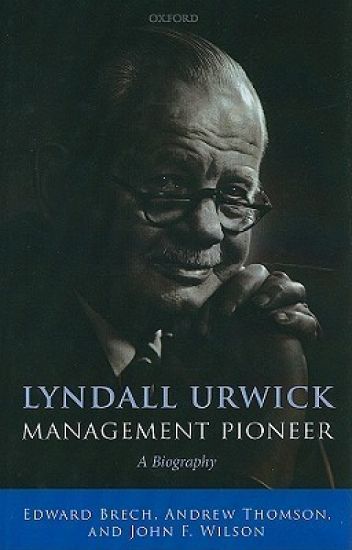
Lyndall Urwick, Management Pioneer
Edward Brech; Andrew Thomson; John F. Wilson
Oxford University Press
2010
sidottu
Lyndall Urwick was the dominant figure in British management between the late 1920s and the early 1960s. His writings and his passion in pursuit of management as a scientific and systematic activity rather than the rule-of-thumb approach to decision-making all too prevalent in Britain exercised a huge influence on management at the time; and ultimately management as we know it today. Urwick was greatly affected by his experience of the First World War and at Rowntree's. He went on to become Director of the International Management Institute between 1928-33, before forming a very influential management consultancy, Urwick Orr and Partners, which he chaired for the rest of his career. He was also deeply involved with almost all the institutional developments in British management up to the 1960s, including the Management Research Groups, the Institute of Industrial Administration, the British Institute of Management, the Administrative Staff College, and the management education side of the Anglo-American Council on Productivity. In pursuit of what he called his 'mission at large', he gave hundreds of talks in his lucid and charismatic style, many of which were published as articles or booklets. These talks were not only in Britain but in Australia after his emigration there in 1961, in America, where he became the best-recognized foreign exponent of management, and in a range of countries around the world. But he will probably be best remembered for his writings, not only on organization theory, where he is recognized as a great synthesizer and leader in the classical school, but on a wide range of other topics, including the history of management, leadership, marketing, and management education and development. Truly he was a man of many parts.

Management has always been part of human organization, but it is only in the last two centuries or so that it has been the central driver of economic activity, as companies have moved from family firms to hugely complex, multinational corporations with many layers of management. The term management is commonly used in three ways: as a process or activity; as a structure in any organization; and as a group or class of people carrying out certain roles in an organization. This book is the first detailed account of the evolution of management in all three senses. The focus is mainly on the UK, but throughout the broader question of why corporate management structures developed so impressively in the USA, Germany and Japan is borne in mind, while arguably little progress was made in this regards in the UK. Equally the authors consider why, given that management is now so widely studied, so little careful research has been undertaken into the evolution of the practice and the profession of management. The book is divided into four sections. Part One provides An Introduction to Management History; Part Two, Management and Organization, explores the historical development through the 19th and 20th centuries; Part Three, Managers in Context, looks at the social and cultural context of management and managers; and Part Four considers three key functional areas, labour, marketing, and accounting and finance. This rich, detailed, and path-breaking book will be essential reading for anyone wanting to understand the evolution of management as we now understand it, whether academics, students or managers themselves.


Management has always been part of human organization, but it is only in the last two centuries or so that it has been the central driver of economic activity, as companies have moved from family firms to hugely complex, multinational corporations with many layers of management. The term management is commonly used in three ways: as a process or activity; as a structure in any organization; and as a group or class of people carrying out certain roles in an organization. This book is the first detailed account of the evolution of management in all three senses. The focus is mainly on the UK, but throughout the broader question of why corporate management structures developed so impressively in the USA, Germany and Japan is borne in mind, while arguably little progress was made in this regards in the UK. Equally the authors consider why, given that management is now so widely studied, so little careful research has been undertaken into the evolution of the practice and the profession of management. The book is divided into four sections. Part One provides An Introduction to Management History; Part Two, Management and Organization, explores the historical development through the 19th and 20th centuries; Part Three, Managers in Context, looks at the social and cultural context of management and managers; and Part Four considers three key functional areas, labour, marketing, and accounting and finance. This rich, detailed, and path-breaking book will be essential reading for anyone wanting to understand the evolution of management as we now understand it, whether academics, students or managers themselves.

This lively survey ranges across several centuries of change in the ways historians have thought and written about religion in America. In particular, John F. Wilson is concerned with how historians have perceived religion's relationship to the political organization of our country. He begins by establishing the genesis of religion as a specialized area of American history in the nineteenth century, and then discusses religious history's development through the early 1970s. Along the way he considers topics ranging from the "long shadow" the Puritans have cast over our comprehension of religion in American history to the ascendancy of such institutions as the University of Chicago as systematizing forces in religious scholarship.Wilson then discusses how scholars, since the early 1970s, have sought to ground their accounts of American religious trends and events in ways that either avoid or transcend references to Puritanism. The rise of comparative religious histories, Wilson notes, has been the welcome outcome. Moving into the present, Wilson explores a range of behaviors, if not beliefs, that might be understood as religious aspects of American life, and looks at how the spiritual or religious dimensions of American cultural life have been expressed in gnosticism, the mass media, and consumerism.One commentator, Wilson notes, suggested that there are no longer any religions as such in America today, but only religious "brands." Wilson himself sees America as a place where there is room for Old World traditions and new spiritual initiatives, a modern nation remarkably hospitable to ancient preoccupations.