Kirjojen hintavertailu. Mukana 12 320 464 kirjaa ja 12 kauppaa.

Kirjailija

John Fitzgerald

Kirjat ja teokset yhdessä paikassa: 32 kirjaa, julkaisuja vuosilta 1988-2023, suosituimpien joukossa Big White Lie. Vertaile teosten hintoja ja tarkista saatavuus suomalaisista kirjakaupoista.

Mukana myös kirjoitusasut: John Fitzgerald

32 kirjaa

Kirjojen julkaisuhaarukka 1988-2023.

Thanksgiving Breakfast: You Can Go Home Again

Thanksgiving Breakfast: You Can Go Home Again

John Fitzgerald

Createspace Independent Publishing Platform
2012
nidottu
A Baby-boomer or a child of one would enjoy reading this book. This novel tells the story of a group of high school friends who keep in touch over a fifty-year span through a reunion of sorts. The novel is set in a little town in Pennsylvania Pennsylvania. The characters gather at their hometown Pub on Wednesday night before Thanksgiving. They reminisce, cajole, and brag, revealing the events taking effect in their lives. The following morning they join others of the community at Thanksgiving Breakfast party preceding the annual High School game. This fascinating novel is poignant and humorous, but it
Validated Designs for Object-oriented Systems

Validated Designs for Object-oriented Systems

John Fitzgerald; Peter Gorm Larsen; Paul Mukherjee; Nico Plat; Marcel Verhoef

Springer London Ltd
2010
nidottu
Object-oriented design methods are commonplace in computing systems development, but are often dismissed as 'boxes & arrows'. If systems developers are to gain full advantage from such methods, they should be able to achieve designs that are not merely the subject of heated argument, but can be improved by careful, rigorous & machine-supported analysis. This book describes an object-oriented design approach that combines the benefits of abstract modelling with the analytic power of formal methods, to give designs that can be rigorously validated & assured with automated support. Aimed at software architects, designers & developers as well as computer scientists, no prior knowledge of formal methods is assumed. The elements of functional modelling are introduced using numerous examples & exercises, industrial case studies & experience reports. Industry-strength tools support the text. Go to www.vdmbook.com to download free-of-charge VDMTools Lite, which gives the possibility to try out examples from the book
Studying British Cinema: 1999-2009

Studying British Cinema: 1999-2009

John Fitzgerald

Auteur Publishing
2010
sidottu
Studying British Cinema: 1999–2009 adopts a number of approaches to popularist, mainstream, and esoteric arthouse films. The book considers the institutional and financial factors that influence U.K. film production and assesses issues of genre, representation, authorship, and social, economic, and political contexts. The growth of coproduction is considered by looking at both Aardman Animation and the Harry Potter franchise (2001 to the present). Representations of social class factor into films as diverse as Red Road (2006) and Love, Actually (2003), and developments in social realism, primarily by female directors, are examined. The revival of the British science fiction and horror film is also covered in detail, and ethnic groups and new economic migrants are viewed in two separate chapters, as well as the growth of films concerning British protagonists in Africa. One section offers a close analysis of two of the most important directors of the decade: Michael Winterbottom and Shane Meadows.
Studying British Cinema: 1999-2009

Studying British Cinema: 1999-2009

John Fitzgerald

Auteur Publishing
2010
pokkari
Studying British Cinema: 1999–2009 adopts a number of approaches to popularist, mainstream, and esoteric arthouse films. The book considers the institutional and financial factors that influence U.K. film production and assesses issues of genre, representation, authorship, and social, economic, and political contexts. The growth of coproduction is considered by looking at both Aardman Animation and the Harry Potter franchise (2001 to the present). Representations of social class factor into films as diverse as Red Road (2006) and Love, Actually (2003), and developments in social realism, primarily by female directors, are examined. The revival of the British science fiction and horror film is also covered in detail, and ethnic groups and new economic migrants are viewed in two separate chapters, as well as the growth of films concerning British protagonists in Africa. One section offers a close analysis of two of the most important directors of the decade: Michael Winterbottom and Shane Meadows.
Modelling Systems

Modelling Systems

John Fitzgerald; Peter Gorm Larsen

Cambridge University Press
2009
sidottu
How can we make sure that the software we build does what it is supposed to? This book provides an insight into established techniques which help developers to overcome the complexity of software development by constructing models of software systems in early design stages. It uses one of the leading formal methods, VDM (Vienna Development Method), and combines training in the formalism with industry-strength tool support and examples derived from real industrial applications. The principles taught here also apply to many of the current generation of formal methods. This second edition has been updated to include advanced online tool support for formal modelling as well as up-to-date reports on real commercial applications in areas as diverse as business information systems and firmware design.
Validated Designs for Object-oriented Systems

Validated Designs for Object-oriented Systems

John Fitzgerald; Peter Gorm Larsen; Paul Mukherjee; Nico Plat; Marcel Verhoef

Springer London Ltd
2005
sidottu
Object-oriented design methods are commonplace in computing systems development, but are often dismissed as 'boxes & arrows'. If systems developers are to gain full advantage from such methods, they should be able to achieve designs that are not merely the subject of heated argument, but can be improved by careful, rigorous & machine-supported analysis. This book describes an object-oriented design approach that combines the benefits of abstract modelling with the analytic power of formal methods, to give designs that can be rigorously validated & assured with automated support. Aimed at software architects, designers & developers as well as computer scientists, no prior knowledge of formal methods is assumed. The elements of functional modelling are introduced using numerous examples & exercises, industrial case studies & experience reports. Industry-strength tools support the text. Go to www.vdmbook.com to download free-of-charge VDMTools Lite, which gives the possibility to try out examples from the book
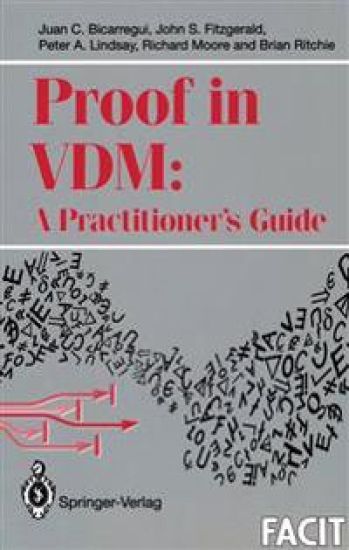
Proof in VDM: A Practitioner’s Guide

Proof in VDM: A Practitioner’s Guide

Juan C. Bicarregui; John Fitzgerald; Peter A. Lindsay; Richard Moore; Brian Ritchie

Springer-Verlag Berlin and Heidelberg GmbH Co. K
1993
nidottu
Formal specifications were first used in the description of program­ ming languages because of the central role that languages and their compilers play in causing a machine to perform the computations required by a programmer. In a relatively short time, specification notations have found their place in industry and are used for the description of a wide variety of software and hardware systems. A formal method - like VDM - must offer a mathematically-based specification language. On this language rests the other key element of the formal method: the ability to reason about a specification. Proofs can be empioyed in reasoning about the potential behaviour of a system and in the process of showing that the design satisfies the specification. The existence of a formal specification is a prerequisite for the use of proofs; but this prerequisite is not in itself sufficient. Both proofs and programs are large formal texts. Would-be proofs may therefore contain errors in the same way as code. During the difficult but inevitable process of revising specifications and devel­ opments, ensuring consistency is a major challenge. It is therefore evident that another requirement - for the successful use of proof techniques in the development of systems from formal descriptions - is the availability of software tools which support the manipu­ lation of large bodies of formulae and help the user in the design of the proofs themselves.