Kirjojen hintavertailu. Mukana 12 390 323 kirjaa ja 12 kauppaa.

Kirjailija

John G. Webster

Kirjat ja teokset yhdessä paikassa: 5 kirjaa, julkaisuja vuosilta 1999-2019, suosituimpien joukossa Mechanical Variables Measurement - Solid, Fluid, and Thermal. Vertaile teosten hintoja ja tarkista saatavuus suomalaisista kirjakaupoista.

5 kirjaa

Kirjojen julkaisuhaarukka 1999-2019.

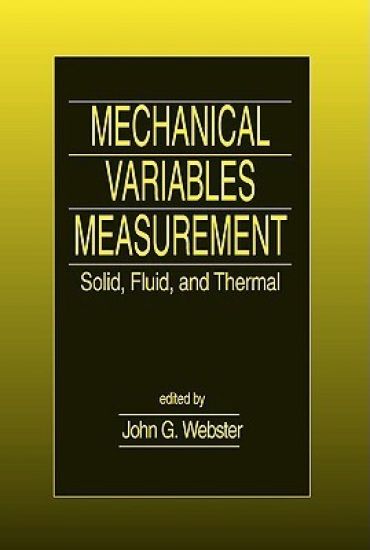
Mechanical Variables Measurement - Solid, Fluid, and Thermal
Accuracy in the laboratory setting is key to maintaining the integrity of scientific research. Inaccurate measurements create false and non-reproducible results, rendering an experiment or series of experiments invalid and wasting both time and money. This handy guide to solid, fluid, and thermal measurement helps minimize this pitfall through careful detailing of measurement techniques. Concise yet thorough, Mechanical Variables Measurement-Solid, Fluid, and Thermal describes the use of instruments and methods for practical measurements required in engineering, physics, chemistry, and the life sciences. Organized according to measurement problem, the entries are easy to access. The articles provide equations to assist engineers and scientists who seek to discover applications and solve problems that arise in areas outside of their specialty. Sections include references to more specialized publications for advanced techniques, as well. It offers instruction for a range of measuring techniques, basic through advanced, that apply to a broad base of disciplines. As an engineer, scientist, designer, manager, researcher, or student, you encounter the problem of measurement often and realize that doing it correctly is pivotal to the success of an experiment. This is the first place to turn when deciding on, performing, and troubleshooting the measurement process. Mechanical Variables Measurement-Solid, Fluid, and Thermal leads the reader, step-by-step, through the straits of experimentation to triumph.
Sensors and Signal Conditioning

Sensors and Signal Conditioning

Ramón Pallás-Areny; John G. Webster

John Wiley Sons Inc
2000
sidottu
Praise for the First Edition . . . "A unique piece of work, a book for electronics engineering, in general, but well suited and excellently applicable also to biomedical engineering . . . I recommend it with no reservation, congratulating the authors for the job performed." –IEEE Engineering in Medicine & Biology "Describes a broad range of sensors in practical use and some circuit designs; copious information about electronic components is supplied, a matter of great value to electronic engineers. A large number of applications are supplied for each type of sensor described . . . This volume is of considerable importance."–Robotica In this new edition of their successful book, renowned authorities Ramon Pallàs-Areny and John Webster bring you up to speed on the latest advances in sensor technology, addressing both the explosive growth in the use of microsensors and improvements made in classical macrosensors. They continue to offer the only combined treatment for both sensors and the signal-conditioning circuits associated with them, following the discussion of a given sensor and its applications with signal-conditioning methods for this type of sensor. New and expanded coverage includes: *New sections on sensor materials and microsensor technology *Basic measurement methods and primary sensors for common physical quantities *A wide range of new sensors, from magnetoresistive sensors and SQUIDs to biosensors *The widely used velocity sensors, fiber-optic sensors, and chemical sensors *Variable CMOS oscillators and other digital and intelligent sensors *68 worked-out examples and 103 end-of-chapter problems with annotated solutions
Mechanical Variables Measurement - Solid, Fluid, and Thermal
Accuracy in the laboratory setting is key to maintaining the integrity of scientific research. Inaccurate measurements create false and non-reproducible results, rendering an experiment or series of experiments invalid and wasting both time and money. This handy guide to solid, fluid, and thermal measurement helps minimize this pitfall through careful detailing of measurement techniques. Concise yet thorough, Mechanical Variables Measurement-Solid, Fluid, and Thermal describes the use of instruments and methods for practical measurements required in engineering, physics, chemistry, and the life sciences. Organized according to measurement problem, the entries are easy to access. The articles provide equations to assist engineers and scientists who seek to discover applications and solve problems that arise in areas outside of their specialty. Sections include references to more specialized publications for advanced techniques, as well. It offers instruction for a range of measuring techniques, basic through advanced, that apply to a broad base of disciplines. As an engineer, scientist, designer, manager, researcher, or student, you encounter the problem of measurement often and realize that doing it correctly is pivotal to the success of an experiment. This is the first place to turn when deciding on, performing, and troubleshooting the measurement process. Mechanical Variables Measurement-Solid, Fluid, and Thermal leads the reader, step-by-step, through the straits of experimentation to triumph.
Analog Signal Processing

Analog Signal Processing

Ramón Pallás-Areny; John G. Webster

John Wiley Sons Inc
1999
sidottu
A proven, cost-effective approach to solving analog signal processing design problems Most design problems involving analog circuits require a great deal of creativity to solve. But, as the authors of this groundbreaking guide demonstrate, finding solutions to most analog signal processing problems does not have to be that difficult. Analog Signal Processing presents an original, five-step, design-oriented approach to solving analog signal processing problems using standard ICs as building blocks. Unlike most authors who prescribe a "bottom-up" approach, Professors Pallás-Areny and Webster cast design problems first in functional terms and then develop possible solutions using available ICs, focusing on circuit performance rather than internal structure. The five steps of their approach move from signal classification, definition of desired functions, and description of analog domain conversions to error classification and error analysis. Featuring 90 worked examples—many of them drawn from actual implementations—and more than 130 skill-building chapter-end problems, Analog Signal Processing is both a valuable working resource for practicing design engineers and a textbook for advanced courses in electronic instrumentation design.
Sensors and Signal Conditioning 2e

Sensors and Signal Conditioning 2e

Ramon Pallas-Areny; John G. Webster

Wiley–Blackwell
muu
Many electronic applications present in our everyday life would not be possible without sensors. Without their ability to measure or control physical quantities, many electronic devices would remain as simple laboratory curiosities. This book is unique in its treatment of both signal conditioning and sensors.