

Kirjailija
John George Bourinot
Kirjat ja teokset yhdessä paikassa: 53 kirjaa, julkaisuja vuosilta 1973-2025, suosituimpien joukossa Canada. Vertaile teosten hintoja ja tarkista saatavuus suomalaisista kirjakaupoista.
53 kirjaa
Kirjojen julkaisuhaarukka 1973-2025.
The Intellectual Development of the Canadian People
John George Bourinot
British Library, Historical Print Editions
2011
pokkari
Title: The Intellectual Development of the Canadian People: and historical review.Publisher: British Library, Historical Print EditionsThe British Library is the national library of the United Kingdom. It is one of the world's largest research libraries holding over 150 million items in all known languages and formats: books, journals, newspapers, sound recordings, patents, maps, stamps, prints and much more. Its collections include around 14 million books, along with substantial additional collections of manuscripts and historical items dating back as far as 300 BC.The HISTORY OF COLONIAL NORTH AMERICA collection includes books from the British Library digitised by Microsoft. This collection refers to the European settlements in North America through independence, with emphasis on the history of the thirteen colonies of Britain. Attention is paid to the histories of Jamestown and the early colonial interactions with Native Americans. The contextual framework of this collection highlights 16th century English, Scottish, French, Spanish, and Dutch expansion. ++++The below data was compiled from various identification fields in the bibliographic record of this title. This data is provided as an additional tool in helping to insure edition identification: ++++ British Library Bourinot, John George; 1881. xi, 128 p.; 8 . 9555.de.3.
The Intellectual Development Of The Canadian People
John George Bourinot
KESSINGER PUBLISHING, LLC
2010
sidottu
Parliamentary Procedure And Practice V2 (1892)
John George Bourinot
KESSINGER PUBLISHING, LLC
2010
pokkari

Parliamentary Procedure And Practice V1 (1892)
John George Bourinot
KESSINGER PUBLISHING, LLC
2010
pokkari



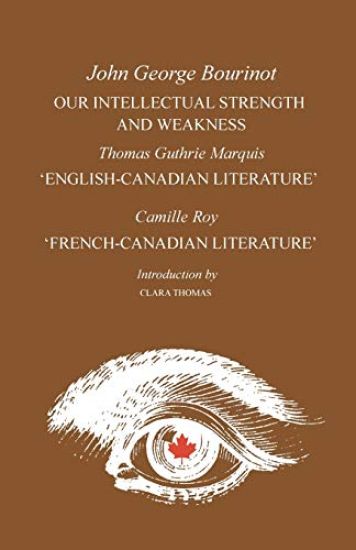
Our Intellectual Strength and Weakness
John George Bourinot; Thomas Guthrie Marquis
University of Toronto Press
1973
pokkari
These three works, displaying marked differences in purpose, tone, and effect, are all classics of Canadian literary and cultural criticism. John George Bourinot was a man of letters, an Imperialist, and a biculturalist, who was confident of his knowledge of the Canadian identity and felt it to be his public mission to align reality with his own personal vision. Writing in 1893 to the élite represented by the members of the Royal Society, he described his work as ‘a monograph on the intellectual development of the Dominion,’ describing ‘the progress of culture in a country still struggling with the difficulties of the material development of half a continent.’ Two decades later, Thomas Guthrie Marquis and Camille Roy wrote what were, in contrast, specialized assignments, contributions to the compendium history, Canada and Its Provinces (1913). Addressing a far larger audience, and treating a vastly enlarged body of Canadian literature, their work comes much closer to contemporary scholarship, with greater clarity, organization, and sheer bulk of information, but with the loss of some of the charm and assurance of Bourinot’s wide sweep. In further contrast to Bourinot’s determined biculturalism and will to unity, Roy and Marquis’ essays display vivid differences in the emotional allegiances and convictions of the founding cultures. Marquis starts by asking the question, ‘Has Canada a voice of her own in literature distinct from that of England?’; Roy treats French-Canadian literature in its Roman Catholic contexts.

I devote the first chapter of this short history to a brief review of the colonisation of the valley of the St. Lawrence by the French, and of their political and social conditions at the Conquest, so that a reader may be able to compare their weak and impoverished state under the repressive dominion of France with the prosperous and influential position they eventually attained under the liberal methods of British rule. In the succeeding chapters I have dwelt on those important events which have had the largest influence on the political development of the several provinces as British possessions. We have, first, the Quebec Act, which gave permanent guarantees for the establishment of the Church of Rome and the maintenance of the language and civil law of France in her old colony. Next, we read of the coming of the United Empire Loyalists, and the consequent establishment of British institutions on a stable basis of loyal devotion to the parent state. Then ensued the war of 1812, to bind the provinces more closely to Great Britain, and create that national spirit which is the natural outcome of patriotic endeavour and individual self-sacrifice. Then followed for several decades a persistent popular struggle for larger political liberty, which was not successful until British statesmen awoke at last from their indifference, on the outbreak of a rebellion in the Canadas, and recognised the necessity of adopting a more liberal policy towards their North American dependencies. The union of the Canadas was succeeded by the concession of responsible government and the complete acknowledgment of the rights of the colonists to manage their provincial affairs without the constant interference of British officials. With this extension of political privileges, the people became still more ambitious, and established a confederation, which has not only had the effect of supplying a remarkable stimulus to their political, social and material development, but has given greater security to British interests on the continent of North America.