Kirjojen hintavertailu. Mukana 12 595 353 kirjaa ja 12 kauppaa.
Kirjailija
John Harriss
Kirjat ja teokset yhdessä paikassa: 14 kirjaa, julkaisuja vuosilta 2000-2025, suosituimpien joukossa Equality (Edition1). Vertaile teosten hintoja ja tarkista saatavuus suomalaisista kirjakaupoista.
Originally published in 1982, this book provides an important set of basic materials for students of rural development. Key papers have been chosen and arranged, and the editor has provided a general introduction and passages that link the papers, alerting the student to rival theoretical interpretations and to regional parallels and contrasts. The book provides a basis for the analysis of the processes that make rural societies and economies what they are and substantially determine the changes that take place within them. The papers help the reader to understand the nature of the phenomena with which rural development has to deal, and in doing so to begin to evaluate the interventions of agencies and planners.
Originally published in 1982, this book provides an important set of basic materials for students of rural development. Key papers have been chosen and arranged, and the editor has provided a general introduction and passages that link the papers, alerting the student to rival theoretical interpretations and to regional parallels and contrasts. The book provides a basis for the analysis of the processes that make rural societies and economies what they are and substantially determine the changes that take place within them. The papers help the reader to understand the nature of the phenomena with which rural development has to deal, and in doing so to begin to evaluate the interventions of agencies and planners.
India has been catapulted to the centre of world attention. Its rapidly growing economy, new geo-political confidence, and global cultural influence have ensured that people across the world recognise India as one of the main sites of social dynamism in the early twenty-first century. In this book, research leaders John Harriss, Craig Jeffrey and Trent Brown explore in depth the economic, social, and political changes occurring in India today, and their implications for the people of India and the world. Each of the book’s fourteen chapters seeks to answer a key question: Is India’s democracy under threat? Can India’s Growth be sustained? How are youth changing India? Drawing on a wealth of scholarly and popular material as well as their own experience researching the country during this period of major transformation, the authors draw the reader into key debates about economic growth, poverty, environmental justice, the character of Indian democracy, rights and social movements, gender, caste, education, and foreign policy. India, they conclude, has undergone some extraordinary and positive changes since the early 1990s but deeply worrying threats remain: increasing authoritarianism, growing inequality, entrenched poverty, and environmental vulnerability. How India responds to these crucial challenges will shape the world’s largest democracy for years to come.
India has been catapulted to the centre of world attention. Its rapidly growing economy, new geo-political confidence, and global cultural influence have ensured that people across the world recognise India as one of the main sites of social dynamism in the early twenty-first century. In this book, research leaders John Harriss, Craig Jeffrey and Trent Brown explore in depth the economic, social, and political changes occurring in India today, and their implications for the people of India and the world. Each of the book’s fourteen chapters seeks to answer a key question: Is India’s democracy under threat? Can India’s Growth be sustained? How are youth changing India? Drawing on a wealth of scholarly and popular material as well as their own experience researching the country during this period of major transformation, the authors draw the reader into key debates about economic growth, poverty, environmental justice, the character of Indian democracy, rights and social movements, gender, caste, education, and foreign policy. India, they conclude, has undergone some extraordinary and positive changes since the early 1990s but deeply worrying threats remain: increasing authoritarianism, growing inequality, entrenched poverty, and environmental vulnerability. How India responds to these crucial challenges will shape the world’s largest democracy for years to come.
The idea of social capital -- meaning, most simply put, 'social connections' -- was unheard of outside a small circle of sociologists until very recently. Now it is proclaimed by the World Bank to be 'the missing link' in international development, and it has become the subject of a flurry of books and research papers, including some, recently, on India. This book explores the origins of the idea of social capital, and its diverse meanings, in the work of James Coleman, Pierre Bourdieu, and of Robert Putnam -- who is responsible, more than any other, through his work on Italy and the United States, for its extraordinary rise. John Harriss then asks why this notion should have taken off in the dramatic way that it has done, and finds in its uses by the World Bank the attempt, systematically, to obscure class relations and power. Social capital has thus come to play a significant part in 'the anti-politics machine' that is constituted by the discourses of international development. This powerful and lucid critique will be of immense use to all those interested in development studies, including sociologists, economists, planners, and NGO and other activists.
What have English terms such as 'civil society', 'democracy', 'development' or 'nationalism' come to mean in an Indian context and how have their meanings and uses changed over time? Why are they the subjects of so much debate - in their everyday uses as well as amongst scholars? How did a concept such as 'Hinduism' come to be framed, and what does it mean now? What is 'caste'? Does it have quite the same meaning now as in the past? Why is the idea of 'faction' so significant in modern India? Why has the idea of 'empowerment' come to be used so extensively? These are the sorts of questions that are addressed in this book. Keywords for Modern India is modelled after the classic exploration of English culture and society through the study of keywords - words that are 'strong, important and persuasive' - by Raymond Williams. The book, like Williams' Keywords, is not a dictionary or an encyclopaedia. Williams said that his was 'an inquiry into a vocabulary', and Keywords for Modern India presents just such an inquiry into the vocabulary deployed in writing in and about India in the English language - which has long been and is becoming ever more a critically important language in India's culture and society. Exploring the changing uses and contested meanings of common but significant words is a powerful and illuminating way of understanding contemporary India, for scholars and for students, and for general readers.
What have English terms such as 'civil society', 'democracy', 'development' or 'nationalism' come to mean in an Indian context and how have their meanings and uses changed over time? Why are they the subjects of so much debate - in their everyday uses as well as amongst scholars? How did a concept such as 'Hinduism' come to be framed, and what does it mean now? What is 'caste'? Does it have quite the same meaning now as in the past? Why is the idea of 'faction' so significant in modern India? Why has the idea of 'empowerment' come to be used so extensively? These are the sorts of questions that are addressed in this book. Keywords for Modern India is modelled after the classic exploration of English culture and society through the study of keywords - words that are 'strong, important and persuasive' - by Raymond Williams. The book, like Williams' Keywords, is not a dictionary or an encyclopaedia. Williams said that his was 'an inquiry into a vocabulary', and Keywords for Modern India presents just such an inquiry into the vocabulary deployed in writing in and about India in the English language - which has long been and is becoming ever more a critically important language in India's culture and society. Exploring the changing uses and contested meanings of common but significant words is a powerful and illuminating way of understanding contemporary India, for scholars and for students, and for general readers.
Twenty years ago India was still generally thought of as an archetypal developing country, home to the largest number of poor people of any country in the world, and beset by problems of low economic growth, casteism and violent religious conflict. Now India is being feted as an economic power-house which might well become the second largest economy in the world before the middle of this century. Its democratic traditions, moreover, remain broadly intact. How and why has this historic transformation come about? And what are its implications for the people of India, for Indian society and politics? These are the big questions addressed in this book by three scholars who have lived and researched in different parts of India during the period of this great transformation. Each of the 13 chapters seeks to answer a particular question: When and why did India take off? How did a weak state promote audacious reform? Is government in India becoming more responsive (and to whom)? Does India have a civil society? Does caste still matter? Why is India threatened by a Maoist insurgency? In addressing these and other pressing questions, the authors take full account of vibrant new scholarship that has emerged over the past decade or so, both from Indian writers and India specialists, and from social scientists who have studied India in a comparative context. India Today is a comprehensive and compelling text for students of South Asia, political economy, development and comparative politics as well as anyone interested in the future of the world's largest democracy.
Twenty years ago India was still generally thought of as an archetypal developing country, home to the largest number of poor people of any country in the world, and beset by problems of low economic growth, casteism and violent religious conflict. Now India is being feted as an economic power-house which might well become the second largest economy in the world before the middle of this century. Its democratic traditions, moreover, remain broadly intact. How and why has this historic transformation come about? And what are its implications for the people of India, for Indian society and politics? These are the big questions addressed in this book by three scholars who have lived and researched in different parts of India during the period of this great transformation. Each of the 13 chapters seeks to answer a particular question: When and why did India take off? How did a weak state promote audacious reform? Is government in India becoming more responsive (and to whom)? Does India have a civil society? Does caste still matter? Why is India threatened by a Maoist insurgency? In addressing these and other pressing questions, the authors take full account of vibrant new scholarship that has emerged over the past decade or so, both from Indian writers and India specialists, and from social scientists who have studied India in a comparative context. India Today is a comprehensive and compelling text for students of South Asia, political economy, development and comparative politics as well as anyone interested in the future of the world's largest democracy.
The idea of social capital – meaning, most simply put, 'social connections' – was unheard of outside a small circle of sociologists until very recently. Now, it is proclaimed by the World Bank to be the 'missing link' in international development and has become the subject of a flurry of books and research papers. Harriss asks why this notion should have taken off in the dramatic way that it has done and finds in its uses by the World Bank the attempt, systematically, to obscure class relations and power.
The idea of social capital – meaning, most simply put, 'social connections' – was unheard of outside a small circle of sociologists until very recently. Now, it is proclaimed by the World Bank to be the 'missing link' in international development and has become the subject of a flurry of books and research papers. Harriss asks why this notion should have taken off in the dramatic way that it has done and finds in its uses by the World Bank the attempt, systematically, to obscure class relations and power.
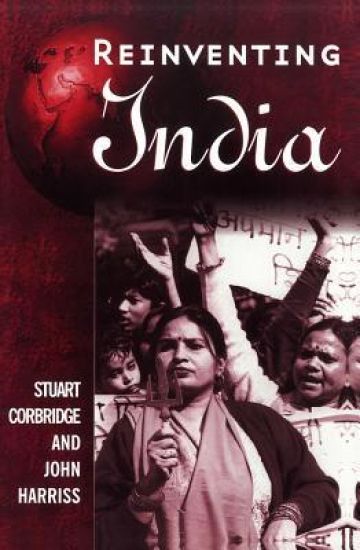
When India was invented as a "modern" country in the years after Independence in 1947 it styled itself as a secular, federal, democratic Republic committed to an ideology of development. Nehru's India never quite fulfilled this promise, but more recently his vision of India has been challenged by two "revolts of the elites": those of economic liberalization and Hindu nationalism. These revolts have been challenged, in turn, by various movements, including those of India's "Backward Classes". These movements have exploited the democratic spaces of India both to challenge for power and to contest prevailing accounts of politics, the state and modernity. Reinventing India offers an analytical account of the history of modern India and of its contemporary reinvention. Part One traces India's transformation under colonial rule, and the ideas and social forces which underlay the deliberations of the Constituent Assembly in 1946 to consider the shaping of the post-colonial state. Part Two then narrates the story of the making and unmaking of this modern India in the period from 1950 to the present day. It pays attention to both economic and political developments, and engages with the interpretations of India's recent history through key writers such as Francine Frankel, Sudipta Kaviraj and Partha Chatterjee. Part Three consists of chapters on the dialectics of economic reform, religion, the politics of Hindu nationalism, and on popular democracy. These chapters articulate a distinct position on the state and society in India at the end of the century, and they allow the authors to engage with the key debates which concern public intellectuals in contemporary India. Reinventing India is a lucid and eminently readable account of the transformations which are shaking India more than fifty years after Independence. It will be welcomed by all students of South Asia, and will be of interest to students of comparative politics and development studies.
This volume examines the history of modern India and its contemporary transformation, providing an account of the changes which are shaking India today at the beginning of the 21st century.