Kirjojen hintavertailu. Mukana 12 390 323 kirjaa ja 12 kauppaa.

Kirjailija

John J. Kirton

Kirjat ja teokset yhdessä paikassa: 15 kirjaa, julkaisuja vuosilta 2004-2024, suosituimpien joukossa China’s G20 Leadership. Vertaile teosten hintoja ja tarkista saatavuus suomalaisista kirjakaupoista.

15 kirjaa

Kirjojen julkaisuhaarukka 2004-2024.

Reconfiguring the Global Governance of Climate Change

Reconfiguring the Global Governance of Climate Change

John J. Kirton; Ella Kokotsis; Brittaney Warren

TAYLOR FRANCIS LTD
2024
nidottu
This book charts the course and causes of UN, G7 and G20 governance of climate change through the crucial period of 2015–2021. It provides a careful, comprehensive and reliable description of the individual and interactive contributions of the G7, G20 and UN summits and analyses their results. The authors explain these contributions and results by considering the impacts of causal candidates, such as a changing physical ecosystem and international political system and the actions of individual leaders of the world’s most systemically significant countries. They apply and improve an established, compact causal model, grounded in international relations theory, to guide these tasks.By developing, prescribing and implementing immediate, realistic actionable policy solutions to cope with the urgent, existential challenge of controlling climate change, this volume will appeal to scholars of international relations, global governance and global environmental governance.
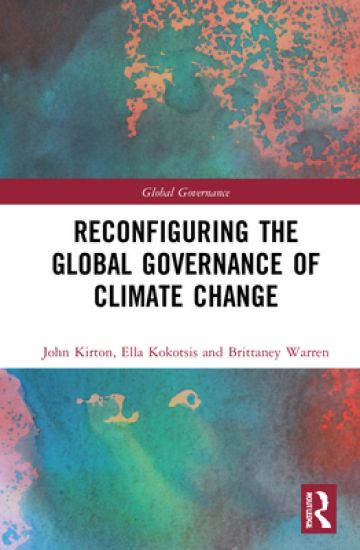
Reconfiguring the Global Governance of Climate Change

Reconfiguring the Global Governance of Climate Change

John J. Kirton; Ella Kokotsis; Brittaney Warren

TAYLOR FRANCIS LTD
2022
sidottu
This book charts the course and causes of UN, G7 and G20 governance of climate change through the crucial period of 2015–2021. It provides a careful, comprehensive and reliable description of the individual and interactive contributions of the G7, G20 and UN summits and analyses their results. The authors explain these contributions and results by considering the impacts of causal candidates, such as a changing physical ecosystem and international political system and the actions of individual leaders of the world’s most systemically significant countries. They apply and improve an established, compact causal model, grounded in international relations theory, to guide these tasks.By developing, prescribing and implementing immediate, realistic actionable policy solutions to cope with the urgent, existential challenge of controlling climate change, this volume will appeal to scholars of international relations, global governance and global environmental governance.
Sustainability, Civil Society and International Governance
How can civil society and global governors come together in new ways to improve links among trade, environmental and social values? In this important and wide-ranging volume, an unparalleled array of contributors examines the many new processes of civil society engagement that have been introduced at the local, regional and global levels. Assessing what more can be done to strengthen the productive partnerships between civil society and global governance, the book draws on the extensive inventory of existing practices and community-based alternatives to demonstrate how particular mechanisms for civil society participation in global governance have enhanced or impeded the specific economic, environmental and political outcomes that many seek to achieve.
Shaping a New International Financial System

Shaping a New International Financial System

Karl Kaiser; John J. Kirton

Routledge
2019
sidottu
This title was first published in 2000: An outstanding volume which examines the professional economic merits, practical feasibility, and underlying politics of the hotly contested competing initiatives for strengthening the international financial system. Challenging much of the conventional wisdom, it offers a comprehensive account of the traditional enduring financial issues facing the G7 and the fundamental architectural elements of the new systemic design. This authoritative text contains a rich and balanced array of contributions from distinguished experts from all G7 countries and from emerging markets outside. Essential reading for academics in the areas of economics and management, to political scientists specializing in international political economy and to officials in the government and the private sector.
Linking Trade, Environment, and Social Cohesion

Linking Trade, Environment, and Social Cohesion

John J. Kirton; Virginia W. Maclaren

Routledge
2019
nidottu
This title was first published in 2002: Focusing on the central issues of the contemporary trade-environment-social cohesion debate, this compelling book analyzes the social and environmental impacts of existing trade liberalization through the World Trade Organization (WTO), North American Free Trade Agreement (NAFTA) and other key regimes. It also explores new strategies for regulation and risk assessment, environmental information, standard setting, voluntary activities, sustainability assessments of trade agreements, and participation by civil society. Features include: -suggests ways in which the NAFTA model might be improved -explores the NAFTA regime with regards to its environmental and social impacts -evaluates the experience and improvement of NAFTA and how it might assist the broader international community Characterized by its meticulous scholarship and fluid style, this authoritative work is an indispensable guide for all those concerned with trade liberalization, environmental enhancement and social cohesion.
China’s G20 Leadership

China’s G20 Leadership

John J. Kirton

Routledge
2019
nidottu
Kirton offers a comprehensive, systematic examination of China’s G20 approach, diplomacy and influence since the G20’s start as a forum for finance ministers and central bankers in 1999. This comprehensive reference tool works its way through China’s elevation to the leaders’ level with summits from 2008-2014, to the prospects for its Antalya Summit in November 2014 and above all China’s first summit as host in Hangzhou in the autumn of 2016. This book contains a full treatment of China’s role in the summits from 2011 to 2014, and China’s plans, role and prospects for the summits in 2015 and 2016. Analytically, it develops and tests at the level of a single member country the systemic hub model of G20 governance that was developed for and guided in Kirton’s 2013 book, G20 Governance for a Globalized World.
Linking Trade, Environment, and Social Cohesion

Linking Trade, Environment, and Social Cohesion

John J. Kirton; Virginia W. Maclaren

Routledge
2017
sidottu
This title was first published in 2002: Focusing on the central issues of the contemporary trade-environment-social cohesion debate, this compelling book analyzes the social and environmental impacts of existing trade liberalization through the World Trade Organization (WTO), North American Free Trade Agreement (NAFTA) and other key regimes. It also explores new strategies for regulation and risk assessment, environmental information, standard setting, voluntary activities, sustainability assessments of trade agreements, and participation by civil society. Features include: -suggests ways in which the NAFTA model might be improved -explores the NAFTA regime with regards to its environmental and social impacts -evaluates the experience and improvement of NAFTA and how it might assist the broader international community Characterized by its meticulous scholarship and fluid style, this authoritative work is an indispensable guide for all those concerned with trade liberalization, environmental enhancement and social cohesion.
Sustainability, Civil Society and International Governance

Sustainability, Civil Society and International Governance

John J. Kirton; Peter Hajnal

CRC Press Inc
2017
sidottu
How can civil society and global governors come together in new ways to improve links among trade, environmental and social values? In this important and wide-ranging volume, an unparalleled array of contributors examines the many new processes of civil society engagement that have been introduced at the local, regional and global levels. Assessing what more can be done to strengthen the productive partnerships between civil society and global governance, the book draws on the extensive inventory of existing practices and community-based alternatives to demonstrate how particular mechanisms for civil society participation in global governance have enhanced or impeded the specific economic, environmental and political outcomes that many seek to achieve.
The Global Governance of Climate Change

The Global Governance of Climate Change

John J. Kirton; Ella Kokotsis

CRC Press Inc
2017
nidottu
Climate change control has risen to the top of the international agenda. Failed efforts, centred in the United Nations, to allocate responsibility have resulted in a challenge now reaching crisis stage. John J. Kirton and Ella Kokotsis analyse the generation and effectiveness of four decades of intergovernmental regimes for controlling global climate change. Informed by international relations theories and critical of the prevailing UN approach, Kirton and Kokotsis trace the global governance of climate change from its 1970s origins to the present and demonstrate the effectiveness of the plurilateral summit alternative grounded in the G7/8 and the G20. Topics covered include: - G7/8 and UN competition and convergence on governing climate change - Kyoto obligations and the post-Kyoto regime - The role of the G7/8 and G20 in generating a regime beyond Kyoto - Projections of and prescriptions for an effective global climate change control regime for the twenty-first century. This topical book synthesizes a rich array of empirical data, including new interview and documentary material about G7/8 and G20 governance of climate change, and makes a valuable contribution to understanding the dynamics of governing climate change. It will appeal to scholars, researchers, and policy makers interested in the dynamics behind governance processes within the intergovernmental realm.
Hard Choices, Soft Law

Hard Choices, Soft Law

John J. Kirton; Michael J. Trebilcock

Routledge
2016
nidottu
An important read for academics and policy-makers alike, Hard Choices, Soft Law asserts that voluntary standards, or 'soft' law, are an important supplement to international law in a number of areas. This key work firstly outlines the approach taken to combining soft and hard law and trade, environment and labour values in the WTO and NAFTA, and in the prospective Millennium Round. Then, using the forestry sector - a realm where formal international law remains largely absent - the book provides a detailed examination of the role of soft law in action. It demonstrates how soft and hard law can be combined to promote trade, environmental and social cohesion, in ways that also permit sustainable development. The book presents a wealth of knowledge from a range of contributors familiar with the work of the G7/G8, the OECD, the Biodiversity Convention and the Codex Alimentarius.
China’s G20 Leadership

China’s G20 Leadership

John J. Kirton

Routledge
2016
sidottu
Kirton offers a comprehensive, systematic examination of China’s G20 approach, diplomacy and influence since the G20’s start as a forum for finance ministers and central bankers in 1999. This comprehensive reference tool works its way through China’s elevation to the leaders’ level with summits from 2008-2014, to the prospects for its Antalya Summit in November 2014 and above all China’s first summit as host in Hangzhou in the autumn of 2016. This book contains a full treatment of China’s role in the summits from 2011 to 2014, and China’s plans, role and prospects for the summits in 2015 and 2016. Analytically, it develops and tests at the level of a single member country the systemic hub model of G20 governance that was developed for and guided in Kirton’s 2013 book, G20 Governance for a Globalized World.
The Global Governance of Climate Change

The Global Governance of Climate Change

John J. Kirton; Ella Kokotsis

Ashgate Publishing Limited
2015
sidottu
Climate change control has risen to the top of the international agenda. Failed efforts, centred in the United Nations, to allocate responsibility have resulted in a challenge now reaching crisis stage. John J. Kirton and Ella Kokotsis analyse the generation and effectiveness of four decades of intergovernmental regimes for controlling global climate change. Informed by international relations theories and critical of the prevailing UN approach, Kirton and Kokotsis trace the global governance of climate change from its 1970s origins to the present and demonstrate the effectiveness of the plurilateral summit alternative grounded in the G7/8 and the G20. Topics covered include: - G7/8 and UN competition and convergence on governing climate change - Kyoto obligations and the post-Kyoto regime - The role of the G7/8 and G20 in generating a regime beyond Kyoto - Projections of and prescriptions for an effective global climate change control regime for the twenty-first century. This topical book synthesizes a rich array of empirical data, including new interview and documentary material about G7/8 and G20 governance of climate change, and makes a valuable contribution to understanding the dynamics of governing climate change. It will appeal to scholars, researchers, and policy makers interested in the dynamics behind governance processes within the intergovernmental realm.
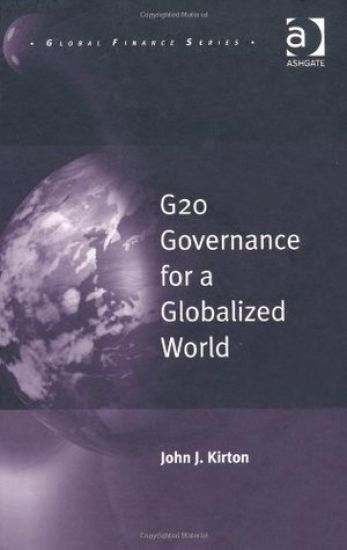
G20 Governance for a Globalized World
This book offers the most thorough, detailed inside story of the preparation, negotiation, performance, and achievements of G20 gatherings from their start at the finance level in 1999 through their rise to become leader-level summits in response to the great global financial crisis in 2008. Follow the moves of America’s George Bush and Barack Obama, Britain’s Gordon Brown and David Cameron, Canada’s Stephen Harper, Germany’s Angela Merkel, and other key leaders as they struggle to contain the worst global recession since the Great Depression of the 1930s. This book provides a full chapter-long account of each of the first four G20 summits from Washington to Toronto with summaries of the ensuing summits. It uses international relations theory to build and apply a model of systemic hub governance to back its central claim to show convincingly that G20 performance has grown to successfully govern an increasingly interconnected, complex, crisis-ridden, globalized twenty-first century world.
G20 Governance for a Globalized World

G20 Governance for a Globalized World

John J. Kirton

Ashgate Publishing Limited
2013
sidottu
This book offers the most thorough, detailed inside story of the preparation, negotiation, performance, and achievements of G20 gatherings from their start at the finance level in 1999 through their rise to become leader-level summits in response to the great global financial crisis in 2008. Follow the moves of America’s George Bush and Barack Obama, Britain’s Gordon Brown and David Cameron, Canada’s Stephen Harper, Germany’s Angela Merkel, and other key leaders as they struggle to contain the worst global recession since the Great Depression of the 1930s. This book provides a full chapter-long account of each of the first four G20 summits from Washington to Toronto with summaries of the ensuing summits. It uses international relations theory to build and apply a model of systemic hub governance to back its central claim to show convincingly that G20 performance has grown to successfully govern an increasingly interconnected, complex, crisis-ridden, globalized twenty-first century world.
Hard Choices, Soft Law

Hard Choices, Soft Law

John J. Kirton; Michael J. Trebilcock

Ashgate Publishing Limited
2004
sidottu
An important read for academics and policy-makers alike, Hard Choices, Soft Law asserts that voluntary standards, or 'soft' law, are an important supplement to international law in a number of areas. This key work firstly outlines the approach taken to combining soft and hard law and trade, environment and labour values in the WTO and NAFTA, and in the prospective Millennium Round. Then, using the forestry sector - a realm where formal international law remains largely absent - the book provides a detailed examination of the role of soft law in action. It demonstrates how soft and hard law can be combined to promote trade, environmental and social cohesion, in ways that also permit sustainable development. The book presents a wealth of knowledge from a range of contributors familiar with the work of the G7/G8, the OECD, the Biodiversity Convention and the Codex Alimentarius.