Kirjojen hintavertailu. Mukana 12 595 353 kirjaa ja 12 kauppaa.

Kirjailija

John Kleinig

Kirjat ja teokset yhdessä paikassa: 23 kirjaa, julkaisuja vuosilta 1973-2024, suosituimpien joukossa Jury Ethics. Vertaile teosten hintoja ja tarkista saatavuus suomalaisista kirjakaupoista.

23 kirjaa

Kirjojen julkaisuhaarukka 1973-2024.

Jury Ethics

Jury Ethics

John Kleinig; James P. Levine; Jeffrey B. Abramson; B. Michael Dann; Shari Seidman Diamond; Norman J. Finkel; Paula Hannaford-Agor; Valerie P. Hans; Julie E. Howe; Nancy J. King

Paradigm
2005
sidottu
Trial by jury is one of the most important aspects of the U.S. legal system. A reflective look at how juries actually function brings out a number of ethical questions surrounding juror conduct and jury dynamics: Do citizens have a duty to serve as jurors? Might they seek exemptions? Is it acceptable for jurors to engage in after-hours research? Might a juror legitimately seek to "nullify" the outcome to express disapproval of the law? Under what conditions might jurors make a valid choice to hold out against or capitulate to their fellow jurors? Is it acceptable to form alliances? After trial, are there problems with entering into publishing contracts? Unfortunately, questions such as these have received scant attention from scholars. This book revives attention to these and other issues of jury ethics by collecting new and insightful essays along with responses from leading scholars in the field of jury studies. Is it acceptable for jurors to engage in after-hours research? Might a juror legitimately seek to "nullify" the outcome to express disapproval of the law? After trial, are there problems with entering into publishing contracts? Unfortunately, questions such as these have received scant attention from scholars. This book revives attention to these and other issues of jury ethics by collecting new and insightful essays along with responses from leading scholars in the field of jury studies. Contributors: Jeffrey Abramson, B. Michael Dann, Shari Seidman Diamond, Norman J. Finkel, Paula Hannaford-Agor, Valerie P. Hans, Julie E. Howe, Nancy J. King, John Kleinig, James P. Levine, Candace McCoy, G. Thomas Munsterman, Maureen O'Connor, Steven Penrod, Alan W. Scheflin, Neil Vidmar
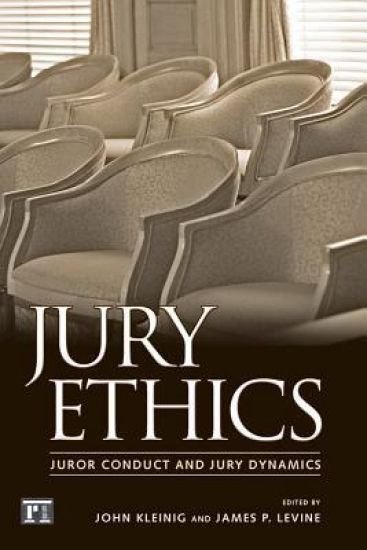
Jury Ethics

Jury Ethics

John Kleinig; James P. Levine; Jeffrey B. Abramson; B. Michael Dann; Shari Seidman Diamond; Norman J. Finkel; Paula Hannaford-Agor; Valerie P. Hans; Julie E. Howe; Nancy J. King

Paradigm
2007
nidottu
Trial by jury is one of the most important aspects of the U.S. legal system. A reflective look at how juries actually function brings out a number of ethical questions surrounding juror conduct and jury dynamics: Do citizens have a duty to serve as jurors? Might they seek exemptions? Is it acceptable for jurors to engage in after-hours research? Might a juror legitimately seek to "nullify" the outcome to express disapproval of the law? Under what conditions might jurors make a valid choice to hold out against or capitulate to their fellow jurors? Is it acceptable to form alliances? After trial, are there problems with entering into publishing contracts? Unfortunately, questions such as these have received scant attention from scholars. This book revives attention to these and other issues of jury ethics by collecting new and insightful essays along with responses from leading scholars in the field of jury studies. Is it acceptable for jurors to engage in after-hours research? Might a juror legitimately seek to "nullify" the outcome to express disapproval of the law? After trial, are there problems with entering into publishing contracts? Unfortunately, questions such as these have received scant attention from scholars. This book revives attention to these and other issues of jury ethics by collecting new and insightful essays along with responses from leading scholars in the field of jury studies. Contributors: Jeffrey Abramson, B. Michael Dann, Shari Seidman Diamond, Norman J. Finkel, Paula Hannaford-Agor, Valerie P. Hans, Julie E. Howe, Nancy J. King, John Kleinig, James P. Levine, Candace McCoy, G. Thomas Munsterman, Maureen O'Connor, Steven Penrod, Alan W. Scheflin, Neil Vidmar
Ethical Issues in Psychosurgery

Ethical Issues in Psychosurgery

John Kleinig

TAYLOR FRANCIS LTD
2024
nidottu
First published in 1985, Ethical Issues in Psychosurgery examines the continuing debate surrounding the treatment of psychiatric disorder by psychosurgery and its ethical implications. Psychosurgery represents a radical treatment and it therefore raises, in a particularly acute and challenging fashion, questions which are implicit In most therapy. The book offers a focussed study in bioethics, a model for bioethical inquiry, as well as introduction to some of the major problems in bioethics. These range from detailed discussions of informed consent, the sanctity of the brain, and the use of experimental therapies, to wider questions of social contract and professionalization. John Kleinig’s balanced and informed treatment of the questions will make this book invaluable not only to those concerned with the philosophy of legal and medical ethics, but also to those in the fields of psychiatric practice and research.
Ethical Issues in Psychosurgery

Ethical Issues in Psychosurgery

John Kleinig

TAYLOR FRANCIS LTD
2022
sidottu
First published in 1985, Ethical Issues in Psychosurgery examines the continuing debate surrounding the treatment of psychiatric disorder by psychosurgery and its ethical implications. Psychosurgery represents a radical treatment and it therefore raises, in a particularly acute and challenging fashion, questions which are implicit In most therapy. The book offers a focussed study in bioethics, a model for bioethical inquiry, as well as introduction to some of the major problems in bioethics. These range from detailed discussions of informed consent, the sanctity of the brain, and the use of experimental therapies, to wider questions of social contract and professionalization. John Kleinig’s balanced and informed treatment of the questions will make this book invaluable not only to those concerned with the philosophy of legal and medical ethics, but also to those in the fields of psychiatric practice and research.
Ends and Means in Policing

Ends and Means in Policing

John Kleinig

Routledge
2021
nidottu
Policing is a highly pragmatic occupation. It is designed to achieve the important social ends of peacekeeping and public safety, and is empowered to do so using means that are ordinarily seen as problematic; that is, the use of force, deception, and invasions of privacy, along with considerable discretion. It is often suggested that the ends of policing justify the use of otherwise problematic means, but do they?This book explores this question from a philosophical perspective. The relationship between ends and means has a long and contested history both in moral/practical reasoning and public policy. Looking at this history through the lens of policing, criminal justice philosopher John Kleinig explores the dialectic of ends and means (whether the ends justify the means, or whether the ends never justify the means) and offers a new, sharpened perspective on police ethics.After tracing the various ways in which ends and means may be construed, the book surveys a series of increasingly concrete issues, focusing especially on those that arise in policing contexts. The competing moral demands made by ends and means culminate in considerations of noble cause corruption, dirty hands theory, lesser degradations (such as tear gas, tasers, chokeholds, and so on), and finally, those means deemed impermissible by the majority in Western culture, such as torture.
Ends and Means in Policing

Ends and Means in Policing

John Kleinig

Routledge
2019
sidottu
Policing is a highly pragmatic occupation. It is designed to achieve the important social ends of peacekeeping and public safety, and is empowered to do so using means that are ordinarily seen as problematic; that is, the use of force, deception, and invasions of privacy, along with considerable discretion. It is often suggested that the ends of policing justify the use of otherwise problematic means, but do they?This book explores this question from a philosophical perspective. The relationship between ends and means has a long and contested history both in moral/practical reasoning and public policy. Looking at this history through the lens of policing, criminal justice philosopher John Kleinig explores the dialectic of ends and means (whether the ends justify the means, or whether the ends never justify the means) and offers a new, sharpened perspective on police ethics.After tracing the various ways in which ends and means may be construed, the book surveys a series of increasingly concrete issues, focusing especially on those that arise in policing contexts. The competing moral demands made by ends and means culminate in considerations of noble cause corruption, dirty hands theory, lesser degradations (such as tear gas, tasers, chokeholds, and so on), and finally, those means deemed impermissible by the majority in Western culture, such as torture.
Philosophical Issues in Education
The philosophy of education is an important component of most education courses. The subject is often split into two traditions, one emphasising the use of analytic philosophy, the other engaging in radical social criticism. This book, first published in 1982, brings together the strengths of both traditions and takes stock of the debate. This study provides an interesting introduction to all the major philosophical issues in education which is different to many other works on the subject.
Philosophical Issues in Education
The philosophy of education is an important component of most education courses. The subject is often split into two traditions, one emphasising the use of analytic philosophy, the other engaging in radical social criticism. This book, first published in 1982, brings together the strengths of both traditions and takes stock of the debate. This study provides an interesting introduction to all the major philosophical issues in education which is different to many other works on the subject.
Valuing Life

Valuing Life

John Kleinig

Princeton University Press
2016
sidottu
Abortion, euthanasia, capital punishment, war, genetic engineering and fetal experimentation, environmental and animal rights--these topics inspire some of today's most heated public controversies. And it is fashionable to pursue these debates in terms of the negative query "Under what conditions may life be disregarded or terminated?" John Kleinig asks a different, more positive question: What may be said in behalf of life? Looking at the full range of appeals to life's value, he considers a variety of issues. Is livingness as such to be affirmed and respected? Is there an ascending order of plant, animal, and human life? Does human life possess a distinctive claim, or must we discriminate between humans that do and humans that do not have claims on us? Kleinig shows that assertions about valuing life camouflage a complex normative vocabulary about worth, reverence, sanctity, dignity, respect, and rights. And "life," too, is subject to an assortment of understandings. Sensitive to the frameworks informing diverse appeals to life's value, this comprehensive work will interest readers concerned with the environment, animal rights, or bioethics. Originally published in 1991. The Princeton Legacy Library uses the latest print-on-demand technology to again make available previously out-of-print books from the distinguished backlist of Princeton University Press. These editions preserve the original texts of these important books while presenting them in durable paperback and hardcover editions. The goal of the Princeton Legacy Library is to vastly increase access to the rich scholarly heritage found in the thousands of books published by Princeton University Press since its founding in 1905.
The Ethics of Patriotism

The Ethics of Patriotism

John Kleinig; Simon Keller; Igor Primoratz

John Wiley Sons Inc
2015
nidottu
The unique approach taken within The Ethics of Patriotism brings together the differing perspectives of three leading figures in the philosophical debate who deliver an up-to-date, accessible, and vigorous presentation of the major views and arguments. Brings together the differing perspectives of three leading philosophers, who, together, explore the major positions on the ethics of patriotismConnects with several burgeoning fields of interest in philosophy and politics, including nationalism, civic virtue, liberalism and republicanism, loyalty, and cosmopolitanismDemonstrates that it is possible to make progress on the question of the ethics of patriotism while taking an ecumenical approach to larger theoretical questionsA timely and relevant response to the upsurge of interest in nationalism, patriotism, and secessions
Valuing Life

Valuing Life

John Kleinig

Princeton University Press
2014
pokkari
Abortion, euthanasia, capital punishment, war, genetic engineering and fetal experimentation, environmental and animal rights--these topics inspire some of today's most heated public controversies. And it is fashionable to pursue these debates in terms of the negative query "Under what conditions may life be disregarded or terminated?" John Kleinig asks a different, more positive question: What may be said in behalf of life? Looking at the full range of appeals to life's value, he considers a variety of issues. Is livingness as such to be affirmed and respected? Is there an ascending order of plant, animal, and human life? Does human life possess a distinctive claim, or must we discriminate between humans that do and humans that do not have claims on us? Kleinig shows that assertions about valuing life camouflage a complex normative vocabulary about worth, reverence, sanctity, dignity, respect, and rights. And "life," too, is subject to an assortment of understandings. Sensitive to the frameworks informing diverse appeals to life's value, this comprehensive work will interest readers concerned with the environment, animal rights, or bioethics. Originally published in 1991. The Princeton Legacy Library uses the latest print-on-demand technology to again make available previously out-of-print books from the distinguished backlist of Princeton University Press. These editions preserve the original texts of these important books while presenting them in durable paperback and hardcover editions. The goal of the Princeton Legacy Library is to vastly increase access to the rich scholarly heritage found in the thousands of books published by Princeton University Press since its founding in 1905.
Prisoners' Rights

Prisoners' Rights

John Kleinig

Routledge
2014
sidottu
This volume brings together a selection of the most important published research articles from the ongoing debate about the moral rights of prisoners. The articles consider the moral underpinnings of the debate and include framework discussions for a theory of prisoners’ rights as well as several international documents which detail the rights of prisoners, including women prisoners. Finally, detailed analysis of the moral bases for particular rights relating to prison conditions covers areas such as: health, solitary confinement, recreation, work, religious observance, library access, the use of prisoners in research and the disenfranchisement of prisoners.
On Loyalty and Loyalties

On Loyalty and Loyalties

John Kleinig

Oxford University Press Inc
2014
nidottu
Deep friendship may express profound loyalty, but so too may virulent nationalism. What can and should we say about this Janus-faced virtue of the will? This volume explores at length the contours of an important and troubling virtue -- its cognates, contrasts, and perversions; its strengths and weaknesses; its awkward relations with universal morality; its oppositional form and limits; as well as the ways in which it functions in various associative connections, such as friendship and familial relations, organizations and professions, nations, countries, and religious tradition.
On Loyalty and Loyalties

On Loyalty and Loyalties

John Kleinig

Oxford University Press Inc
2014
sidottu
Deep friendship may express profound loyalty, but so too may virulent nationalism. What can and should we say about this Janus-faced virtue of the will? This volume explores at length the contours of an important and troubling virtue -- its cognates, contrasts, and perversions; its strengths and weaknesses; its awkward relations with universal morality; its oppositional form and limits; as well as the ways in which it functions in various associative connections, such as friendship and familial relations, organizations and professions, nations, countries, and religious tradition.
Ethics and Criminal Justice

Ethics and Criminal Justice

John Kleinig

Cambridge University Press
2008
pokkari
This textbook looks at the main ethical questions that confront the criminal justice system - legislature, law enforcement, courts, and corrections - and those who work within that system, especially police officers, prosecutors, defence lawyers, judges, juries, and prison officers. John Kleinig sets the issues in the context of a liberal democratic society and its ethical and legislative underpinnings, and illustrates them with a wide and international range of real-life case studies. Topics covered include discretion, capital punishment, terrorism, restorative justice, and re-entry. Kleinig's discussion is both philosophically acute and grounded in institutional realities, and will enable students to engage productively with the ethical questions which they encounter both now and in the future - whether as criminal justice professionals or as reflective citizens.
Ethics and Criminal Justice

Ethics and Criminal Justice

John Kleinig

Cambridge University Press
2008
sidottu
This textbook looks at the main ethical questions that confront the criminal justice system - legislature, law enforcement, courts, and corrections - and those who work within that system, especially police officers, prosecutors, defence lawyers, judges, juries, and prison officers. John Kleinig sets the issues in the context of a liberal democratic society and its ethical and legislative underpinnings, and illustrates them with a wide and international range of real-life case studies. Topics covered include discretion, capital punishment, terrorism, restorative justice, and re-entry. Kleinig's discussion is both philosophically acute and grounded in institutional realities, and will enable students to engage productively with the ethical questions which they encounter both now and in the future - whether as criminal justice professionals or as reflective citizens.
The Ethics of Policing

The Ethics of Policing

John Kleinig

Cambridge University Press
1996
pokkari
This book is the most systematic, comprehensive and philosophically sophisticated discussion of police ethics yet published. It offers an in-depth analysis of the ethical values that police, as servants of the community, should uphold as they go about their task. The book considers the foundations and purpose of police authority in broad terms but also tackles specific problems such as accountability, the use of force, deceptive stratagems used to gain information or trap the criminally intentioned, corruption, and the tension between personal values and communal concerns. Offering the fullest, most rigorous and up-to-date treatment of police ethics currently available, this book will be a perfect textbook in courses on applied ethics in philosophy departments or police and criminal justice ethics in departments of criminology and law schools.