Kirjojen hintavertailu. Mukana 12 221 150 kirjaa ja 12 kauppaa.

Kirjailija

John L. Jackson

Kirjat ja teokset yhdessä paikassa: 3 kirjaa, julkaisuja vuosilta 2005-2017, suosituimpien joukossa Racial Americana. Vertaile teosten hintoja ja tarkista saatavuus suomalaisista kirjakaupoista.

3 kirjaa

Kirjojen julkaisuhaarukka 2005-2017.

Impolite Conversations: On Race, Politics, Sex, Money, and Religion
When was the last time you said everything on your mind without holding back? In this no-holds-barred discussion of America's top hot-button issues, a journalist and a cultural anthropologist express opinions that are widely held in private--but rarely heard in public.Everyone edits what they say. It's a part of growing up. But what if we applied tell-it-like-it-is honesty to grown-up issues? In Impolite Conversations, two respected thinkers and writers openly discuss five "third-rail" topics--from multi-racial identities to celebrity worship to hyper-masculinity among black boys--and open the stage for honest discussions about important and timely concerns. Organized around five subjects--Race, Politics, Sex, Money, Religion--the dialogue between Cora Daniels and John L. Jackson Jr. may surprise, provoke, affirm, or challenge you. In alternating essays, the writers use reporting, interviews, facts, and figures to back up their arguments, always staying firmly rooted in the real world. Sometimes they agree, sometimes they don't, but they always reach their conclusions with respect for the different backgrounds they come from and the reasons they disagree. Whether you oppose or sympathize with these two impassioned voices, you'll end up knowing more than you did before and appreciating the candid, savvy, and often humorous ways in which they each take a stand.

Thin Description

Thin Description

John L. Jackson

Harvard University Press
2013
sidottu
The African Hebrew Israelites of Jerusalem are often dismissed as a fringe cult for their beliefs that African Americans are descendants of the ancient Israelites and that veganism leads to immortality. But John L. Jackson questions what “fringe” means in a world where cultural practices of every stripe circulate freely on the Internet. In this poignant and sophisticated examination of the limits of ethnography, the reader is invited into the visionary, sometimes vexing world of the AHIJ. Jackson challenges what Clifford Geertz called the “thick description” of anthropological research through a multidisciplinary investigation of how the AHIJ use media and technology to define their public image in the twenty-first century.Moving far beyond the “modest witness” of nineteenth-century scientific discourse or the “thick descriptions” of twentieth-century anthropology, Jackson insists that Geertzian thickness is an impossibility, especially in a world where the anthropologist’s subject is a self-aware subject—one who crafts his own autoethnography while critically consuming the ethnographer’s offerings. Thin Description takes as its topic a group situated along the fault lines of several diasporas—African, American, Jewish—and provides an anthropological account of how race, religion, and ethnographic representation must be understood anew in the twenty-first century lest we reenact old mistakes in the study of black humanity.
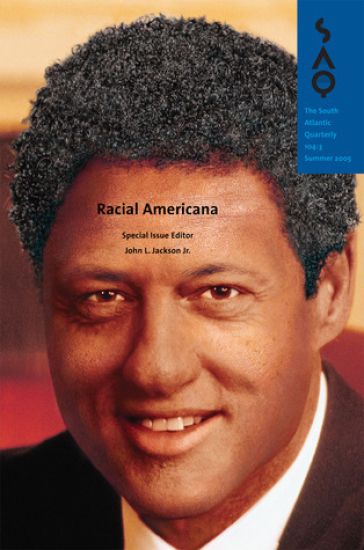
Racial Americana

Racial Americana

John L. Jackson

Duke University Press
2005
pokkari
If sociologist and cultural critic W. E. B. Du Bois proved prophetic about the twentieth century and its color lines, the beginning of the twenty-first century has given rise to divergent pronouncements about the potential of race relations and racial discourse in American society. Older categories of black victims and white victimizers hardly seem up to the task of making social sense out of today’s complex racial issues. Racial Americana explores new modes of racial theorizing that provide a more nuanced framework for understanding the social facts that underpin race (as belief system, as common sense, and as biological mythmaking), examining what those underpinnings forewarn about the future of social difference in the United States.Imagining America’s racialist future, the diverse contributors to this special issue-anthropologists, sociologists, historians, poets, and literary critics-offer their conceptualizations of race today, discuss how racial ideology has changed through the years, and explain its continuing ability to morph according to geopolitical, cultural, and economic strictures. Essays focus on how notions of race have helped constitute varied definitions of Americanness in the past and the present; offer critiques and recuperations of antiessentialist efforts; excavate the affective links between racism and patriotism after September 11; examine how race and gender intersect in the lives of African American jazz musicians; and determine what Du Bois's earlier arguments say about contemporary representations of “Latinidad.” Contributors. Elizabeth Alexander, Amiri Baraka, Tess Chakkalakal, Theodore A. Harris, John Hartigan Jr., Sharon P. Holland, John L. Jackson Jr., Marcyliena Morgan, Vijay Prashad, Don Robotham, Nichole T. Rustin, Brackette F. Williams