Kirjojen hintavertailu. Mukana 12 152 606 kirjaa ja 12 kauppaa.
Kirjailija
John L. Volakis
Kirjat ja teokset yhdessä paikassa: 4 kirjaa, julkaisuja vuosilta 1998-2012, suosituimpien joukossa Polymer-Ceramic Composites for Conformal Multilayer Antenna/RF Systems. Vertaile teosten hintoja ja tarkista saatavuus suomalaisista kirjakaupoista.
Mukana myös kirjoitusasut: John L Volakis, John. L Volakis
Electrical Engineering Finite Element Method for Electromagnetics Antennas, Microwave Circuits, and Scattering Applications A volume in the IEEE/OUP Series on Electromagnetic Wave Theory Donald G. Dudley, Series Editor Employed in a large number of commercial electromagnetic simulation packages, the finite element method is one of the most popular and well-established numerical techniques in engineering. This book covers the theory, development, implementation, and application of the finite element method and its hybrid versions to electromagnetics. Finite Element Method for Electromagnetics begins with a step-by-step presentation of the finite element method and its variations, and then provides up-to-date coverage of three-dimensional formulations and modern applications to open- and closed-domain problems. Topics covered include:*Galerkins and Ritz methods*One- and two-dimensional theory and applications*Three-dimensional development of the method using edge elements and applications*Mesh truncation schemes*Matlab sample codes*Efficient implementation of the finite element method, sparse matrix storage schemes, popular iterative solvers, eigenvalue solutions*Experiences on code porting to parallel computersIntegral algorithms for fast implementation of the boundary integral matrix-vector products. Written by experts who have extensive experience in both teaching and implementing this method to many applications, Finite Element Method for Electromagnetics a can be used as a textbook for first-year graduate students, as well as a handy reference for engineers and scientists interested in computational electromagnetics. About the IEEE/OUP Series on Electromagnetic Wave Theory Formerly the IEEE Press Series on Electromagnetic Waves, this joint series between IEEE Press and Oxford University Press offers outstanding coverage of the field, with new titles as well as reprintings and revisions of recognized classics that maintain long-term archival significance in electromagnetic waves and applications. Designed specifically for graduate students, practicing engineers, and researchers, this series provides affordable volumes that explore electromagnetic waves and applications beyond the undergraduate level.
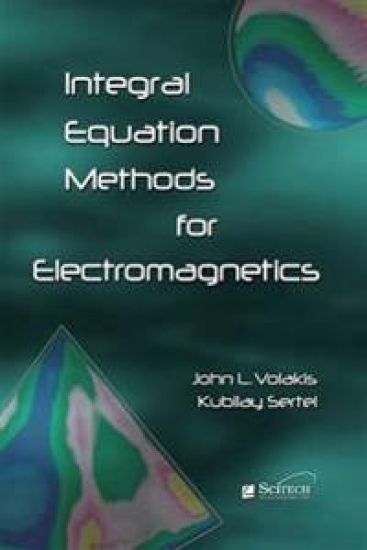
This text/reference is a detailed look at the development and use of integral equation methods for electromagnetic analysis, specifically for antennas and radar scattering. Developers and practitioners will appreciate the broad-based approach to understanding and utilizing integral equation methods and the unique coverage of historical developments that led to the current state-of-the-art. In contrast to existing books, Integral Equation Methods for Electromagnetics lays the groundwork in the initial chapters so students and basic users can solve simple problems and work their way up to the most advanced and current solutions. This is the first book to discuss the solution of two-dimensional integral equations in many forms of their application and utility. As 2D problems are simpler to discuss, the student and basic reader can gain the necessary expertise before diving into 3D applications. This is also the first basic text to cover fast integral methods for metallic, impedance, and material geometries. It will provide the student or advanced reader with a fairly complete and up-to-date coverage of integral methods for composite scatterers.
This book provides a brief overview of the popular Finite Element Method (FEM) and its hybrid versions for electromagnetics with applications to radar scattering, antennas and arrays, guided structures, microwave components, frequency selective surfaces, periodic media, and RF materials characterizations and related topics. It starts by presenting concepts based on Hilbert and Sobolev spaces as well as Curl and Divergence spaces for generating matrices, useful in all engineering simulation methods. It then proceeds to present applications of the finite element and finite element-boundary integral methods for scattering and radiation. Applications to periodic media, metamaterials and bandgap structures are also included. The hybrid volume integral equation method for high contrast dielectrics and is presented for the first time. Another unique feature of the book is the inclusion of design optimization techniques and their integration within commercial numerical analysis packages for shape and material design. To aid the reader with the method's utility, an entire chapter is devoted to two-dimensional problems. The book can be considered as an update on the latest developments since the publication of our earlier book (Finite Element Method for Electromagnetics, IEEE Press, 1998). The latter is certainly complementary companion to this one.