

Kirjailija
John Laird
Kirjat ja teokset yhdessä paikassa: 30 kirjaa, julkaisuja vuosilta 1986-2026, suosituimpien joukossa A Study in Moral Theory. Vertaile teosten hintoja ja tarkista saatavuus suomalaisista kirjakaupoista.
30 kirjaa
Kirjojen julkaisuhaarukka 1986-2026.

In the author’s opinion there are three primary conceptions of human freedom - non-coercion, autonomy and indeterminism. He presents his thoughts to define, compare, distinguish and correlate these, not merely with regard to the freedom of the human will, but also and more generally with regard to freedom in human life and thought. The discussion is psychological, ethical and theological. Originally published in 1947.
Complementary to Theism and Cosmology, this book begins with a discussion of philosophical and theological idea-ism, and our common beliefs concerning nature, man, and God. It is principally concerned with idealism - the place of ideals in reality rather than with the place of ideas. It discusses personality, justice, value, morals and theism versus pantheism then ends with a discussion of the general relations between a cosmological theism and a theism whose primary interest is the conservation and the incarnation of what is good and fine.

Theism is one of the major types of metaphysics and cosmology is the general theory of the whole wide world. Must the world have an over-worldly source, or any source? Would "space" crumble unless God perpetually sustained it by his brooding omnipresence? Is all power, properly understood, divine power? These large questions, never out of date, are examined by Professor Laird in the light of contemporary philosophy. This seminal work, originally published in 1940 is a lucid and profound discussion in theological philosophy.
Universal Subgoaling and Chunking
John Laird; Paul Rosenbloom; Allen Newell
Springer-Verlag New York Inc.
2012
nidottu
Rarely do research paths diverge and converge as neatly and productively as the paths exemplified by the two efforts contained in this book. The story behind these researches is worth recounting. The story, as far as I'm concerned, starts back in the Fall of1976, when John Laird and Paul Rosenbloom, as new graduate students in computer science at Carnegie-Mellon University, joined the Instructible Production System (IPS) project (Rychener, Forgy, Langley, McDermott, Newell, Ramakrishna, 1977; Rychener & Newell, 1978). In those days, production systems were either small or special or both (Newell, 1973; Shortliffe, 1976). Mike Rychener had just completed his thesis (Rychener, 1976), showing how production systems could effectively and perspicuously program the full array of artificial intelligence (AI) systems, by creating versions of Studellt (done in an earlier study, Rychener 1975), EPAM, GPS, King-Pawn-King endgames, a toy-blocks problem solver, and a natural-language input system that connected to the blocks-world system.


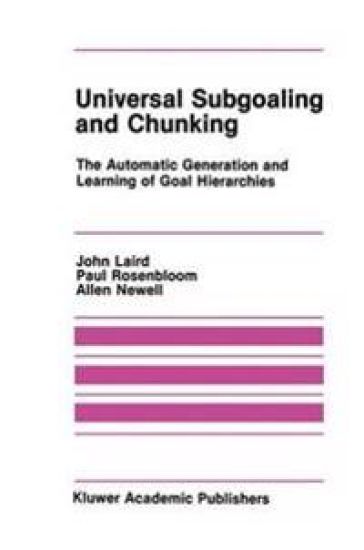
Universal Subgoaling and Chunking
John Laird; Paul Rosenbloom; Allen Newell
Kluwer Academic Publishers
1986
sidottu
Rarely do research paths diverge and converge as neatly and productively as the paths exemplified by the two efforts contained in this book. The story behind these researches is worth recounting. The story, as far as I'm concerned, starts back in the Fall of1976, when John Laird and Paul Rosenbloom, as new graduate students in computer science at Carnegie-Mellon University, joined the Instructible Production System (IPS) project (Rychener, Forgy, Langley, McDermott, Newell, Ramakrishna, 1977; Rychener & Newell, 1978). In those days, production systems were either small or special or both (Newell, 1973; Shortliffe, 1976). Mike Rychener had just completed his thesis (Rychener, 1976), showing how production systems could effectively and perspicuously program the full array of artificial intelligence (AI) systems, by creating versions of Studellt (done in an earlier study, Rychener 1975), EPAM, GPS, King-Pawn-King endgames, a toy-blocks problem solver, and a natural-language input system that connected to the blocks-world system.