Kirjojen hintavertailu. Mukana 12 123 316 kirjaa ja 12 kauppaa.

Kirjailija

John Lofland

Kirjat ja teokset yhdessä paikassa: 15 kirjaa, julkaisuja vuosilta 1985-2025, suosituimpien joukossa Davis: Transformation. Vertaile teosten hintoja ja tarkista saatavuus suomalaisista kirjakaupoista.

15 kirjaa

Kirjojen julkaisuhaarukka 1985-2025.

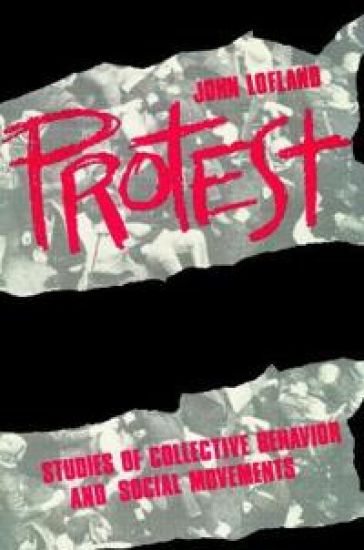
Protest

Protest

John Lofland

Routledge
2017
sidottu
This volume addresses three major issues: What are the circumstances in which people elect to protest; what are the forms of such action; and how do people organize to do so? Phrased differently, what are the contexts of protest (collective behavior), personal readiness for protest (conversion), and finally joining together for protest in movement organizations and movement strategies.The key to the book's value is its theoretical sophistication. These studies address in a systematic way fundamental alternatives to organizing protests and outline in detail options for structuring units of social movement. The author deals especially with movement organization locals, including "corps" and "cells." Such units are examined in terms of how they coexist and how they exist sequentially through time. Several case studies of movement organization are included, such as the Unification Church and Mankind United.The work places a heavy emphasis on protest action or strategy. In the final section four chapters examine the entire gamut of strategic possibilities, ranging from polite politics to violent action. Protest is a distinctive and complex strategy. The work carefully evaluates varieties of protest that have become significant in the 1980s. In each section of the book Lofland draws out underlying themes and issues that interrelate the studies and places protest in the larger context of political and social change and theories to date.
Davis: Transformation

Davis: Transformation

John Lofland

Arcadia Publishing (SC)
2016
nidottu
Davis has undergone a major transformation from the mid-20th century to today, growing from a small college town of about 3,000 residents and 1,500 students to a world-class university city of 80,000 area residents and 35,000 students. Major features of this revolution include the creation of a vibrant downtown, environmentally sensitive politics, diverse and innovative neighborhoods, and a citywide system of bike lanes. A thriving University of California at Davis campus was the economic dynamo that attracted talented students and faculty. Their environmentalist values spurred innovations in solar energy, waste recycling, bicycle infrastructure, subsidized public transit, energy-saving construction, and farm-to-fork localization of food supplies, among other new civic directions that remain an essential part of the city's culture today.
Davis: Transformation

Davis: Transformation

John Lofland

Arcadia Publishing Library Editions
2016
sidottu
Davis has undergone a major transformation from the mid-20th century to today, growing from a small college town of about 3,000 residents and 1,500 students to a world-class university city of 80,000 area residents and 35,000 students. Major features of this revolution include the creation of a vibrant downtown, environmentally sensitive politics, diverse and innovative neighborhoods, and a citywide system of bike lanes. A thriving University of California at Davis campus was the economic dynamo that attracted talented students and faculty. Their environmentalist values spurred innovations in solar energy, waste recycling, bicycle infrastructure, subsidized public transit, energy-saving construction, and farm-to-fork localization of food supplies, among other new civic directions that remain an essential part of the city s culture today."
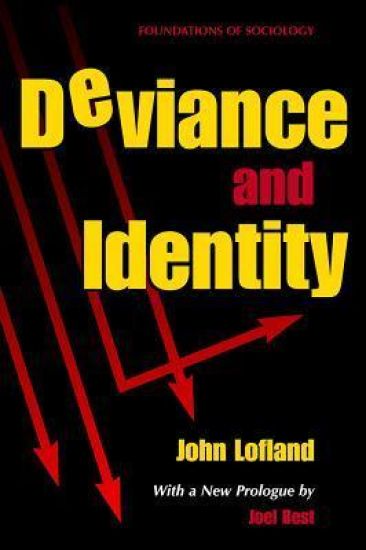
Deviance and Identity

Deviance and Identity

John Lofland

Eliot Werner Publications Inc
2002
nidottu
The sociology of deviance was in its heyday when Prentice-Hall published this book in 1969. John Lofland traces the field from pre-World War II to the late sixties and pioneers the application of 'grounded theory' to the study of deviant behavior. In his new prologue, Joel Best writes, 'More than thirty years after the book first appeared, we have no better synthesis of the labeling approach.' From the Prologue to the Percheron Press Edition: 'In 1969 John Lofland sought to organize the sociology of deviance. He presented a synthesis, a framework, and invited sociologists to evaluate it. That invitation still stands and it deserves to be accepted.'
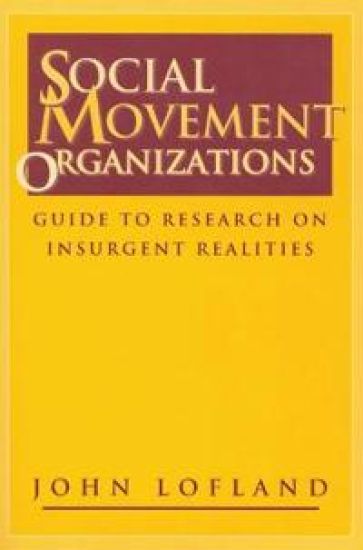
Social Movement Organizations

Social Movement Organizations

John Lofland

AldineTransaction
1996
sidottu
The authorative and richly detailed handbook is divided into three parts: (1) procedures for studying SMOs; (2) propositions or generalizations about them; and (3) perspectives or wider considerations relating to them. Included are discussions of such basic questions as: What causes SMOs and why do people join them? What are the beliefs and practices of SMOs? What effect do SMOs have, and what are the social reactions to them?
Social Movement Organizations

Social Movement Organizations

John Lofland

AldineTransaction
1996
nidottu
The authorative and richly detailed handbook is divided into three parts: (1) procedures for studying SMOs; (2) propositions or generalizations about them; and (3) perspectives or wider considerations relating to them. Included are discussions of such basic questions as: What causes SMOs and why do people join them? What are the beliefs and practices of SMOs? What effect do SMOs have, and what are the social reactions to them?
Psychiatry in Transition

Psychiatry in Transition

John Lofland

Transaction Publishers
1994
nidottu
When the first edition of Psychiatry in Transition came out, Dr. Gene Usdin wrote that "to read Marmor's papers is to read not only psychiatric history, but also where that history will be in the next decade." That next decade has happened, and Marmor's papers remain a beacon of professional endeavor. This second edition includes a final chapter on "Short-Term Dynamic Psychotherapy," in which the historical background of brief psychotherapy, focusing on the contributions of Freud, Ferenczi, Rand, and Alexander, is examined and synthesized.Throughout, certain basic themes stand out. First is the necessity for building upon a solid foundation of scientific thought, coupled with a readiness to change theories that do not fit with established facts. Second, Marmor offers a systems theory to replace simplistic, unitary, or linear theories. Third, he presents some common denominators for illuminating the divergent views that characterize contemporary psychiatric theory and practice. The whole is linked by a deep concern with betterment of the human predicament.Marmor demonstrates that causation in psychiatry can be optimally understood in terms of multiple interacting variables rather than as a response to unitary factors. He foreshadows and predicts developments that are now current in contemporary psychiatric practice, such as the relationship between neurochemistry and behavior, and group therapy with dynamic psychotherapy. He also deals with the importance of cultural and socioeconomic factors in individual personality development. The work concludes with a series of chapters on interethnic hostility, nationalism, and urban violence.Marmor's work clarifies the nature of the psychoanalytic process by liberating it from obscurantism and jargon. This book points the way toward unraveling some of the cognitive dissonance in this area. As Leon Eisenberg observed, this is "an admirable vade mecum of dynamic psychiatry both for residents in training and clinicians in practice."
Polite Protesters

Polite Protesters

John Lofland

Syracuse University Press
1993
sidottu
This work shows how the Peace Movement in the USA in the 1980s was composed of small, scattered and meanly-funded organisations. It describes how these activists combatted the US government's military build-up by using tactics normally associated with ""polite"" interest groups.
Protest

Protest

John Lofland

Transaction Publishers
1985
nidottu
This volume addresses three major issues: What are the circumstances in which people elect to protest; what are the forms of such action; and how do people organize to do so? Phrased differently, what are the contexts of protest (collective behavior), personal readiness for protest (conversion), and finally joining together for protest in movement organizations and movement strategies.The key to the book's value is its theoretical sophistication. These studies address in a systematic way fundamental alternatives to organizing protests and outline in detail options for structuring units of social movement. The author deals especially with movement organization locals, including "corps" and "cells." Such units are examined in terms of how they coexist and how they exist sequentially through time. Several case studies of movement organization are included, such as the Unification Church and Mankind United.The work places a heavy emphasis on protest action or strategy. In the final section four chapters examine the entire gamut of strategic possibilities, ranging from polite politics to violent action. Protest is a distinctive and complex strategy. The work carefully evaluates varieties of protest that have become significant in the 1980s. In each section of the book Lofland draws out underlying themes and issues that interrelate the studies and places protest in the larger context of political and social change and theories to date.