Kirjojen hintavertailu. Mukana 12 595 353 kirjaa ja 12 kauppaa.

Kirjailija

John Lukacs

Kirjat ja teokset yhdessä paikassa: 21 kirjaa, julkaisuja vuosilta 1994-2025, suosituimpien joukossa The Duel: The Eighty-Day Struggle Between Churchill and Hitler. Vertaile teosten hintoja ja tarkista saatavuus suomalaisista kirjakaupoista.

21 kirjaa

Kirjojen julkaisuhaarukka 1994-2025.

The Last European War

The Last European War

John Lukacs

TAYLOR FRANCIS LTD
2025
sidottu
In this book, originally published in 1977, John Lukacs argues that the years 1939–41 were the decisive phase of the Second World War and The Last European War describes the history of an entire continent during these two years, one of the most crucial periods in Western civilization. Unorthodox in his approach, in this book, the author looks critically at many of the myths, military and political, that still obscure the history of the Second World War. He shows how the war was experienced by the many Europeans involved in it. The first part of the book is full of rare insights and the second part set a new precedent in the annals of modern historical work. The author discusses the everyday lives of peoples, the march of armies, the movement of politics, the sentiments of entire nations, and the convergence of thoughts and beliefs.
Five Days in London, May 1940

Five Days in London, May 1940

John Lukacs

YALE UNIVERSITY PRESS
2024
pokkari
"A masterpiece. . . . Nobody has done more than John Lukacs to turn the short history book into an art form."—Anthony Beevor "As gripping as any novel."—Robert Harris"A short but magnificent history book."—Daniel Finkelstein The days from May 24 to May 28, 1940, altered the course of the history of the twentieth century, as the members of the British War Cabinet debated whether to negotiate with Hitler or to continue what became known as the Second World War. The decisive importance of these five days is the focus of John Lukacs’s magisterial new book. Lukacs takes us hour by hour into the critical unfolding of events at 10 Downing Street, where Churchill and the members of his cabinet were painfully considering their war responsibilities. We see how the military disasters taking place on the Continent—particularly the plight of the nearly 400,000 British soldiers bottled up in Dunkirk—affected Churchill’s fragile political situation, for he had been prime minister only a fortnight and was regarded as impetuous and hotheaded even by many of his own party. Lukacs also investigates the mood of the British people, drawing on newspaper and Mass-Observation reports that show how the citizenry, though only partly informed about the dangers that faced them, nevertheless began to support Churchill’s determination to stand fast. Other historians have dealt with Churchill’s difficulties during this period, using the partial revelations of certain memoirs and private and public papers. But Lukacs is the first to convey the drama and importance of these days, and he does so in a compelling narrative that combines deep knowledge with high literary style.
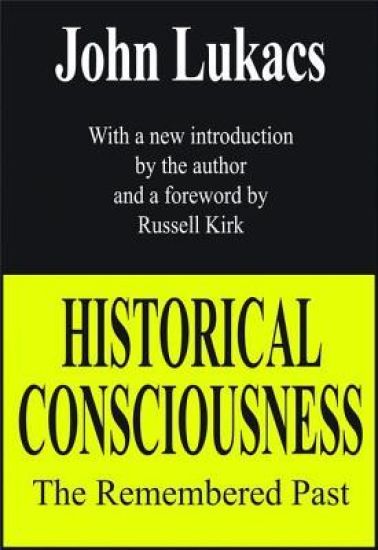
Historical Consciousness

Historical Consciousness

John Lukacs

Routledge
2017
sidottu
One of the most important developments of Western civilization has been the growth of historical consciousness. Consciously or not, history has become a form of thought applied to every facet of human experience; every field of human action can be studied, described, or understood through its history. In this extraordinary analysis of the meaning of the remembered past, John Lukacs discusses the evolution of historical consciousness since its first emergence about three centuries ago.
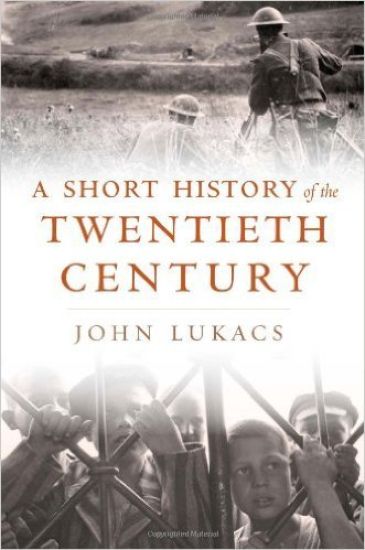
A Short History of the Twentieth Century

A Short History of the Twentieth Century

John Lukacs

The Belknap Press
2013
sidottu
The historian John Lukacs offers a concise history of the twentieth century—its two world wars and cold war, its nations and leaders. The great themes woven through this spirited narrative are inseparable from the author’s own intellectual preoccupations: the fading of liberalism, the rise of populism and nationalism, the achievements and dangers of technology, and the continuing democratization of the globe.The historical twentieth century began with the First World War in 1914 and ended seventy-five years later with the collapse of the Soviet Empire in 1989. The short century saw the end of European dominance and the rise of American power and influence throughout the world. The twentieth century was an American century—perhaps the American century. Lukacs explores in detail the phenomenon of national socialism (national socialist parties, he reminds us, have outlived the century), Hitler’s sole responsibility for the Second World War, and the crucial roles played by his determined opponents Churchill and Roosevelt. Between 1939 and 1942 Germany came closer to winning than many people suppose.Lukacs casts a hard eye at the consequences of the Second World War—the often misunderstood Soviet-American cold war—and at the shifting social and political developments in the Far and Middle East and elsewhere. In an eloquent closing meditation on the passing of the twentieth century, he reflects on the advance of democracy throughout the world and the limitations of human knowledge.
The Future of History

The Future of History

John Lukacs

Yale University Press
2012
pokkari
A master historian explores the critical future of history writing and teaching For more than sixty years, John Lukacs has been writing, teaching, and reading about the past. In this inspired volume, he turns his attention to the future. Throughout The Future of History, Lukacs reflects on his discipline, eloquently arguing that the writing and teaching of history are literary rather than scientific, comprising knowledge that is neither wholly objective nor subjective. History at its best, he contends, is personal and participatory.Despite a recently unprecedented appetite for history among the general public, as evidenced by history television program ratings, sales of popular history books, and increased participation in local historical societies, Lukacs believes that the historical profession is in a state of disarray. He traces a decline in history teaching throughout higher education, matched by a corresponding reduction in the number of history students. He reviews a series of short-lived fads within the profession that have weakened the fundamentals of the field. In looking for a way forward, Lukacs explores the critical relationships between history and literature, including ways in which novelists have contributed to historical understanding. Through this startling and enlightening work, readers will understand Lukacs's assertion that "everything has its history, including history" and that history itself has a future, since everything we know comes from the past.
The Legacy of the Second World War

The Legacy of the Second World War

John Lukacs

Yale University Press
2011
pokkari
The master historian John Lukacs explores lasting questions and enigmas about World War II, its consequences, and its persistent legacy Sixty-five years after the conclusion of World War II, its consequences are still with us. In this probing book, the acclaimed historian John Lukacs raises perplexing questions about World War II that have yet to be explored. In a work that brilliantly argues for World War II’s central place in the history of the twentieth century, Lukacs applies his singular expertise toward addressing the war’s most persistent enigmas.The Second World War was Hitler’s war. Yet questions about Hitler’s thoughts and his decisions still remain. How did the divisions of Europe—and, consequently, the Cold War—come about? What were the true reasons for Werner Heisenberg’s mission to Niels Bohr in Copenhagen in September 1941? What led to “Rainbow Five,” the American decision to make the war against Germany an American priority even in the event of a two-ocean world war? Was the Cold War unavoidable? In this work, which offers both an accessible primer for students and challenging new theses for scholars, Lukacs addresses these and other riddles, revealing the ways in which the war and its legacy still touch our lives today.
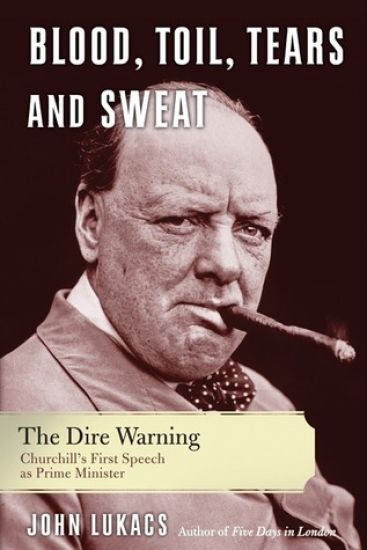
Blood, Toil, Tears, and Sweat

Blood, Toil, Tears, and Sweat

John Lukacs

Basic Books
2009
pokkari
On 13 May 1940, Winston Churchill stood before the House of Parliament to deliver his first speech as prime minister. German troops were advancing across Europe Neville Chamberlain's government had fallen three days earlier. Churchill needed to prove himself an able leader, and he also needed to convince an unwilling nation to support his stand against Hitler. In this taut meditation on a great leader under great pressure, Lukacs demonstrates that Churchill delivered his triumphant speech despite his own sense that England might soon fall to Hitler's armies. A riveting portrait of leadership in its confrontation with radical evil, Lukacs's book is essential reading for WWII buffs, Churchill aficionadi, and anyone interested in leadership.
Last Rites

Last Rites

John Lukacs

Yale University Press
2009
sidottu
A master historian offers an eloquent and personal auto-history of his life and his ideas Twenty years ago, John Lukacs paused to set down the history of his own thoughts and beliefs in Confessions of an Original Sinner, an adroit blend of autobiography and personal philosophy. Now, in Last Rites, he continues and expands his reflections, this time integrating his conception of history and human knowledge with private memories of his wives and loves, and enhancing the book with footnotes from his idiosyncratic diaries. The resulting volume is fascinating and delightful—an auto-history by a passionate, authentic, brilliant, and witty man.Lukacs begins with a concise rendering of a historical understanding of our world (essential reading for any historian), then follows with trenchant observations on his life in the United States, commentary on his native Hungary and the new meanings it took for him after 1989, and deeply personal portraits of his three wives, about whom he has not written before. He includes also a chapter on his formative memories of May and June 1940 and of Winston Churchill, a subject in some of Lukacs’s later studies. Last Rites is a richly layered summation combined with a set of extraordinary observations—an original book only John Lukacs could have written.Praise for Confessions of an Original Sinner: “[Lukacs] is an often witty and always fascinating—even entertaining—writer.”—Washington Post
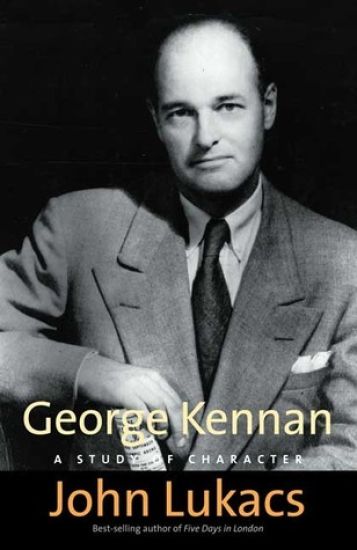
George Kennan

George Kennan

John Lukacs

Yale University Press
2007
pokkari
A profoundly moving biographical study of George Kennan by the fine historian John Lukacs A man of impressive mental powers, of extraordinary intellectual range, and—last but not least—of exceptional integrity, George Frost Kennan (1904-2005) was an adviser to presidents and secretaries of state, with a decisive role in the history of this country (and of the entire world) for a few crucial years in the 1940s, after which he was made to retire; but then he became a scholar who wrote seventeen books, scores of essays and articles, and a Pulitzer Prize–winning memoir. He also wrote remarkable public lectures and many thousands of incisive letters, laying down his pen only in the hundredth year of his life. Having risen within the American Foreign Service and been posted to various European capitals, and twice to Moscow, Kennan was called back to Washington in 1946, where he helped to inspire the Truman Doctrine and draft the Marshall Plan. Among other things, he wrote the “X” or “Containment” article for which he became, and still is, world famous (an article which he regarded as not very important and liable to misreading). John Lukacs describes the development and the essence of Kennan’s thinking; the—perhaps unavoidable—misinterpretations of his advocacies; his self-imposed task as a leading realist critic during the Cold War; and the importance of his work as a historian during the second half of his long life.
Democracy and Populism

Democracy and Populism

John Lukacs

Yale University Press
2006
pokkari
A highly esteemed historian reflects on the dangerous descent of democracy into populism—particularly in the United States. Democracy has changed substantially since the second World War, evolving into a dangerous and possibly irreversible populism, says John Lukacs in this intensely interesting—and troubling—book. The esteemed historian offers biting, timely, and controversial observations on the power of the media and the precarious state of American democracy today. "In taking up Tocqueville’s theme, democracy in America, our most perceptive and far-ranging historian corrects many misconceptions about the recent past and deals commandingly with this country’s zeal to implant our blend of freedoms abroad. He will arouse thought as he always does and stir the emotions more than usual."—Jacques Barzun "Lukacs is indisputably one of the English language’s greatest—and most idiosyncratic—historians. . . . This is a wonderful book to chew on. . . . For the intelligent and historically literate general reader, this may well be a great joy."—Jonah Goldberg, National Review
A New Republic

A New Republic

John Lukacs

Yale University Press
2004
pokkari
An eminent historian offers his views on American democracy In A New Republic, one of America’s most respected historians offers a major statement on the nature of our political system and a critical look at the underpinnings of our society. American democracy, says John Lukacs, has been transformed from an exercise in individual freedom and opportunity to a bureaucratic system created by and for the dominance of special groups. His book, first published in 1984 as Outgrowing Democracy, is now reissued with a new introduction, in which Lukacs explains his methodology, and a new final chapter, which sums up Lukacs’s thoughts on American democracy today.Reviews of the earlier edition“A rich, subtle, and often ingenious argument . . . an eloquent, provocative, but disturbing book.”—Edwin M. Yoder, Jr., Washington Post Book World“Mr. Lukacs is an original and subtle historian, and [this book] is an engaging intellectual surprise party. . . . I was continuously enchanted by the play of his ideas—by the sharpness of his distinctions and the acuteness of his descriptions.”—Naomi Bliven, New Yorker “It has been a long time since Americans were offered such a provocative interpretation of their historical predicament. . . . We would be foolish not to examine it closely.”—Laurence Tool, Society
Churchill: Visionary. Statesman. Historian.

Churchill: Visionary. Statesman. Historian.

John Lukacs

Yale University Press
2004
pokkari
A clear-eyed view of Winston Churchill, the workings of his historical imagination, and his successes and failures as a statesman, by the celebrated historian of World War II and best-selling author of Five Days in London, May 1940 John Lukacs has spent a lifetime considering the complex personality and statesmanship of Winston Churchill. In previous books Lukacs has told the story of Churchill’s titanic struggle with Adolf Hitler in the early days of World War II. Now, in Churchill: Visionary. Statesman. Historian., he turns his attention to Churchill the man and visionary statesman. Each chapter of this book provides an essential portrait of Churchill. Lukacs treats Churchill’s vital relationships with Stalin, Roosevelt, and Eisenhower, as well as his complex, farsighted political vision concerning the coming of World War II and the Cold War. Lukacs also assesses Churchill’s abilities as a historian looking backward into the origins of the conflicts of which he was so much a part. In addition, the author examines the often contradictory ways Churchill has been perceived by critics and admirers alike. The last chapter is a powerful and deeply moving evocation of the three days Lukacs spent in London attending Churchill’s funeral in 1965. In Churchill: Visionary. Statesman. Historian., Lukacs deftly sets forth the essence of this towering figure of twentieth-century history with the consummate mastery of a great historian.
At the End of an Age

At the End of an Age

John Lukacs

Yale University Press
2003
pokkari
At the End of an Age isa deeply informed and rewarding reflection on the nature of historical and scientific knowledge. Of extraordinary philosophical, religious, and historical scope, it is the product of a great historian’s lifetime of thought on the subject of his discipline and the human condition. While running counter to most of the accepted ideas and doctrines of our time, it offers a compelling framework for understanding history, science, and man’s capacity for self-knowledge. In this work, John Lukacs describes how we in the Western world have now been living through the ending of an entire historical age that began in Western Europe about five hundred years ago. Unlike people during the ending of the Middle Ages or the Roman empire, we can know where we are. But how and what is it that we know? In John Lukacs’s view, there is no science apart from scientists, and all of “Science,” including our view of the universe, is a human creation, imagined and defined by fallible human beings in a historical continuum. This radical and reactionary assertion—in its way a summa ofthe author’s thinking, expressed here and there in many of his previous twenty-odd books—leads to his fundamental assertion that, contrary to all existing cosmological doctrines and theories, it is this earth which is the very center of the universe—the only universe we know and can know.
Five Days in London, May 1940

Five Days in London, May 1940

John Lukacs

Yale University Press
2001
pokkari
Washington Post Book World Bestseller “Customers are raving about Five Days in London.”—Amazon.com “Gripping. . . . Lukacs’s story is not new . . . but [he] has transformed it into a memorable drama.”—M. F. Perutz, New York Review of Books The days from May 24 to May 28, 1940, altered the course of the history of the twentieth century, as the members of the British War Cabinet debated whether to negotiate with Hitler or to continue what became known as the Second World War. The decisive importance of these five days is the focus of John Lukacs’s magisterial new book. Lukacs takes us hour by hour into the critical unfolding of events at 10 Downing Street, where Churchill and the members of his cabinet were painfully considering their war responsibilities. We see how the military disasters taking place on the Continent—particularly the plight of the nearly 400,000 British soldiers bottled up in Dunkirk—affected Churchill’s fragile political situation, for he had been prime minister only a fortnight and was regarded as impetuous and hotheaded even by many of his own party. Lukacs also investigates the mood of the British people, drawing on newspaper and Mass-Observation reports that show how the citizenry, though only partly informed about the dangers that faced them, nevertheless began to support Churchill’s determination to stand fast. Other historians have dealt with Churchill’s difficulties during this period, using the partial revelations of certain memoirs and private and public papers. But Lukacs is the first to convey the drama and importance of these days, and he does so in a compelling narrative that combines deep knowledge with high literary style.
The Duel: The Eighty-Day Struggle Between Churchill and Hitler
This is a day-by-day account of the eighty-day struggle in 1940 between Hitler--poised on the edge of absolute victory--and Churchill--threatened by imminent invasion and defeat--on the eve of the second World War. "A masterful book--masterful in its portrayal of its protagonists, masterful in its overall understanding of the death-struggle in which they engaged, masterful, above all, in its vivid, suspenseful chronicling of the most momentous eighty days in the history of this century." --Geoffrey Ward "This is a marvelous book. John Lukacs has lucid, unsentimental insight into the mind and character of both Churchill and Hitler." --Conor Cruise O'Brien "A wonderful story wonderfully told." --George F. Will "It is salutary to be reminded in this powerful study how close Hitler came to winning in 1940. . . . An impressive study . . . written] with elegance and panache." --Peter Stansky, New York Times "A master of narrative history on a par with Barbara Tuchman and Garrett Mattingly." --Kirkus Reviews
A Student's Guide to Study of History
To study history is to learn about oneself. And to fail to grasp the importance of the past—to remain ignorant of the deeds and writing of previous generations—is to bind oneself by the passions and prejudices of the age into which one is born. John Lukacs, one of today's most widely published historians, explains what the study of history entails, how it has been approached over the centuries, and why it should be undertaken by today's students. This guide is an invitation to become a master of the historian's craft.
Confessions Of Original Sinner

Confessions Of Original Sinner

John Lukacs

St Augustine's Press
2000
sidottu
In this eloquent and thought-provoking "autohistory," John Lukacs, distinguished historian and writer, describes the history of his own convictions and beliefs. The journey takes us from the Hungary of the 1930s and the ravaged Budapest of World War II to Lukacs’s discovery of the New World, his forays into the intellectual life of New York City, and finally his settling in Philadelphia. Along the way, Lukacs examines many of the major currents of our period, including fascism, communism, democracy, anti-Semitism, and the Christian realism from which springs the book’s title. What emerges is a mind that brings to bear on the conflicts of the twentieth century the erudition of the European heritage and the independence of the American. In prose as elegant as it is supple, Confessions of an Original Sinner is at once the vivid account of one man’s voyage and an important contribution to that small library that brings into sharp focus the major intellectual developments of our time.
A Thread of Years

A Thread of Years

John Lukacs

Yale University Press
1999
pokkari
The distinguished historian John Lukacs has been described as "one of the most powerful as well as one of the most learned minds [of the] century" by Conor Cruise O'Brien and as "one of the most original and profound of contemporary thinkers" by Paul Fussell. Here Lukacs presents a series of fictionalized vignettes of daily life as experienced by ordinary individuals in the United States (although Lukacs takes us to some European countries as well), each in a year from 1901 to 1969, and each followed by a short dialogue in which the author argues with an interlocutor (who may or may not be himself) over why he has chosen to develop a given scenario in that particular year and what its significance might be.The period represents the life of a single man, K., which Lukacs weaves in and out of the text and through which can be traced the leitmotif of the book: the decline of Anglo-American civilization and of the ideal of the gentleman. The book is primarily a work in the history of manners and mores, a delightful-and poignant-succession of sketches that brings the reader into the inner and often undeclared life of individuals and places them in the larger dramas of historical process in this century.
The Hitler of History

The Hitler of History

John Lukacs

VINTAGE
1998
nidottu
"A valuable service . . . serious, entertaining, provocative and distinctive." --Cleveland Plain Dealer In the fifty years since his suicide amid the ruins of Berlin, Adolf Hitler has been the subject of more biographies than any comparable figure of our time--and at the center of a crucial historical debate over the nature of evil and moral responsibility in the twentieth century. In this brilliant and original book, the historian John Lukacs climbs above the fray to produce a definitive "history of a history: the history of the evolution of our understanding of Hitler's life and our debates about its meaning." Like an expert attorney, Lukacs puts the biographies on trial, identifying their strengths, weaknesses, and hidden agendas. And through their intersecting and conflicting accounts, he addresses the enduring enigmas surrounding the demiurge of the Third Reich. Was Hitler a revolutionary or a reactionary? How successful was he as a statesman and a strategist? What was his primary motive for the extermination of the Jews? The Hitler of History answers these questions as fully as any modern work can hope to, with an intellectual boldness that makes it absolutely essential to any understanding of the post-Hitler world. "Lukacs is a shrewd historian and an engaging writer . . . a sharp and sober portrait." --Philadelphia Inquirer