Kirjojen hintavertailu. Mukana 12 595 353 kirjaa ja 12 kauppaa.

Kirjailija

John M. Carey

Kirjat ja teokset yhdessä paikassa: 9 kirjaa, julkaisuja vuosilta 1992-2019, suosituimpien joukossa Presidents and Assemblies. Vertaile teosten hintoja ja tarkista saatavuus suomalaisista kirjakaupoista.

9 kirjaa

Kirjojen julkaisuhaarukka 1992-2019.

Presidents and Assemblies

Presidents and Assemblies

Matthew Soberg Shugart; John M. Carey

Cambridge University Press
1992
sidottu
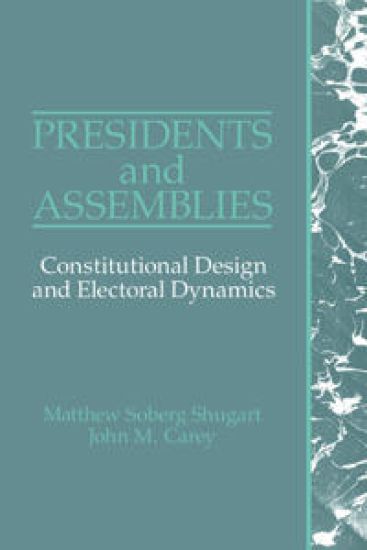
In recent years renewed attention has been directed to the importance of the role of institutional design in democratic politics. Particular interest has concerned constitutional design and the relative merits of parliamentary versus presidential systems. In this book, the authors systematically assess the strengths and weaknesses of various forms of presidential systems, drawing on recent developments in the theoretical literature about institutional design and electoral rules. They develop a typology of democratic regimes structured around the separation of powers principle, including two hybrid forms, the premier-presidential and president-parliamentary systems, and they evaluate a number of alternative ways of balancing powers between the branches within these basic frameworks. They also demonstrate that electoral rules are critically important in determining how political authority is exercised.
Presidents and Assemblies

Presidents and Assemblies

Matthew Soberg Shugart; John M. Carey

Cambridge University Press
1992
pokkari
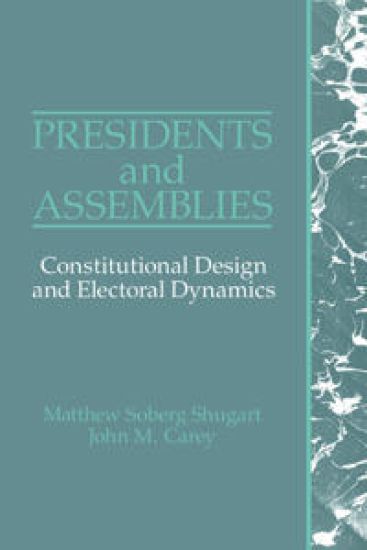
In recent years renewed attention has been directed to the importance of the role of institutional design in democratic politics. Particular interest has concerned constitutional design and the relative merits of parliamentary versus presidential systems. In this book, the authors systematically assess the strengths and weaknesses of various forms of presidential systems, drawing on recent developments in the theoretical literature about institutional design and electoral rules. They develop a typology of democratic regimes structured around the separation of powers principle, including two hybrid forms, the premier-presidential and president-parliamentary systems, and they evaluate a number of alternative ways of balancing powers between the branches within these basic frameworks. They also demonstrate that electoral rules are critically important in determining how political authority is exercised.
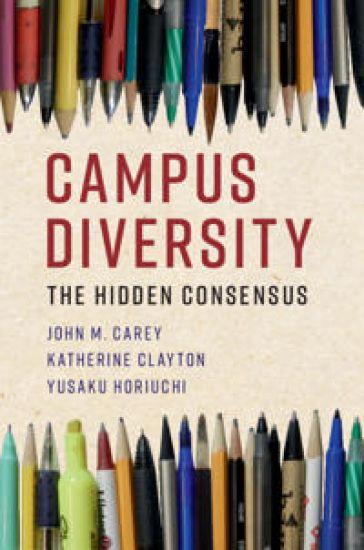
Campus Diversity

Campus Diversity

John M. Carey; Katherine Clayton; Yusaku Horiuchi

Cambridge University Press
2019
sidottu
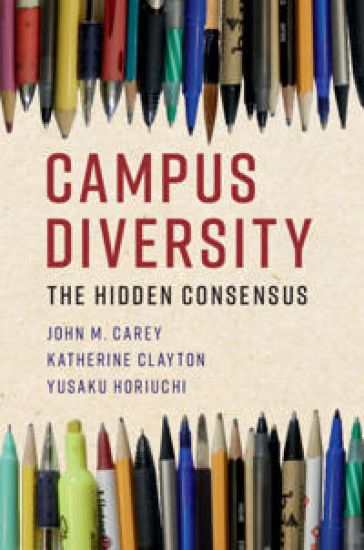
Media, politicians, and the courts portray college campuses as divided over diversity and affirmative action. But what do students and faculty really think? This book uses a novel technique to elicit honest opinions from students and faculty and measure preferences for diversity in undergraduate admissions and faculty recruitment at seven major universities, breaking out attitudes by participants' race, ethnicity, gender, socio-economic status, and political partisanship. Scholarly excellence is a top priority everywhere, but the authors show that when students consider individual candidates, they favor members of all traditionally underrepresented groups - by race, ethnicity, gender, and socio-economic background. Moreover, there is little evidence of polarization in the attitudes of different student groups. The book reveals that campus communities are less deeply divided than they are often portrayed to be; although affirmative action remains controversial in the abstract, there is broad support for prioritizing diversity in practice.
Campus Diversity

Campus Diversity

John M. Carey; Katherine Clayton; Yusaku Horiuchi

Cambridge University Press
2019
pokkari
Media, politicians, and the courts portray college campuses as divided over diversity and affirmative action. But what do students and faculty really think? This book uses a novel technique to elicit honest opinions from students and faculty and measure preferences for diversity in undergraduate admissions and faculty recruitment at seven major universities, breaking out attitudes by participants' race, ethnicity, gender, socio-economic status, and political partisanship. Scholarly excellence is a top priority everywhere, but the authors show that when students consider individual candidates, they favor members of all traditionally underrepresented groups - by race, ethnicity, gender, and socio-economic background. Moreover, there is little evidence of polarization in the attitudes of different student groups. The book reveals that campus communities are less deeply divided than they are often portrayed to be; although affirmative action remains controversial in the abstract, there is broad support for prioritizing diversity in practice.
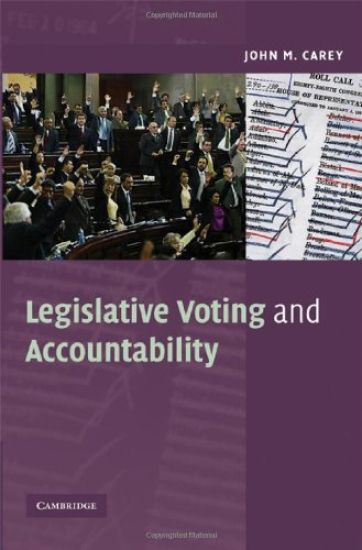
Legislative Voting and Accountability

Legislative Voting and Accountability

John M. Carey

Cambridge University Press
2008
sidottu
Legislatures are the core representative institutions in modern democracies. Citizens want legislatures to be decisive, and they want accountability, but they are frequently disillusioned with the representation legislators deliver. Political parties can provide decisiveness in legislatures, and they may provide collective accountability, but citizens and political reformers frequently demand another type of accountability from legislators – at the individual level. Can legislatures provide both kinds of accountability? This book considers what collective and individual accountability require and provides the most extensive cross-national analysis of legislative voting undertaken to date. It illustrates the balance between individualistic and collective representation in democracies, and how party unity in legislative voting shapes that balance. In addition to quantitative analysis of voting patterns, the book draws on extensive field and archival research to provide an extensive assessment of legislative transparency throughout the Americas.
Legislative Voting and Accountability

Legislative Voting and Accountability

John M. Carey

Cambridge University Press
2008
pokkari
Legislatures are the core representative institutions in modern democracies. Citizens want legislatures to be decisive, and they want accountability, but they are frequently disillusioned with the representation legislators deliver. Political parties can provide decisiveness in legislatures, and they may provide collective accountability, but citizens and political reformers frequently demand another type of accountability from legislators – at the individual level. Can legislatures provide both kinds of accountability? This book considers what collective and individual accountability require and provides the most extensive cross-national analysis of legislative voting undertaken to date. It illustrates the balance between individualistic and collective representation in democracies, and how party unity in legislative voting shapes that balance. In addition to quantitative analysis of voting patterns, the book draws on extensive field and archival research to provide an extensive assessment of legislative transparency throughout the Americas.
Term Limits in State Legislatures

Term Limits in State Legislatures

John M. Carey; Richard G. Niemi; Lynda W. Powell

The University of Michigan Press
2000
nidottu
It has been predicted that term limits in state legislatures--soon to be in effect in eighteen states--will first affect the composition of the legislatures, next the behavior of legislators, and finally legislatures as institutions. The studies in Term Limits in State Legislatures demonstrate that term limits have had considerably less effect on state legislatures than proponents predicted.The term-limit movement--designed to limit the maximum time a legislator can serve in office--swept through the states like wildfire in the first half of the 1990s. By November 2000, state legislators will have been "term limited out" in eleven states.This book is based on a survey of nearly 3,000 legislators from all fifty states along with intensive interviews with twenty-two legislative leaders in four term-limited states. The data were collected as term limits were just beginning to take effect in order to capture anticipatory effects of the reform, which set in as soon as term limit laws were passed. In order to understand the effects of term limits on the broader electoral arena, the authors also examine data on advancement of legislators between houses of state legislatures and from the state legislatures to Congress.The results show that there are no systematic differences between term limit and non-term limit states in the composition of the legislature (e.g., professional backgrounds, demographics, ideology). Yet with respect to legislative behavior, term limits decrease the time legislators devote to securing pork and heighten the priority they place on the needs of the state and on the demands of conscience relative to district interests. At the same time, with respect to the legislature as an institution, term limits appear to be redistributing power away from majority party leaders and toward governors and possibly legislative staffers.This book will be of interest both to political scientists, policymakers, and activists involved in state politics.John M. Carey is Assistant Professor of Political Science, Washington University in St. Louis. Richard G. Niemi is Professor of Political Science, University of Rochester. Lynda W. Powell is Professor of Political Science, University of Rochester.
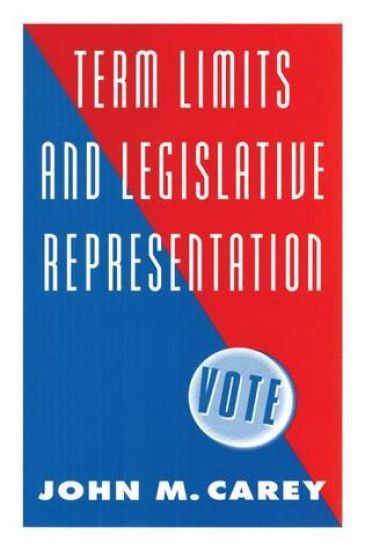
Term Limits and Legislative Representation

Term Limits and Legislative Representation

John M. Carey

Cambridge University Press
1998
pokkari
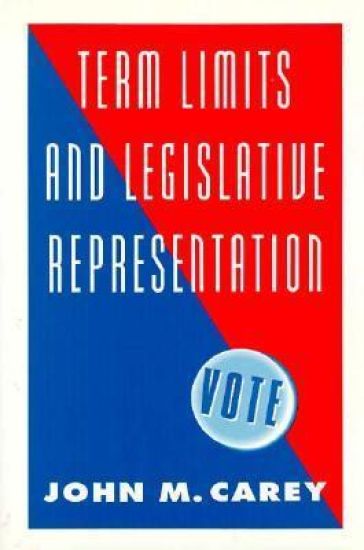
Virtually all legislative theory is built on the assumption that politicians are first and foremost reelection-seekers, and because so few countries have ever limited legislative reelection, this assumption has rarely been questioned. As a result, political science has been ill-equipped to offer insights on the impact of legislative term limits. Term Limits and Legislative Representation tests the central arguments made by both supporters and opponents of such reform by examining the experience of Costa Rica, the only long-term democracy to impose term limits on legislators, and by providing extensive comparisons with legislatures in Venezuela and the United States. Professor Carey challenges claims made about the effects of term limits on political careers, pork barrel politics, and the effectiveness of political parties in passing their programs.
Term Limits and Legislative Representation

Term Limits and Legislative Representation

John M. Carey

Cambridge University Press
1996
sidottu
Virtually all legislative theory is built on the assumption that politicians are first and foremost reelection-seekers, and because so few countries have ever limited legislative reelection, this assumption has rarely been questioned. As a result, political science has been ill-equipped to offer insights on the impact of legislative term limits. Term Limits and Legislative Representation tests the central arguments made by both supporters and opponents of such reform by examining the experience of Costa Rica, the only long-term democracy to impose term limits on legislators, and by providing extensive comparisons with legislatures in Venezuela and the United States. Professor Carey challenges claims made about the effects of term limits on political careers, pork barrel politics, and the effectiveness of political parties in passing their programs.