

Kirjailija
John M. McNamara
Kirjat ja teokset yhdessä paikassa: 10 kirjaa, julkaisuja vuosilta 1999-2020, suosituimpien joukossa Madonna. Vertaile teosten hintoja ja tarkista saatavuus suomalaisista kirjakaupoista.
10 kirjaa
Kirjojen julkaisuhaarukka 1999-2020.

The principles of game theory apply to a wide range of topics in biology. This book presents the central concepts in evolutionary game theory and provides an authoritative and up-to-date account. The focus is on concepts that are important for biologists in their attempts to explain observations. This strong connection between concepts and applications is a recurrent theme throughout the book which incorporates recent and traditional ideas from animal psychology, neuroscience, and machine learning that provide a mechanistic basis for behaviours shown by players of a game. The approaches taken to modelling games often rest on idealized and unrealistic assumptions whose limitations and consequences are not always appreciated. The authors provide a novel reassessment of the field, highlighting how to overcome limitations and identifying future directions. Game Theory in Biology is an advanced textbook suitable for graduate level students as well as professional researchers (both empiricists and theoreticians) in the fields of behavioural ecology and evolutionary biology. It will also be of relevance to a broader interdisciplinary audience including psychologists and neuroscientists.

The principles of game theory apply to a wide range of topics in biology. This book presents the central concepts in evolutionary game theory and provides an authoritative and up-to-date account. The focus is on concepts that are important for biologists in their attempts to explain observations. This strong connection between concepts and applications is a recurrent theme throughout the book which incorporates recent and traditional ideas from animal psychology, neuroscience, and machine learning that provide a mechanistic basis for behaviours shown by players of a game. The approaches taken to modelling games often rest on idealized and unrealistic assumptions whose limitations and consequences are not always appreciated. The authors provide a novel reassessment of the field, highlighting how to overcome limitations and identifying future directions. Game Theory in Biology is an advanced textbook suitable for graduate level students as well as professional researchers (both empiricists and theoreticians) in the fields of behavioural ecology and evolutionary biology. It will also be of relevance to a broader interdisciplinary audience including psychologists and neuroscientists.

Summers on the Nebraska Shore
John M. McNamara
Createspace Independent Publishing Platform
2017
nidottu

Duncan Chase is an imperfect storm. His fiftieth birthday looms, prompting reflection along several fronts. Gold-record winning songwriter. Widower, whose wife committed suicide twenty-five years earlier, wracking him with guilt and rage. Estranged son of an academic with expectations he could never meet. An agoraphobic due to panic attacks and anxiety for which he only recently sought treatment. Wednesday nights he auditions new compositions at the local pub to gauge audience reaction. Formulaic love songs his agent urges him to write for their ease of sale. Duncan's reflection on this front scratches an itch to write songs more authentic and raw than the bland compositions he currently constructs. When a young woman at an open mic night at the pub impresses him with her talent and beauty, he considers collaboration, one of many changes he entertains since beginning medication for his anxiety. Unconscious comparisons of the woman to his wife emerge and he exploits the tempest of emotions surrounding her death. Can he mold them into a song of apology to her? Can the notion of apology also extend to his father? The collaboration with the young singer/songwriter unfolds easily and Duncan imagines intimacy beyond the mere creative. Years of living alone in self-imposed isolation leave him ill-equipped to read people with certainty and although her reality falls short of his expectations, he gains a greater sense of purpose for the encounter. This is John M. McNamara's seventh work of fiction.

The Dreams of Teddy Schreck
John M. McNamara
Createspace Independent Publishing Platform
2013
nidottu


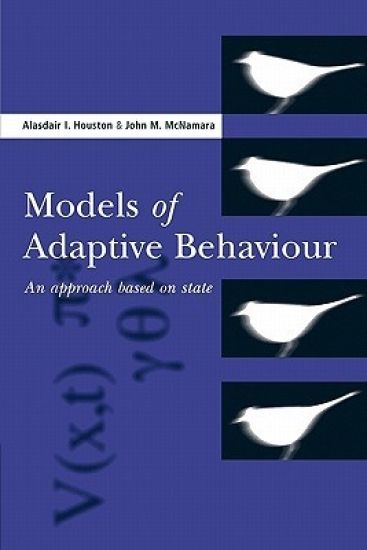
Models of Adaptive Behaviour
Alasdair I. Houston; John M. McNamara
Cambridge University Press
1999
pokkari
Models of Adaptive Behaviour sets out a framework for adaptive explanations of behaviour, and applies this to give analyses of a range of biological issues such as energetic gain, energy-predation trade-offs, dynamic games, state-dependent life histories, annual routines and fluctuating environments. It gives a definitive account of this exciting new field, summarizing previous research, presenting new material and suggesting directions for future research. Organisms differ in terms of their state - for example in their size, energy relations or temperature - which often affects their behaviour. The framework adopted in this book takes this into account, and provides a common currenct for comparing diverse actions. Ultimately this could lead to the development of state-dependent dynamic models. This book will be a revelation for graduate students and researchers interested in behavioural or evolutionary biology.
Models of Adaptive Behaviour
Alasdair I. Houston; John M. McNamara
Cambridge University Press
1999
sidottu
Models of Adaptive Behaviour sets out a framework for adaptive explanations of behaviour, and applies this to give analyses of a range of biological issues such as energetic gain, energy-predation trade-offs, dynamic games, state-dependent life histories, annual routines and fluctuating environments. It gives a definitive account of this exciting new field, summarizing previous research, presenting new material and suggesting directions for future research. Organisms differ in terms of their state - for example in their size, energy relations or temperature - which often affects their behaviour. The framework adopted in this book takes this into account, and provides a common currenct for comparing diverse actions. Ultimately this could lead to the development of state-dependent dynamic models. This book will be a revelation for graduate students and researchers interested in behavioural or evolutionary biology.