Kirjailija
John Mason
Kirjat ja teokset yhdessä paikassa: 95 kirjaa, julkaisuja vuosilta 1984-2025, suosituimpien joukossa Å lære algebraisk tenkning. Vertaile teosten hintoja ja tarkista saatavuus suomalaisista kirjakaupoista.
95 kirjaa
Kirjojen julkaisuhaarukka 1984-2025.
Designing and Using Mathematical Tasks
John Mason; Sue Johnston-Wilder
TARQUIN PUBLICATIONS
2006
sidottu
'Beginning and established teachers of mathematics as well as teacher educators will all find this book a rich resource when focusing on the crucial issue of designing and using tasks to provoke real learning in mathematics. It has become a central feature of our PGCE course in mathematics'. David Wright, Tutor in mathematics education, University of Newcastle Mathematics seems, on the face of it, a cut and dried subject. But does being able to 'do' mathematics mean being competent at techniques? Understanding how ideas and techniques fit together? Using basic principles in problem-solving? Something else.or all of these? Designing and Using Mathematical Tasks addresses these questions by thinking about learning as transformation in the way that learners perceive or think. By being given appropriate tasks, learners increase their choice of actions and develop their powers to think mathematically. They also develop their competence and fluency in using specific techniques and language and their appreciation of how ideas fit together. Contents include: . Introduction: learning, teaching and behaviour: theory and practice . Mathematical topics . Mathematical tasks . Mathematical activity . Interaction . Progression in mathematics This book forms part of the Open University course ME825
Verdades que romperán las barreras que impiden la excelencia en su vida.
John Mason, autor de varios éxitos de librería, captura verdades que inspiran en declaraciones concisas en este libro escrito en un formato fácil de recordar y aplicar a los asuntos grandes y pequeños que afectan su vida. Cada página está llena de sabiduría práctica y consejos sanos.

Mathematics as a Constructive Activity
Anne Watson; John Mason
Routledge Member of the Taylor and Francis Group
2005
nidottu
This book explains and demonstrates the teaching strategy of asking learners to construct their own examples of mathematical objects. The authors show that the creation of examples can involve transforming and reorganizing knowledge and that, although this is usually done by authors and teachers, if the responsibility for making examples is transferred to learners, their knowledge structures can be developed and extended. A multitude of examples to illustrate this is provided, spanning primary, secondary, and college levels. Readers are invited to learn from their own past experience augmented by tasks provided in the book, and are given direct experience of constructing examples through a collection of many tasks at many levels. Classroom stories show the practicalities of introducing such shifts in mathematics education. The authors examine how their approach relates to improving the learning of mathematics and raise future research questions.*Based on the authors' and others' theoretical and practical experience, the book includes a combination of exercises for the reader, practical applications for teaching, and solid scholarly grounding.*The ideas presented are generic in nature and thus applicable across every phase of mathematics teaching and learning.*Although the teaching methods offered are ones that engage learners imaginatively, these are also applied to traditional approaches to mathematics education; all tasks offered in the book are within conventional mathematics curriculum content.Mathematics as a Constructive Activity: Learners Generating Examples is intended for mathematics teacher educators, mathematics teachers, curriculum developers, task and test designers, and classroom researchers, and for use as a text in graduate-level mathematics education courses.
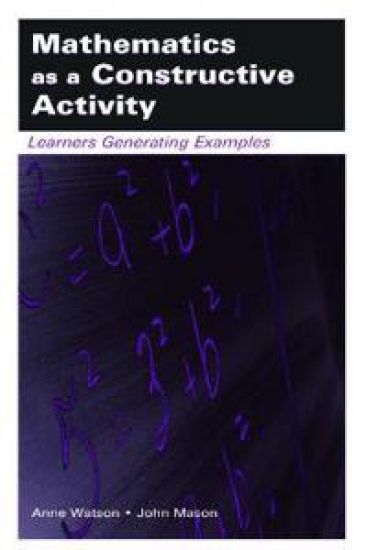
Mathematics as a Constructive Activity
Anne Watson; John Mason
Routledge Member of the Taylor and Francis Group
2005
sidottu
This book explains and demonstrates the teaching strategy of asking learners to construct their own examples of mathematical objects. The authors show that the creation of examples can involve transforming and reorganizing knowledge and that, although this is usually done by authors and teachers, if the responsibility for making examples is transferred to learners, their knowledge structures can be developed and extended. A multitude of examples to illustrate this is provided, spanning primary, secondary, and college levels. Readers are invited to learn from their own past experience augmented by tasks provided in the book, and are given direct experience of constructing examples through a collection of many tasks at many levels. Classroom stories show the practicalities of introducing such shifts in mathematics education. The authors examine how their approach relates to improving the learning of mathematics and raise future research questions.*Based on the authors' and others' theoretical and practical experience, the book includes a combination of exercises for the reader, practical applications for teaching, and solid scholarly grounding.*The ideas presented are generic in nature and thus applicable across every phase of mathematics teaching and learning.*Although the teaching methods offered are ones that engage learners imaginatively, these are also applied to traditional approaches to mathematics education; all tasks offered in the book are within conventional mathematics curriculum content.Mathematics as a Constructive Activity: Learners Generating Examples is intended for mathematics teacher educators, mathematics teachers, curriculum developers, task and test designers, and classroom researchers, and for use as a text in graduate-level mathematics education courses.

Con su peculiar estilo, John Mason le inspira a tener el valor para vivir de la manera en que Dios desea que usted viva. Los consejos vitales fáciles de leer y de recordar llenan las páginas de este libro. Con ellos usted encontrará ánimo, reto y motivación para una vida de mayor realización. Algunos de los desafíos son:Atrévase a ser a quién usted esAprenda a disfrutar de soñar en grandeEl fracaso espera sobre la senda de la persistenciaEl éxito llega cuando uno se atreve a dar pasos pequeñosEncuentre un camino hacia la meta, no un camino que lo desvíe de ella

Developing Thinking in Algebra
John Mason; Alan Graham; Sue Johnston-Wilder
SAGE Publications Inc
2005
sidottu
'This is an incredibly interesting and thought provoking book. Intended for anyone interested in developing their own mathematical thinking, or of the students they teach, whether at a primary level or right through to FE. The book is a delightful blend of theory and practice - encouraging the reader to participate, to solve problems and to develop their own thinking' - Peter Hall, Imberhorne School, East Grinstead' Mason, Graham, and Johnston-Wilder have admirably succeeded in casting most of school algebra in terms of generalisation activity? not just the typical numerical and geometric pattern-based work, but also solving quadratics and simultaneous equations, graphing equations, and factoring. The authors raise our awareness of the scope of generalization and of the power of using this as a lens not just for algebra but for all of mathematics!' - Professor Carolyn Kieran, Departement de Mathematiques, Universite du Quebec a Montreal Algebra has always been a watershed for pupils learning mathematics. This book will enable you to think about yourself as a learner of algebra in a new way, and thus to teach algebra more successfully, overcoming difficulties and building upon skills that all learners have. This book is based on teaching principles developed by the team at The Open University's Centre for Mathematics Education which has a 20-year track record of innovative approaches to teaching and learning algebra. Written for teachers working with pupils aged 7-16, it includes numerous tasks ready for adaption for your teaching and discusses principles that teachers have found useful in preparing and conducting lessons. This is a 'must have' resource for all teachers of mathematics, primary or secondary, and their support staff. Anyone who wishes to create an understanding and enthusiasm for algebra, based upon firm research and effective practice, will enjoy this book. This book is the course reader for The Open University Course ME625 Developing Algebraic Thinking
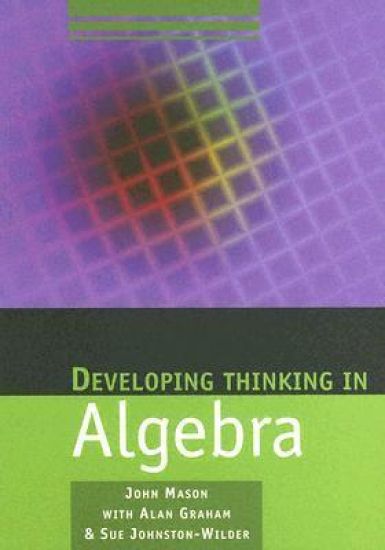
Developing Thinking in Algebra
John Mason; Alan Graham; Sue Johnston-Wilder
SAGE Publications Inc
2005
nidottu
'This is an incredibly interesting and thought provoking book. Intended for anyone interested in developing their own mathematical thinking, or of the students they teach, whether at a primary level or right through to FE. The book is a delightful blend of theory and practice - encouraging the reader to participate, to solve problems and to develop their own thinking' - Peter Hall, Imberhorne School, East Grinstead' Mason, Graham, and Johnston-Wilder have admirably succeeded in casting most of school algebra in terms of generalisation activity? not just the typical numerical and geometric pattern-based work, but also solving quadratics and simultaneous equations, graphing equations, and factoring. The authors raise our awareness of the scope of generalization and of the power of using this as a lens not just for algebra but for all of mathematics!' - Professor Carolyn Kieran, Departement de Mathematiques, Universite du Quebec a Montreal Algebra has always been a watershed for pupils learning mathematics. This book will enable you to think about yourself as a learner of algebra in a new way, and thus to teach algebra more successfully, overcoming difficulties and building upon skills that all learners have. This book is based on teaching principles developed by the team at The Open University's Centre for Mathematics Education which has a 20-year track record of innovative approaches to teaching and learning algebra. Written for teachers working with pupils aged 7-16, it includes numerous tasks ready for adaption for your teaching and discusses principles that teachers have found useful in preparing and conducting lessons. This is a 'must have' resource for all teachers of mathematics, primary or secondary, and their support staff. Anyone who wishes to create an understanding and enthusiasm for algebra, based upon firm research and effective practice, will enjoy this book. This book is the course reader for The Open University Course ME625 Developing Algebraic Thinking

Central to caring professions such as teaching is the need to notice and be sensitive to the experiences of pupils and teachers. Starting from this position, Researching Your Own Practice demonstrates that in order to develop your professional practice you must first develop your own sensitivities and awareness. One must be attuned to fresh possibilities when they are needed and be alert to such a need through awareness of what is happening at any given time.By giving a full explanation of this theory and a guide to its implementation, this book provides a practical approach to becoming more methodical and systematic in professional development. It also gives the reader a basis for turning professional development into practitioner research, as well as giving advice on how noticing can be used to improve any research, or be used as a research paradigm in its own right.The discipline of noticing is a groundbreaking approach to professional development and research, based upon noticing a possibility for the future, noticing a possibility in the present moment and reflecting back on what has been noticed before in order to prepare for the future. John Mason, one of the discipline's most authoritative exponents, provides us here with a clear, persuasive and practical guide to its understanding and implementation.

Central to caring professions such as teaching is the need to notice and be sensitive to the experiences of pupils and teachers. Starting from this position, Researching Your Own Practice demonstrates that in order to develop your professional practice you must first develop your own sensitivities and awareness. One must be attuned to fresh possibilities when they are needed and be alert to such a need through awareness of what is happening at any given time.By giving a full explanation of this theory and a guide to its implementation, this book provides a practical approach to becoming more methodical and systematic in professional development. It also gives the reader a basis for turning professional development into practitioner research, as well as giving advice on how noticing can be used to improve any research, or be used as a research paradigm in its own right.The discipline of noticing is a groundbreaking approach to professional development and research, based upon noticing a possibility for the future, noticing a possibility in the present moment and reflecting back on what has been noticed before in order to prepare for the future. John Mason, one of the discipline's most authoritative exponents, provides us here with a clear, persuasive and practical guide to its understanding and implementation.
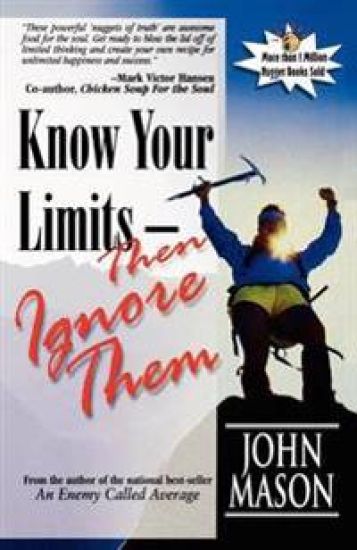
John Mason's latest book has 101 "nuggets of truth" providing scriptural motivation, godly wisdom and practical principles. It teaches how to break through barriers and reach new levels.

Mason provides concise coverage of the entire Cold War, paying particular attention to the Soviet-American dimension. This pamphlet: * Analyzes the origins of the conflict * Examines how the existence of nuclear weapons gives a unique character to the period * Discusses the involvement of other nations and regions, particularly China * Explains how and why the cold war ended * Draws on recent research of revisionist scholars.
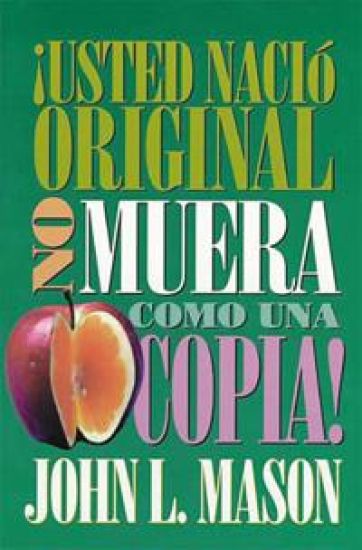
Enseñanzas para cada semana que le permitirá conocer el plan de Dios para su vida.