Kirjojen hintavertailu. Mukana 12 595 353 kirjaa ja 12 kauppaa.

Kirjailija

John McCumber

Kirjat ja teokset yhdessä paikassa: 15 kirjaa, julkaisuja vuosilta 1989-2023, suosituimpien joukossa The Company of Words. Vertaile teosten hintoja ja tarkista saatavuus suomalaisista kirjakaupoista.

15 kirjaa

Kirjojen julkaisuhaarukka 1989-2023.

Time in the Ditch

Time in the Ditch

John McCumber

NORTHWESTERN UNIVERSITY PRESS
2023
nidottu
In Time in the Ditch, John McCumber explores the effects of McCarthyism on American philosophy in the 1940s and 1950 and the possibility that the political pressures of the McCarthy era skewed the development of the discipline. Why was silence maintained for so long? And what happens, McCumber asks, when political events and pressures go beyond interfering with individual careers to influence the nature of a discipline itself?
The Philosophy Scare

The Philosophy Scare

John McCumber

University of Chicago Press
2016
sidottu
From the rise of formalist novels that championed the heroism of the individual to the proliferation of abstract art as a counter to socialist realism, the years of the Cold War had a profound impact on American intellectual life. As John McCumber shows in this fascinating account, philosophy, too, was hit hard by the Red Scare. Detailing the immense political pressures that reshaped philosophy departments in midcentury America, he shows just how radically politics can alter the course of intellectual history. McCumber begins with the story of Max Otto, whose appointment to the UCLA Philosophy Department in 1947 was met with widespread protest charging him as an atheist. Drawing on Otto's case, McCumber details the hugely successful conservative efforts that, by 1960, had all but banished the existentialist and pragmatist paradigms not to mention Marxism from philosophy departments all across the country, replacing them with an approach that valorized scientific objectivity and free markets and which downplayed the anti-theistic implications of modern thought. As he shows, while there have since been many instances of definitive and even explosive rejection of this conservative trend, its effects can still be seen at American universities today.
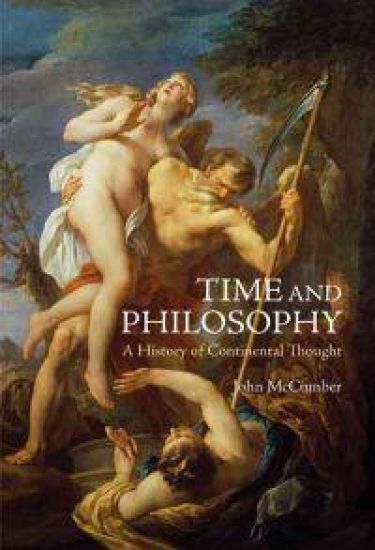
Time and Philosophy

Time and Philosophy

John McCumber

Acumen Publishing Ltd
2014
nidottu
"Time and Philosophy" presents a detailed survey of continental thought through an historical account of its key texts. The common theme taken up in each text is how philosophical thought should respond to time. Looking at the development of continental philosophy in both Europe and America, the philosophers discussed range from Hegel, Marx, Kierkegaard, Nietzsche, Husserl, Heidegger, Arendt, Adorno and Horkheimer, Sartre, de Beauvoir, Foucault, Derrida, to the most influential thinkers of today, Agamben, Badiou, Butler and Ranciere. Throughout, the concern is to elucidate the primary texts for readers coming to them for the first time. But, beyond this, "Time and Philosophy" aims to reveal the philosophical rigour which underpins and connects the history of continental thought.
Understanding Hegel's Mature Critique of Kant

Understanding Hegel's Mature Critique of Kant

John McCumber

Stanford University Press
2013
sidottu
Hegel's critique of Kant was a turning point in the history of philosophy: for the first time, the concrete, situated, and in certain senses "naturalistic" style pioneered by Hegel confronted the thin, universalistic, and argumentatively purified style of philosophy that had found its most rigorous expression in Kant. The controversy has hardly died away: it virtually haunts contemporary philosophy from epistemology to ethical theory. Yet if this book is right, the full import of Hegel's critique of Kant has not been understood. Working from Hegel's mature texts (after 1807) and reading them in light of an overall interpretation of Hegel's project as a linguistic, "definitional" system, the book offers major reinterpretations of Hegel's views: The Kantian thing-in-itself is not denied but relocated as a temporal aspect of our experience. Hegel's linguistic idealism is understood in terms of his realistic view of sensation. Instead of claiming that Kant's categorical imperative is too empty to provide concrete moral guidance, Hegel praises its emptiness as the foundation for a diverse society.
On Philosophy

On Philosophy

John McCumber

Stanford University Press
2013
sidottu
Deepening divisions separate today's philosophers, first, from the culture at large; then, from each other; and finally, from philosophy itself. Though these divisions tend to coalesce publicly as debates over the Enlightenment, their roots lie much deeper. Overcoming them thus requires a confrontation with the whole of Western philosophy. Only when we uncover the strange heritage of Aristotle's metaphysics, as reworked, for example, by Descartes and Kant, can we understand contemporary philosophy's inability to dialogue with women, people of color, LGBTs, and other minority groups. Only when we have understood that inability can we see how the thought of Hegel and Heidegger contains the seeds of a remedy. And only when armed with such a remedy can philosophy rise to the challenges posed by thinkers such as David Foster Wallace and Abraham Lincoln. The book's interpretations of these figures and others past and present are as scrupulous as its conclusions will be controversial. The result contributes to the most important question confronting us today: does reason itself have a future?
On Philosophy

On Philosophy

John McCumber

Stanford University Press
2013
pokkari
Deepening divisions separate today's philosophers, first, from the culture at large; then, from each other; and finally, from philosophy itself. Though these divisions tend to coalesce publicly as debates over the Enlightenment, their roots lie much deeper. Overcoming them thus requires a confrontation with the whole of Western philosophy. Only when we uncover the strange heritage of Aristotle's metaphysics, as reworked, for example, by Descartes and Kant, can we understand contemporary philosophy's inability to dialogue with women, people of color, LGBTs, and other minority groups. Only when we have understood that inability can we see how the thought of Hegel and Heidegger contains the seeds of a remedy. And only when armed with such a remedy can philosophy rise to the challenges posed by thinkers such as David Foster Wallace and Abraham Lincoln. The book's interpretations of these figures and others past and present are as scrupulous as its conclusions will be controversial. The result contributes to the most important question confronting us today: does reason itself have a future?
Time and Philosophy

Time and Philosophy

John McCumber

MCGILL-QUEEN'S UNIVERSITY PRESS
2011
nidottu
Looking at the development of continental philosophy in both Europe and America, McCumber discusses philosophers ranging from Hegel, Marx, Kierkegaard, Nietzsche, Husserl, Heidegger, Arendt, Adorno and Horkheimer, Sartre, de Beauvoir, Foucault, and Derrida to the most influential thinkers of today - Agamben, Badiou, Bulter, and Ranciere. Throughout, McCumber's concern is to elucidate the primary texts for readers coming to these thinkers for the first time, while revealing the philosophical rigour that underpins and connects the history of continental thought.
Time and Philosophy

Time and Philosophy

John McCumber

Acumen Publishing Ltd
2011
sidottu
"Time and Philosophy" presents a detailed survey of continental thought through an historical account of its key texts. The common theme taken up in each text is how philosophical thought should respond to time. Looking at the development of continental philosophy in both Europe and America, the philosophers discussed range from Hegel, Marx, Kierkegaard, Nietzsche, Husserl, Heidegger, Arendt, Adorno and Horkheimer, Sartre, de Beauvoir, Foucault, Derrida, to the most influential thinkers of today, Agamben, Badiou, Butler and Ranciere. Throughout, the concern is to elucidate the primary texts for readers coming to them for the first time. But, beyond this, "Time and Philosophy" aims to reveal the philosophical rigour which underpins and connects the history of continental thought.
Reshaping Reason

Reshaping Reason

John McCumber

Indiana University Press
2007
pokkari
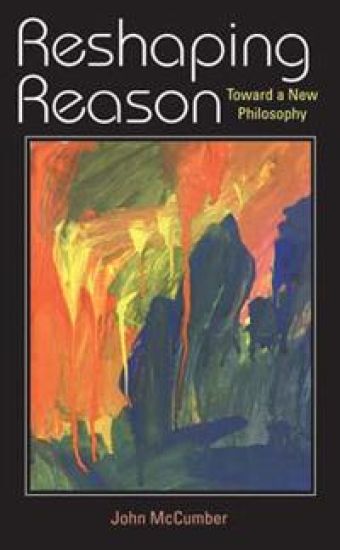
In Reshaping Reason, John McCumber breathes new life into American philosophy. Moving past the tired divide between "analytic" and "continental" camps, he proposes new directions to unite a discipline which has become more unfocused and invisible. McCumber recommends a new set of rational tools to enable philosophers and then puts these tools to work to redefine epistemology, ontology, and ethics. Reshaping Reason explores philosophy's achievements and failures in a cold light and paves the way for the discipline to become more meaningful and relevant to society at large.
Philosophy and Freedom

Philosophy and Freedom

John McCumber

Indiana University Press
2000
pokkari
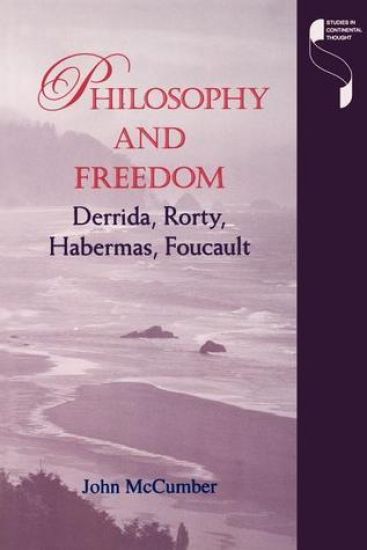
John McCumber asserts that the true target of philosophical liberation is to break the structures of domination that have been encoded in western civilization. Because of the emancipatory nature of their thought, Derrida, Foucault, Habermas, and Rorty challenge domination, but they do not see their challenge clearly and it does not rise to the level of conscious critique in their writings. Using Nietzsche's writings on "the great liberation" as a starting point, McCumber captures the valuable, but elusive insights of these thinkers and places them in the larger, pluralistic movement toward philosophical freedom.
Metaphysics and Oppression

Metaphysics and Oppression

John McCumber

Indiana University Press
1999
pokkari
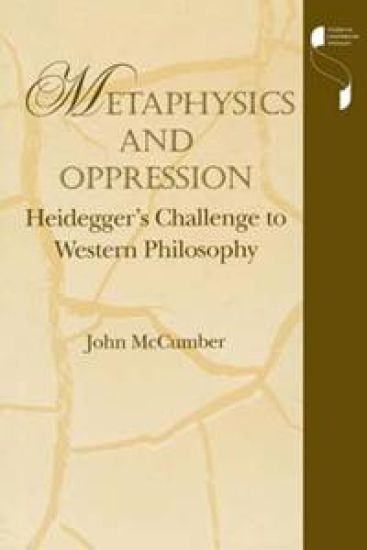
"In this stunning philosophical accomplishment, McCumber sheds important new light on the history of substance metaphysics and Heidegger's challenge to metaphysical thinking. . . . Well-documented, brilliant, definitely a major contribution to philosophy!" —Choice In this compelling work, John McCumber unfolds a history of Western metaphysics that is also a history of the legitimation of oppression. That is, until Heidegger. But Heidegger himself did not see how his conception of metaphysics opened doors to challenge the domination encoded in structures and institutions—such as slavery, colonialism, and marriage—that in the past have given order to the Western world.
The Company of Words

The Company of Words

John McCumber

Northwestern University Press
1993
nidottu
In this provocative work, John McCumber asks us to understand Hegel's system as a new approach to linguistic communication. Hegel, he argues, is concerned with building community and mutual comprehension rather than with completing metaphysics or developing historical critique. According to McCumber's radial interpretation, Hegel constructs a complex ideal of how we should use certain words. This ideal philosophical vocabulary is flexible and open to revision, and is constructed according to principles available at all time and all places; it is responsive to, but not dictated by, the shared language of cultured discourse whose concepts it attempts to refine and universalize.
Poetic Interaction

Poetic Interaction

John McCumber

University of Chicago Press
1989
sidottu
Poetic Interaction presents an original approach to the history of philosophy in order to elaborate a fresh theory that accounts for the place freedom in the Western philosophical tradition. In his thorough analysis of the aesthetic theories of Hegel, Heidegger, and Kant, John McCumber shows that the interactionist perspective recently put forth by Jürgen Habermas was in fact already present in some form in the German Enlightenment and in Heidegger's hermeneutic phenomenology. McCumber's historical placement of the interactionist perspective runs counter to both Habermas's own views and to those of scholars who would locate the origin of these developments in American pragmatism. From the metaphysical approaches of Plato and Aristotle to the interactionist approaches of Habermas and Albrecht Wellmer, McCumber provides an original narrative of the history of philosophy that focuses on the ways that each thinker has formulated the relationships between language, truth, and freedom. Finally, McCumber presents his critical demarcation of various forms of freedom to reveal that the interactionist approach has to be expanded and enlarged to include all that is understood by "poetic interaction." For McCumber, freedom is inherently pluralistic. Poetic Interaction will be invaluable to political philosophers, historians of philosophy, philosophers of language, and scholars of legal criticism.