Kirjojen hintavertailu. Mukana 12 595 353 kirjaa ja 12 kauppaa.

Kirjailija

John N. Crossley

Kirjat ja teokset yhdessä paikassa: 3 kirjaa, julkaisuja vuosilta 2005-2025, suosituimpien joukossa Adapting Proofs-as-Programs. Vertaile teosten hintoja ja tarkista saatavuus suomalaisista kirjakaupoista.

3 kirjaa

Kirjojen julkaisuhaarukka 2005-2025.

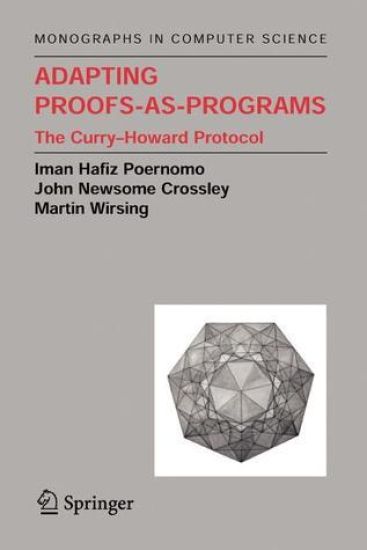
Adapting Proofs-as-Programs

Adapting Proofs-as-Programs

Iman Poernomo; John N. Crossley; Martin Wirsing

Springer-Verlag New York Inc.
2010
nidottu
This book ?nds new things to do with an old idea. The proofs-as-programs paradigm constitutes a set of approaches to developing programs from proofs in constructive logic. It has been over thirty years since the paradigm was ?rst conceived. At that time, there was a belief that proofs-as-programs had the - tential for practical application to semi-automated software development. I- tial applications were mostly concerned with ?ne-grain, mathematical program synthesis. For various reasons, research interest in the area eventually tended toward more theoretic issues of constructive logic and type theory. However, in recent years, the situation has become more balanced, and there is increasingly active research in applying constructive techniques to industrial-scale, complex software engineering problems. Thismonographdetailsseveralimportantadvancesinthisdirectionofpr- tical proofs-as-programs. One of the central themes of the book is a general, abstract framework for developing new systems of program synthesis by adapting proofs-as-programs to new contexts. Framework-oriented approaches that facilitate analogous - proaches to building systems for solving particular problems have been popular and successful. Thesemethodsarehelpful asthey providea formal toolbox that enablesa“roll-your-own”approachtodevelopingsolutions.Itishopedthatour framework will have a similar impact. The framework is demonstrated by example. We will give two novel - plications of proofs-as-programs to large-scale, coarse-grain software engine- ing problems: contractual imperative program synthesis and structured p- gram synthesis. These applications constitute an exemplary justi?cation of the framework. Also, in and of themselves, these approaches to synthesis should be interesting forresearchers working in the target problem domains.
Adapting Proofs-as-Programs

Adapting Proofs-as-Programs

Iman Poernomo; John N. Crossley; Martin Wirsing

Springer-Verlag New York Inc.
2005
sidottu
This book ?nds new things to do with an old idea. The proofs-as-programs paradigm constitutes a set of approaches to developing programs from proofs in constructive logic. It has been over thirty years since the paradigm was ?rst conceived. At that time, there was a belief that proofs-as-programs had the - tential for practical application to semi-automated software development. I- tial applications were mostly concerned with ?ne-grain, mathematical program synthesis. For various reasons, research interest in the area eventually tended toward more theoretic issues of constructive logic and type theory. However, in recent years, the situation has become more balanced, and there is increasingly active research in applying constructive techniques to industrial-scale, complex software engineering problems. Thismonographdetailsseveralimportantadvancesinthisdirectionofpr- tical proofs-as-programs. One of the central themes of the book is a general, abstract framework for developing new systems of program synthesis by adapting proofs-as-programs to new contexts. Framework-oriented approaches that facilitate analogous - proaches to building systems for solving particular problems have been popular and successful. Thesemethodsarehelpful asthey providea formal toolbox that enablesa“roll-your-own”approachtodevelopingsolutions.Itishopedthatour framework will have a similar impact. The framework is demonstrated by example. We will give two novel - plications of proofs-as-programs to large-scale, coarse-grain software engine- ing problems: contractual imperative program synthesis and structured p- gram synthesis. These applications constitute an exemplary justi?cation of the framework. Also, in and of themselves, these approaches to synthesis should be interesting forresearchers working in the target problem domains.
What Is Mathematical Logic?

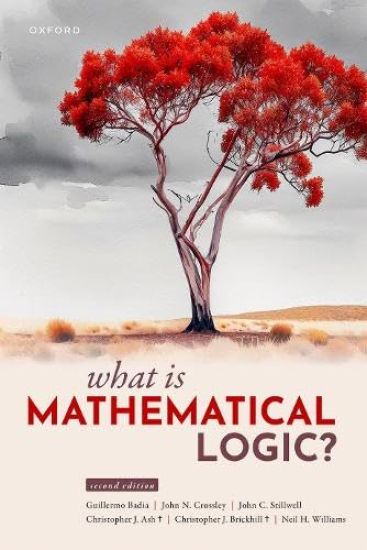
What Is Mathematical Logic?

Guillermo Badia; John N. Crossley; John C. Stillwell; Christopher J. Ash †; Christopher J. Brickhill †; Neil H. Williams

Oxford University Press
2025
sidottu
Mathematical logic has grown from an exotic branch of mathematics into an indispensable tool in computer science as well as other parts of mathematics. This concise book presents the subject of mathematical logic in a lively and approachable fashion although logic can be a formidably abstruse topic, even for mathematicians. This second edition of What is Mathematical Logic?, originally published 50 years ago, deals with important ideas in modern mathematical logic, without the detialed mathematical work required of those with a professional interest in logic. The ideas are set forth simply and clearly in a pleasant style and, despite the book's relative brevity, all the basic material is covered in these pages. Three new chapters have been added, coevering automatic theorem proving, logic beyond traditional first order logic, and other logics including intuitionistic, free, and modal logics. Students of computer science and mathematical logic will find it a stimulating introduction and valuable supplement for courses, including current further reading suggestions in this lively area at the intersection of mathematics, philosophy, and computer science.