Kirjojen hintavertailu. Mukana 12 390 323 kirjaa ja 12 kauppaa.

Kirjailija

John O'Quigley

Kirjat ja teokset yhdessä paikassa: 4 kirjaa, julkaisuja vuosilta 2008-2022, suosituimpien joukossa Survival Analysis. Vertaile teosten hintoja ja tarkista saatavuus suomalaisista kirjakaupoista.

4 kirjaa

Kirjojen julkaisuhaarukka 2008-2022.

Survival Analysis

Survival Analysis

John O'Quigley

Springer Nature Switzerland AG
2022
nidottu
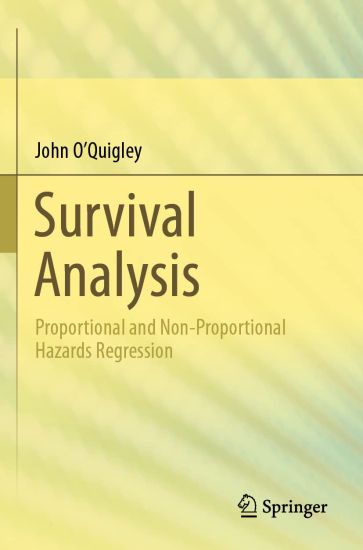
This book provides an extensive coverage of the methodology of survival analysis, ranging from introductory level material to deeper more advanced topics. The framework is that of proportional and non-proportional hazards models; a structure that is broad enough to enable the recovery of a large number of established results as well as to open the way to many new developments. The emphasis is on concepts and guiding principles, logical and graphical. Formal proofs of theorems, propositions and lemmas are gathered together at the end of each chapter separate from the main presentation. The intended audience includes academic statisticians, biostatisticians, epidemiologists and also researchers in these fields whose focus may be more on the applications than on the theory. The text could provide the basis for a two semester course on survival analysis and, with this goal in mind, each chapter includes a section with a range of exercises as a teaching aid for instructors.
Survival Analysis

Survival Analysis

John O'Quigley

Springer Nature Switzerland AG
2021
sidottu
This book provides an extensive coverage of the methodology of survival analysis, ranging from introductory level material to deeper more advanced topics. The framework is that of proportional and non-proportional hazards models; a structure that is broad enough to enable the recovery of a large number of established results as well as to open the way to many new developments. The emphasis is on concepts and guiding principles, logical and graphical. Formal proofs of theorems, propositions and lemmas are gathered together at the end of each chapter separate from the main presentation. The intended audience includes academic statisticians, biostatisticians, epidemiologists and also researchers in these fields whose focus may be more on the applications than on the theory. The text could provide the basis for a two semester course on survival analysis and, with this goal in mind, each chapter includes a section with a range of exercises as a teaching aid for instructors.
Proportional Hazards Regression

Proportional Hazards Regression

John O'Quigley

Springer-Verlag New York Inc.
2010
nidottu
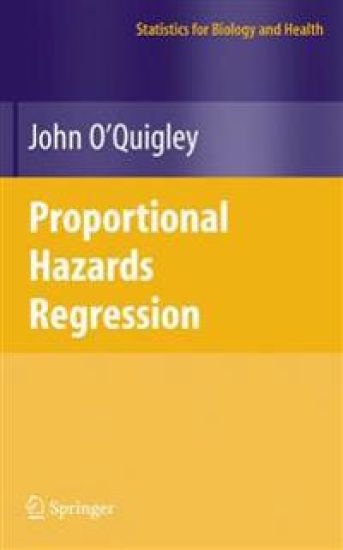
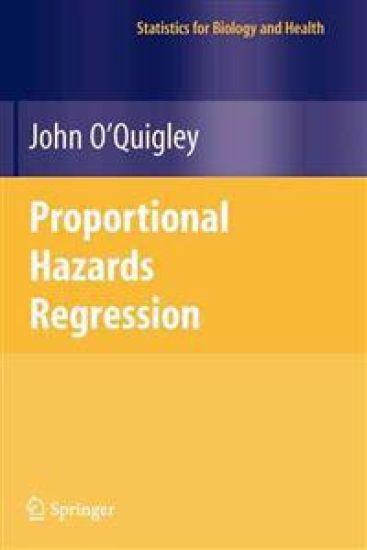
Proportional hazards models and their extensions (models with ti- dependent covariates, models with time dependent regression co- cients, models with random coe?cients and any mixture of these) can be used to characterize just about any applied problem to which the techniques of survival analysis are appropriate. This simple obser- tion enables us to ?nd an elegant statistical expression for all plausible practical situations arising in the analysis of survival data. We have a single unifying framework. In consequence, a solid understanding of the framework itself o?ers the statistician the ability to tackle the thorniestofquestionswhichmayarisewhendealingwithsurvivaldata. The main goal of this text is not to present or review the very s- stantial amount of research that has been carried out on proportional hazards and related models. Rather, the goal is to consider the many questions which are of interest in a regression analysis of survival data (prediction, goodness of ?t, model construction, inference and int- pretation in the presence of misspeci?ed models) from the standpoint of the proportional hazards and the non-proportional hazards models.
Proportional Hazards Regression

Proportional Hazards Regression

John O'Quigley

Springer-Verlag New York Inc.
2008
sidottu
Proportional hazards models and their extensions (models with ti- dependent covariates, models with time dependent regression co- cients, models with random coe?cients and any mixture of these) can be used to characterize just about any applied problem to which the techniques of survival analysis are appropriate. This simple obser- tion enables us to ?nd an elegant statistical expression for all plausible practical situations arising in the analysis of survival data. We have a single unifying framework. In consequence, a solid understanding of the framework itself o?ers the statistician the ability to tackle the thorniestofquestionswhichmayarisewhendealingwithsurvivaldata. The main goal of this text is not to present or review the very s- stantial amount of research that has been carried out on proportional hazards and related models. Rather, the goal is to consider the many questions which are of interest in a regression analysis of survival data (prediction, goodness of ?t, model construction, inference and int- pretation in the presence of misspeci?ed models) from the standpoint of the proportional hazards and the non-proportional hazards models.