Kirjojen hintavertailu. Mukana 12 390 323 kirjaa ja 12 kauppaa.

Kirjailija

John Oller

Kirjat ja teokset yhdessä paikassa: 9 kirjaa, julkaisuja vuosilta 1999-2024, suosituimpien joukossa White Shoe. Vertaile teosten hintoja ja tarkista saatavuus suomalaisista kirjakaupoista.

9 kirjaa

Kirjojen julkaisuhaarukka 1999-2024.

Gangster Hunters

Gangster Hunters

John Oller

Penguin Putnam Inc
2024
sidottu
J. Edgar Hoover was the face of the FBI. But the federal agents in the field, relentlessly chasing the most notorious gangsters of the 1930s with their own lives on the line, truly transformed the Bureau. Gangster Hunters details the fascinating story of the birth of the modern FBI. In 1932, the FBI lacked jurisdiction over murder cases. It also could not pursue bank robberies or kidnappings, and it had no power of arrest. Relegated to the sidelines, the Bureau mostly investigated corporate wrongdoing, such as bank fraud and antitrust violations. Agents spent their days at their desks. But all of that changed during the War on Crime, which began in 1933 and lasted until 1936. Hunting down infamous public enemies in tense, frequently blood-soaked shootouts, the Bureau was thrust onto the front pages for the first time. Young agents, fresh out of law school and anticipating a quiet, white-collar job, faced off with murderous felons who were heavily armed, clad in bulletproof vests, and owned cars that outraced the best vehicles the Bureau had. But the federal men were fiercely devoted--to the Bureau, to each other, and to bringing America's most wanted criminals to justice. The G-men crisscrossed the United States in pursuit of the likes of John Dillinger, Bonnie and Clyde, Ma Barker's criminal family, Baby Face Nelson, and Pretty Boy Floyd. But they were always one step behind and a moment too late, the criminals slipping between their fingers and leaving bodies in their wake. Facing mounting criticism, the agents had to learn to adapt. After all, more than their reputations were at stake. John Oller transports readers right to the most harrowing and consequential raids of the 1930s, with fast-paced action that shows the lengths both sides would go to win.
Rogues' Gallery

Rogues' Gallery

John Oller

Penguin Putnam Inc
2022
nidottu
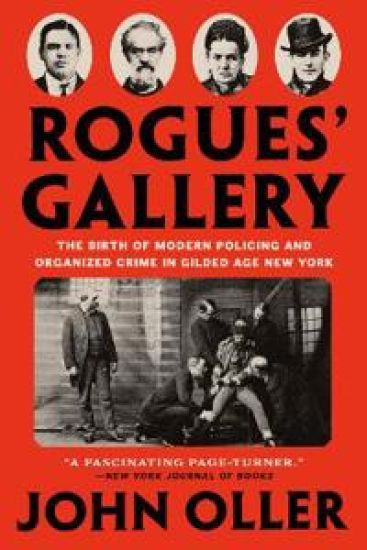
From the beginnings of big-city police work to the rise of the Mafia, Rogues' Gallery is a colorful and captivating history of crime and punishment in the bustling streets of Old New York.Rogues' Gallery is a sweeping, epic tale of two revolutions, one feeding off the other, that played out on the streets of New York City during an era known as the Gilded Age. For centuries, New York had been a haven of crime. A thief or murderer not caught in the act nearly always got away. But in the early 1870s, an Irish cop by the name of Thomas Byrnes developed new ways to catch criminals. Mug shots and daily lineups helped witnesses point out culprits; the famed rogues' gallery allowed police to track repeat offenders; and the third-degree interrogation method induced recalcitrant crooks to confess. Byrnes worked cases methodically, interviewing witnesses, analyzing crime scenes, and developing theories that helped close the books on previously unsolvable crimes. Yet as policing became ever more specialized and efficient, crime itself began to change. Robberies became bolder and more elaborate, murders grew more ruthless and macabre, and the street gangs of old transformed into hierarchal criminal enterprises, giving birth to organized crime, including the Mafia. As the decades unfolded, corrupt cops and clever criminals at times blurred together, giving way to waves of police reform at the hands of men like Theodore Roosevelt. This is a tale of unforgettable characters: Marm Mandelbaum, a matronly German-immigrant woman who paid off cops and politicians to protect her empire of fencing stolen goods; Clubber Williams, a sadistic policeman who wielded a twenty-six-inch club against suspects, whether they were guilty or not; Danny Driscoll, the murderous leader of the Irish Whyos Gang and perhaps the first crime boss of New York; Big Tim Sullivan, the corrupt Tammany Hall politician who shielded the Whyos from the law; the suave Italian Paul Kelly and the thuggish Jewish gang leader Monk Eastman, whose rival crews engaged in brawls and gunfights all over the Lower East Side; and Joe Petrosino, a Sicilian-born detective who brilliantly pursued early Mafioso and Black Hand extortionists until a fateful trip back to his native Italy. Set against the backdrop of New York's Gilded Age, with its extremes of plutocratic wealth, tenement poverty, and rising social unrest, Rogues' Gallery is a fascinating story of the origins of modern policing and organized crime in an eventful era with echoes for our own time.
Rogues' Gallery

Rogues' Gallery

John Oller

E P Dutton Co Inc
2021
sidottu
From the beginnings of big-city police work to the rise of the Mafia, Rogues' Gallery is a colorful and captivating history of crime and punishment in the bustling streets of Old New York.Rogues' Gallery is a sweeping, epic tale of two revolutions, one feeding off the other, that played out on the streets of New York City during an era known as the Gilded Age. For centuries, New York had been a haven of crime. A thief or murderer not caught in the act nearly always got away. But in the early 1870s, an Irish cop by the name of Thomas Byrnes developed new ways to catch criminals. Mug shots and daily line-ups helped witnesses point out culprits; the famed rogues' gallery allowed police to track repeat offenders; and the third-degree interrogation method induced recalcitrant crooks to confess. Byrnes worked cases methodically, interviewing witnesses, analyzing crime scenes, and developing theories that helped close the books on previously unsolvable crimes. Yet as policing became ever more specialized and efficient, crime itself began to change. Robberies became bolder and more elaborate, murders grew more ruthless and macabre, and the street gangs of old transformed into hierarchal criminal enterprises, giving birth to organized crime, including the Mafia. As the decades unfolded, corrupt cops and clever criminals at times blurred together, giving way to waves of police reform at the hands of men like Theodore Roosevelt. This is a tale of unforgettable characters: Marm Mendelbaum, a matronly German-immigrant woman who paid off cops and politicians to protect her empire of fencing stolen goods; Clubber Williams, a sadistic policeman who wielded a twenty-six-inch club against suspects, whether they were guilty or not; Danny Driscoll, the murderous leader of the Irish Whyos Gang and perhaps the first crime boss of New York; Big Tim Sullivan, the corrupt Tammany Hall politician who shielded the Whyos from the law; the suave Italian Paul Kelly and the thuggish Jewish gang leader Monk Eastman, whose rival crews engaged in brawls and gunfights all over the Lower East Side; and Joe Petrosino, a Sicilian-born detective who brilliantly pursued early Mafioso and Black Hand extortionists until a fateful trip back to his native Italy. Set against the backdrop of New York's Gilded Age, with its extremes of plutocratic wealth, tenement poverty, and rising social unrest, Rogues' Gallery is a fascinating story of the origins of modern policing and organized crime in an eventful era with echoes for our own time.
White Shoe

White Shoe

John Oller

E P Dutton Co Inc
2019
sidottu
The fascinating true story of how a group of visionary attorneys helped make American business synonymous with Big Business, and Wall Street the center of the financial world The legal profession once operated on a smaller scale--folksy lawyers arguing for fairness and justice before a judge and jury. But by the year 1900, a new type of lawyer was born, one who understood business as well as the law. Working hand in glove with their clients, over the next two decades these New York City "white shoe" lawyers devised and implemented legal strategies that would drive the business world throughout the twentieth century. These lawyers were architects of the monopolistic new corporations so despised by many, and acted as guardians who helped the kings of industry fend off government overreaching. Yet they also quietly steered their robber baron clients away from a "public be damned" attitude toward more enlightened corporate behavior during a period of progressive, turbulent change in America. Author John Oller, himself a former Wall Street lawyer, gives us a richly-written glimpse of turn-of-the-century New York, from the grandeur of private mansions and elegant hotels and the city's early skyscrapers and transportation systems, to the depths of its deplorable tenement housing conditions. Some of the biggest names of the era are featured, including business titans J. P. Morgan and John D. Rockefeller, lawyer-statesmen Elihu Root and Charles Evans Hughes, and presidents Theodore Roosevelt, William Howard Taft, and Woodrow Wilson. Among the colorful, high-powered lawyers vividly portrayed, White Shoe focuses on three: Paul Cravath, who guided his client George Westinghouse in his war against Thomas Edison and launched a new model of law firm management--the "Cravath system"; Frank Stetson, the "attorney general" for financier J. P. Morgan who fiercely defended against government lawsuits to break up Morgan's business empires; and William Nelson Cromwell, the lawyer "who taught the robber barons how to rob," and was best known for his instrumental role in creating the Panama Canal. In White Shoe, the story of this small but influential band of Wall Street lawyers who created Big Business is fully told for the first time.
The Swamp Fox

The Swamp Fox

John Oller

Da Capo Press Inc
2018
pokkari
In the darkest days of the American Revolution, Francis Marion and his band of militia freedom fighters kept hope alive for the patriot cause during the critical British "southern campaign." Employing insurgent guerrilla tactics that became commonplace in later centuries, Marion and his brigade inflicted enemy losses that were individually small but cumulatively a large drain on British resources and morale.Although many will remember the stirring adventures of the "Swamp Fox" from the Walt Disney television series of the late 1950s and the fictionalized Marion character played by Mel Gibson in the 2000 film The Patriot, the real Francis Marion bore little resemblance to either of those caricatures. But his exploits were no less heroic as he succeeded, against all odds, in repeatedly foiling the highly trained, better-equipped forces arrayed against him.In this action-packed biography we meet many colorful characters from the Revolution: Banastre Tarleton, the British cavalry officer who relentlessly pursued Marion over twenty-six miles of swamp, only to call off the chase and declare (per legend) that "the Devil himself could not catch this damned old fox," giving Marion his famous nickname; Thomas Sumter, the bold but rash patriot militia leader whom Marion detested; Lord Cornwallis, the imperious British commander who ordered the hanging of rebels and the destruction of their plantations; "Light-Horse Harry" Lee, the urbane young Continental cavalryman who helped Marion topple critical British outposts in South Carolina; but most of all Francis Marion himself, "the Washington of the South," a man of ruthless determination yet humane character, motivated by what his peers called "the purest patriotism."In The Swamp Fox, the first major biography of Marion in more than forty years, John Oller compiles striking evidence and brings together much recent learning to provide a fresh look both at Marion, the man, and how he helped save the American Revolution.
Jean Arthur

Jean Arthur

John Oller

Limelight Editions
2004
pokkari
The luminous star of Mr. Smith Goes to Washington, Shane, and other classic films was, as the subtitle aptly puts it, "the actress nobody knew." Jean Arthur (1900-91) kept her personal life private, disdained the Hollywood publicity machine, and was called "difficult" because of her perfectionism and remoteness from costars on the movie set. John Oller, a lawyer, tracked down kinsfolk and friends never before interviewed to capture the elusive personality of a free spirit best embodied in her favorite role, Peter Pan. Arthur herself might have appreciated his warm, respectful portrait. ..."[An] insightful, painstakingly researched analysis of Arthur's life and career raises the curtain on the complex, conflicted person behind the screen persona...Captures the special shine of a unique star who turned out to be a genuine eccentric." -Chicago Tribune
Images That Work

Images That Work

J. Roland Giardetti; John Oller

Praeger Publishers Inc
1999
sidottu
Oller and Giardetti provide a simple, comprehensive, and fully consistent theory to explain why some messages and images communicate more effectively than others — and then show specialists in advertising, marketing, and high stake communications how to apply the theory in their work. With examples and illustrations that practitioners and academics alike will find understandable, they provide readers with a solid grounding in semiotics, the study of how meanings are constructed and construed in signs. In doing so Oller and Giardetti help high stakes communicators find new ways to reach and persuade others — but speak against deceit and subterfuge. They make clear that messages must be consistent with the facts, and that the most successful communicators share one special trait: integrity. A readable, research-based, up-to-date treatment of an important emerging field of study, and a carefully developed guide for practitioners and academics alike. Images That Work is about emotions, desires, ideas, and the hard objects, events, and tensional relations in the common world of space and time. It is about creating and presenting words and pictures in ways that communicate genuine substance from real people to other real people. Oller and Giardetti begin with the foundations of integrity, the glory of supreme effort, and the weaknesses of fads, fashions, and untested gut feelings. They draw examples from high stakes messages in advertising, entertainment, and other communications industries. In doing so they make clear that not only are effective messages consistent with material facts, they are also comprehensive in how they convey facts and yet concise and simple enough to fit into the time and space that consumers will devote to the message. And along the way they give readers a solid grounding in the fascinating and relatively new field of semiotics, a field that has already become well established in the academic community and which has begun to spread its influence to the world outside.