Kirjailija
John P. Kotter
Kirjat ja teokset yhdessä paikassa: 32 kirjaa, julkaisuja vuosilta 1986-2025, suosituimpien joukossa HBR's 10 Must Reads on Change Management, Vol. 2 (with bonus article "Accelerate!" by John P. Kotter). Vertaile teosten hintoja ja tarkista saatavuus suomalaisista kirjakaupoista.
32 kirjaa
Kirjojen julkaisuhaarukka 1986-2025.
Going far beyond previous empirical work, John Kotter and James Heskett provide the first comprehensive critical analysis of how the "culture" of a corporation powerfully influences its economic performance, for better or for worse. Through painstaking research at such firms as Hewlett-Packard, Xerox, ICI, Nissan, and First Chicago, as well as a quantitative study of the relationship between culture and performance in more than 200 companies, the authors describe how shared values and unwritten rules can profoundly enhance economic success or, conversely, lead to failure to adapt to changing markets and environments.With penetrating insight, Kotter and Heskett trace the roots of both healthy and unhealthy cultures, demonstrating how easily the latter emerge, especially in firms which have experienced much past success. Challenging the widely held belief that "strong" corporate cultures create excellent business performance, Kotter and Heskett show that while many shared values and institutionalized practices can promote good performances in some instances, those cultures can also be characterized by arrogance, inward focus, and bureaucracy -- features that undermine an organization's ability to adapt to change. They also show that even "contextually or strategically appropriate" cultures -- ones that fit a firm's strategy and business context -- will not promote excellent performance over long periods of time unless they facilitate the adoption of strategies and practices that continuously respond to changing markets and new competitive environments.Fundamental to the process of reversing unhealthy cultures and making them more adaptive, the authors assert, is effective leadership. At the heart of this groundbreaking book, Kotter and Heskett describe how executives in ten corporations established new visions, aligned and motivated their managers to provide leadership to serve their customers, employees, and stockholders, and thus created more externally focused and responsive cultures.
HBR's 10 Must Reads on Change Management (including featured article "Leading Change," by John P. Kotter)
Harvard Business Review; John P. Kotter; Renee A. Mauborgne; W. Chan Kim
Harvard Business Review Press
2011
pokkari
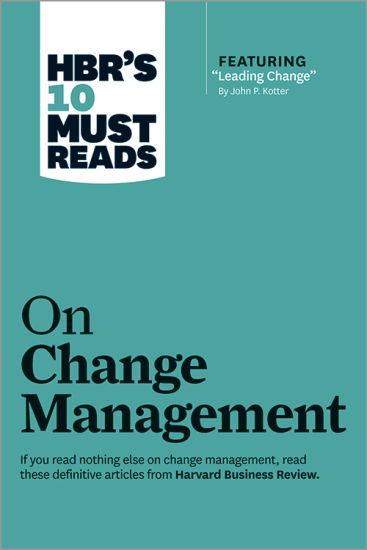
Most company's change initiatives fail. Yours don't have to. If you read nothing else on change management, read these 10 articles (featuring "Leading Change," by John P. Kotter). We've combed through hundreds of Harvard Business Review articles and selected the most important ones to help you spearhead change in your organization. HBR's 10 Must Reads on Change Management will inspire you to: - Lead change through eight critical stages - Establish a sense of urgency - Overcome addiction to the status quo - Mobilize commitment - Silence naysayers - Minimize the pain of change - Concentrate resources - Motivate change when business is good This collection of best-selling articles includes: featured article "Leading Change: Why Transformation Efforts Fail" by John P. Kotter, "Change Through Persuasion," "Leading Change When Business Is Good: An Interview with Samuel J. Palmisano," "Radical Change, the Quiet Way," "Tipping Point Leadership," "A Survival Guide for Leaders," "The Real Reason People Won't Change," "Cracking the Code of Change," "The Hard Side of Change Management," and "Why Change Programs Don't Produce Change."
HBR's 10 Must Reads on Change Management (including featured article "Leading Change," by John P. Kotter)
Harvard Business Review; John P. Kotter; Renee A. Mauborgne; W. Chan Kim
Harvard Business Review Press
2011
sidottu
Most company's change initiatives fail. Yours don't have to. If you read nothing else on change management, read these 10 articles (featuring “Leading Change,” by John P. Kotter). We've combed through hundreds of Harvard Business Review articles and selected the most important ones to help you spearhead change in your organization. HBR's 10 Must Reads on Change Management will inspire you to: Lead change through eight critical stagesEstablish a sense of urgencyOvercome addiction to the status quoMobilize commitmentSilence naysayersMinimize the pain of changeConcentrate resourcesMotivate change when business is good This collection of best-selling articles includes: featured article "Leading Change: Why Transformation Efforts Fail" by John P. Kotter, "Change Through Persuasion," "Leading Change When Business Is Good: An Interview with Samuel J. Palmisano," "Radical Change, the Quiet Way," "Tipping Point Leadership," "A Survival Guide for Leaders," "The Real Reason People Won't Change," "Cracking the Code of Change," "The Hard Side of Change Management," and "Why Change Programs Don't Produce Change."
You've got a good idea. You know it could make a crucial difference for you, your organization, your community. You present it to the group, but get confounding questions, inane comments, and verbal bullets in return. Before you know what's happened, your idea is dead, shot down. You're furious. Everyone has lost: Those who would have benefited from your proposal. You. Your company. Perhaps even the country. It doesn't have to be this way, maintain John Kotter and Lorne Whitehead. In Buy-In, they reveal how to win the support your idea needs to deliver valuable results. The key? Understand the generic attack strategies that naysayers and obfuscators deploy time and time again. Then engage these adversaries with tactics tailored to each strategy. By "inviting in the lions" to critique your idea--and being prepared for them--you'll capture busy people's attention, help them grasp your proposal's value, and secure their commitment to implementing the solution. The book presents a fresh and amusing fictional narrative showing attack strategies in action. It then provides several specific counterstrategies for each basic category the authors have defined--including: * Death-by-delay: Your enemies push discussion of your idea so far into the future it's forgotten. * Confusion: They present so much data that confidence in your proposal dies. * Fearmongering: Critics catalyze irrational anxieties about your idea. * Character assassination: They slam your reputation and credibility. Smart, practical, and filled with useful advice, Buy-In equips you to anticipate and combat attacks--so your good idea makes it through to make a positive change.
In today's complex work world, things no longer get done simply because someone issues an order and someone else follows it.Most of us work in socially intricate organizations where we need the help not only of subordinates but of colleagues, superiors, and outsiders to accomplish our goals. This often leaves us in a "power gap" because we must depend on people over whom we have little or no explicit control.This is a book about how to bridge that gap: how to exercise the power and influence you need to get things done through others when your responsibilities exceed your formal authority.Full of original ideas and expert insights about how organizations?and the people in them?function, Power and Influence goes further, demonstrating that lower-level personnel also need strong leadership skills and interpersonal know-how to perform well.Kotter shows how you can develop sufficient resources of "unofficial" power and influence to achieve goals, steer clear of conflicts, foster creative team behavior, and gain the cooperation and support you need from subordinates, coworkers, superiors?even people outside your department or organization.He also shows how you can avoid the twin traps of naivete and cynicism when dealing with power relationships, and how to use your power without abusing it.Power and Influence is essential for top managers who need to overcome the infighting, foot-dragging, and politicking that can destroy both morale and profits; for middle managers who don't want their careers sidetracked by unproductive power struggles; for professionals hindered by bureaucratic obstacles and deadline delays; and for staff workers who have to "manage the boss."This is not a book for those who want to "grab" power for their own ends. But if you'd like to create smooth, responsive working relationships and increase your personal effectiveness on the job, Kotter can show you how?and make the dynamics of power work for you instead of against you.
Most organizational change initiatives fail spectacularly (at worst) or deliver lukewarm results (at best). In his international bestseller Leading Change, John Kotter revealed why change is so hard, and provided an actionable, eight-step process for implementing successful transformations. The book became the change bible for managers worldwide. Now, in A Sense of Urgency, Kotter shines the spotlight on the crucial first step in his framework: creating a sense of urgency by getting people to actually see and feel the need for change. Why focus on urgency? Without it, any change effort is doomed. Kotter reveals the insidious nature of complacency in all its forms and guises. In this exciting new book, Kotter explains: * How to go beyond "the business case" for change to overcome the fear and anger that can suppress urgency * Ways to ensure that your actions and behaviors -- not just your words -- communicate the need for change * How to keep fanning the flames of urgency even after your transformation effort has scored some early successes Written in Kotter's signature no-nonsense style, this concise and authoritative guide helps you set the stage for leading a successful transformation in your company.
Managing your boss: Isn't that merely manipulation? Corporate cozying up? Not according to John Gabarro and John Kotter. In this handy guidebook, the authors contend that you manage your boss for a very good reason: to do your best on the job--and thereby benefit not only yourself but also your supervisor and your entire company. Your boss depends on you for cooperation, reliability, and honesty. And you depend on him or her for links to the rest of the organization, for setting priorities, and for obtaining critical resources. By managing your boss--clarifying your own and your supervisor's strengths, weaknesses, goals, work styles, and needs--you cultivate a relationship based on mutual respect and understanding. The result? A healthy, productive bond that enables you both to excel. Gabarro and Kotter provide valuable guidelines for building this essential relationship--including strategies for determining how your boss prefers to process information and make decisions, tips for communicating mutual expectations, and tactics for negotiating priorities. Thought provoking and practical, Managing Your Boss enables you to lay the groundwork for one of the most crucial working relationships you'll have in your career.
Widely acknowledged as the world's foremost authority on leadership, John Kotter has devoted his remarkable career to studying organizations and those who run them, and his bestselling books and essays have guided and inspired leaders at all levels. Here, in this collection of his acclaimed Harvard Business Review articles, is an astute assessment of the real work of leaders, as only John Kotter can offer. To complement the HBR articles, Kotter also contributes a new piece, a thoughtful reflection on the themes that have developed throughout his work. Convinced that most organizations today lack the leadership they need, Kotter's mission is to help us better understand what leaders--real leaders--do. True leadership, he reminds us, is an elusive quality, and too often we confuse management duties and personal style with leadership, or even mistake unworthy leaders for the real thing. Yet without leadership, organizations move too slowly, stagnate, and lose their way. With John Kotter on What Leaders Really Do, readers will learn how to become more effective leaders as they explore pressing issues such as power, influence, dependence, and strategies for change.
This 20-year study of the 115 members of Harvard Business School's Class of '74 identifies the factors that influenced their career decisions and explores the breakthroughs that brought them wealth, satisfaction and security during a time of intense economic volatility.
Strong managers produce predictability and order, but leaders create, communicate and implement visions of the future which enable companies to change themselves in a changing competitive marketplace. Building upon his landmark analysis of the job of the general manager and his influential work on leadership, power and influence, John Kotter now focuses on the human factors which bring change. Using case studies from 11 top corporations, Kotter unfolds the stories behind the great successes of leaders who propelled their companies beyond expectations. Through example after example, Kotter identifies the specific personal attributes of these leaders and illustrates the practices that create outstanding leadership.
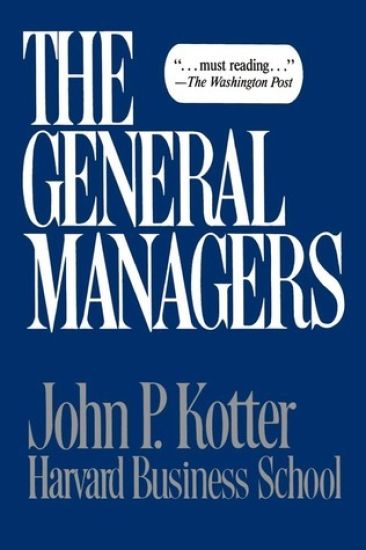
In this unprecedented study of America's leading executives, John Kotter shatters the popular management notion of the effective "generalist" manager who can step into any business or division and run it. Based on his first-hand observations of fifteen top GMs from nine major companies, Kotter persuasively shows that the best manager is actually a specialist who has spent most of his or her career in one industry, learning its intricacies and establishing cooperative working relationships. Acquiring the painstaking knowledge and large, informal networks vital to being a successful manager takes years; outsiders, no matter how talented or well-trained seldom can do as well, this in-depth profile reveals. Much more than a fascinating collective portrait of the day-to-day activities of today's top executives, The General Managers provides stimulating new insights into the nature of modern management and the tactics of its most accomplished practitioners.