

Kirjailija
John P Perkins
Kirjat ja teokset yhdessä paikassa: 5 kirjaa, julkaisuja vuosilta 1991-2026, suosituimpien joukossa Commissioned to Love. Vertaile teosten hintoja ja tarkista saatavuus suomalaisista kirjakaupoista.
Mukana myös kirjoitusasut: John P. Perkins
5 kirjaa
Kirjojen julkaisuhaarukka 1991-2026.
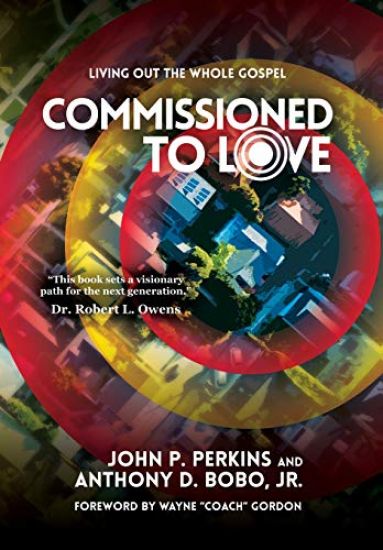
Commissioned to Love
John P Perkins; Anthony D Bobo; Wayne Coach Gordon
I Am Intercultural
2020
sidottu

Pastor John P. Perkins and Anthony D. Bobo, Jr. ask what it means to do justice, to move into reconciliation, to live out evangelism, and to make disciples.In this book, readers will find a clear introduction to the eight principles of Christian Community Development along with a consideration of each of the Commission Circles outlined by Jesus in Acts 1:8, identifying our Jerusalem, Judea, Samaria, and ends of the earth. They ask what it looks like for the Church to live and move as the people of Jesus, empowered by His Holy Spirit, in each of these spheres of influence.This book is both theoretical and practical, as the authors go on to explain what these intersections look like in the lived experience of their practical ministries. "The authors have woven a convincing case that the mission of the gospel is intrinsic and inescapably holistic for and to all. I believe that the church and others who read this book would benefit greatly as they will find in these principles a well-rounded approach for a missional thrust for the next era of leaders."The book offers a framework to aid leaders and congregations in making disciples in all nations & among all people groups not with just words but with their actions as well. John and Anthony outline, in tangible terms, a spiritual formation to help the next generation become "gospel activists". They encourage a pursuit of a holistic approach to bring about the transformation of a cynical generation who wants real reconciliation in a divided world. "Commissioned to Love is the kind of book that promotes excellent missiology, systematic reflection and discipleship making. It calls to all, but especially the next generation to proclaim the gospel of Jesus Christ." From the Afterword, by Dr. Robert L. Owens
Prior to 1974, the ~adrenergic receptors were known only in- directly as entities that responded to drugs in a selective manner to mediate a variety of physiologically important responses. During the intervening years, our view of ~adrenergic receptors has changed dramatically. The availability of high affinity 125I-labeled radioligands selective for these receptors presaged an explosion of experimenta- tion utilizing direct binding assays to establish the biochemical properties of the receptor protein. In the opening chapter, Stadel and Lefkowitz describe this development and its impact on our under- standing of the molecular basis of ~adrenergic receptor function. The availability of well-characterized receptor ligands, coupled with the development of efficient methods for detergent solubilization, formed the basis of receptor purification using affinity chromatography. The related technique of photoaffinity labeling provided a means to estimate the molecular mass of these receptors. The availability of substantial amounts of purified ~2-adrenergic receptor allowed determination of segments of its amino acid se- quence. This information led to the production of polynucleotide probes and eventually to cloning of the receptor gene and determi- nation of the complete primary sequence of the receptor protein. Caron and Lefkowitz review the investigations leading to this major development and discuss the methods involved. They analyze our current perception of the relation of receptor function to its structure and discuss the general features of the G protein-interacting receptor family, of which the ~-adrenergic receptors are prototypes.

Prior to 1974, the ~adrenergic receptors were known only in- directly as entities that responded to drugs in a selective manner to mediate a variety of physiologically important responses. During the intervening years, our view of ~adrenergic receptors has changed dramatically. The availability of high affinity 125I-labeled radioligands selective for these receptors presaged an explosion of experimenta- tion utilizing direct binding assays to establish the biochemical properties of the receptor protein. In the opening chapter, Stadel and Lefkowitz describe this development and its impact on our under- standing of the molecular basis of ~adrenergic receptor function. The availability of well-characterized receptor ligands, coupled with the development of efficient methods for detergent solubilization, formed the basis of receptor purification using affinity chromatography. The related technique of photoaffinity labeling provided a means to estimate the molecular mass of these receptors. The availability of substantial amounts of purified ~2-adrenergic receptor allowed determination of segments of its amino acid se- quence. This information led to the production of polynucleotide probes and eventually to cloning of the receptor gene and determi- nation of the complete primary sequence of the receptor protein. Caron and Lefkowitz review the investigations leading to this major development and discuss the methods involved. They analyze our current perception of the relation of receptor function to its structure and discuss the general features of the G protein-interacting receptor family, of which the ~-adrenergic receptors are prototypes.