Kirjojen hintavertailu. Mukana 12 595 353 kirjaa ja 12 kauppaa.

Kirjailija

John R. Barry

Kirjat ja teokset yhdessä paikassa: 4 kirjaa, julkaisuja vuosilta 1994-2012, suosituimpien joukossa Digital Communication. Vertaile teosten hintoja ja tarkista saatavuus suomalaisista kirjakaupoista.

4 kirjaa

Kirjojen julkaisuhaarukka 1994-2012.

Digital Communication

Digital Communication

John R. Barry; Edward A. Lee; David G. Messerschmitt

Springer-Verlag New York Inc.
2012
nidottu
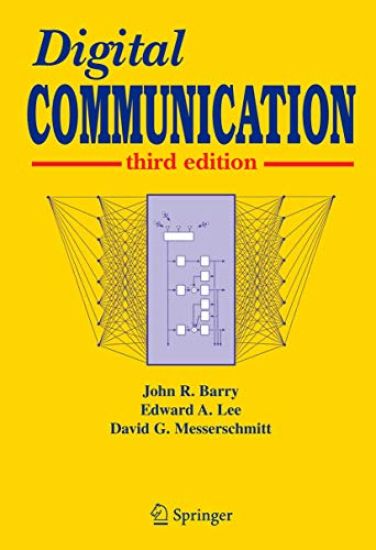
This book concerns digital communication. Specifically, we treat the transport of bit streams from one geographical location to another over various physical media, such as wire pairs, coaxial cable, optical fiber, and radio. We also treat multiple-access channels, where there are potentially multiple transmitters and receivers sharing a common medium. Ten years have elapsed since the Second Edition, and there have been remarkable advances in wireless communication, including cellular telephony and wireless local-area networks. This Third Edition expands treatment of communication theories underlying wireless, and especially advanced techniques involving multiple antennas, which tum the traditional single-input single-output channel into a multiple-input multiple-output (MIMO) channel. This is more than a trivial advance, as it stimulates many advanced techniques such as adaptive antennas and coding techniques that take advantage of space as well as time. This is reflected in the addition of two new chapters, one on the theory of MIMO channels, and the other on diversity techniques for mitigating fading. The field of error-control coding has similarly undergone tremendous changes in the past decade, brought on by the invention of turbo codes in 1993 and the subsequent rediscovery of Gallager's low-density parity-check codes. Our treatment of error-control coding has been rewritten to reflect the current state of the art. Other materials have been reorganized and reworked, and three chapters from the previous edition have been moved to the book's Web site to make room.
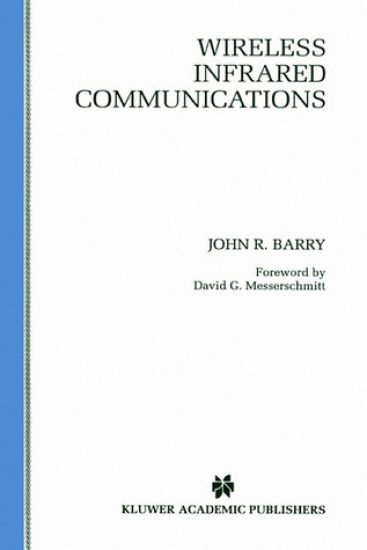
Wireless Infrared Communications

Wireless Infrared Communications

John R. Barry

Springer-Verlag New York Inc.
2012
nidottu
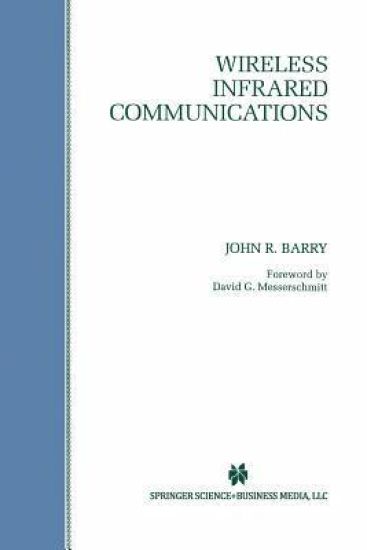
The demand for wireless access to network services is growing in virtually all communications and computing applications. Once accustomed to unteathered opera­ tion, users resent being tied to a desk or a fixed location, but will endure it when there is some substantial benefit, such as higher resolution or bandwidth. Recent technolog­ ical advances, however, such as the scaling of VLSI, the development of low-power circuit design techniques and architectures, increasing battery energy capacity, and advanced displays, are rapidly improving the capabilities of wireless devices. Many of the technological advances contributing to this revolution pertain to the wireless medium itself. There are two viable media: radio and optical. In radio, spread-spectrum techniques allow different users and services to coexist in the same bandwidth, and new microwave frequencies with plentiful bandwidth become viable as the speed of the supporting low-cost electronics increases. Radio has the advantage of being available ubiquitously indoors and outdoors, with the possibility of a seam­ less system infrastructure that allows users to move between the two. There are unan­ swered (but likely to be benign) biological effects of microwave radiation at higher power densities. Optical communications is enhanced by advances in photonic devices, such as semiconductor lasers and detectors. Optical is primarily an indoor technology - where it need not compete with sunlight - and offers advantages such as the immediate availability of a broad bandwidth without the need for regulatory approval.
Digital Communication

Digital Communication

John R. Barry; Edward A. Lee; David G. Messerschmitt

Springer
2003
sidottu
This book concerns digital communication. Specifically, we treat the transport of bit streams from one geographical location to another over various physical media, such as wire pairs, coaxial cable, optical fiber, and radio. We also treat multiple-access channels, where there are potentially multiple transmitters and receivers sharing a common medium. Ten years have elapsed since the Second Edition, and there have been remarkable advances in wireless communication, including cellular telephony and wireless local-area networks. This Third Edition expands treatment of communication theories underlying wireless, and especially advanced techniques involving multiple antennas, which tum the traditional single-input single-output channel into a multiple-input multiple-output (MIMO) channel. This is more than a trivial advance, as it stimulates many advanced techniques such as adaptive antennas and coding techniques that take advantage of space as well as time. This is reflected in the addition of two new chapters, one on the theory of MIMO channels, and the other on diversity techniques for mitigating fading. The field of error-control coding has similarly undergone tremendous changes in the past decade, brought on by the invention of turbo codes in 1993 and the subsequent rediscovery of Gallager's low-density parity-check codes. Our treatment of error-control coding has been rewritten to reflect the current state of the art. Other materials have been reorganized and reworked, and three chapters from the previous edition have been moved to the book's Web site to make room.
Wireless Infrared Communications

Wireless Infrared Communications

John R. Barry

Springer
1994
sidottu
The demand for wireless access to network services is growing in virtually all communications and computing applications. Once accustomed to unteathered opera­ tion, users resent being tied to a desk or a fixed location, but will endure it when there is some substantial benefit, such as higher resolution or bandwidth. Recent technolog­ ical advances, however, such as the scaling of VLSI, the development of low-power circuit design techniques and architectures, increasing battery energy capacity, and advanced displays, are rapidly improving the capabilities of wireless devices. Many of the technological advances contributing to this revolution pertain to the wireless medium itself. There are two viable media: radio and optical. In radio, spread-spectrum techniques allow different users and services to coexist in the same bandwidth, and new microwave frequencies with plentiful bandwidth become viable as the speed of the supporting low-cost electronics increases. Radio has the advantage of being available ubiquitously indoors and outdoors, with the possibility of a seam­ less system infrastructure that allows users to move between the two. There are unan­ swered (but likely to be benign) biological effects of microwave radiation at higher power densities. Optical communications is enhanced by advances in photonic devices, such as semiconductor lasers and detectors. Optical is primarily an indoor technology - where it need not compete with sunlight - and offers advantages such as the immediate availability of a broad bandwidth without the need for regulatory approval.