Kirjojen hintavertailu. Mukana 12 181 891 kirjaa ja 12 kauppaa.

Kirjailija

John R. Meyer

Kirjat ja teokset yhdessä paikassa: 9 kirjaa, julkaisuja vuosilta 1975-2017, suosituimpien joukossa The Economics of Slavery. Vertaile teosten hintoja ja tarkista saatavuus suomalaisista kirjakaupoista.

Mukana myös kirjoitusasut: John R Meyer

9 kirjaa

Kirjojen julkaisuhaarukka 1975-2017.

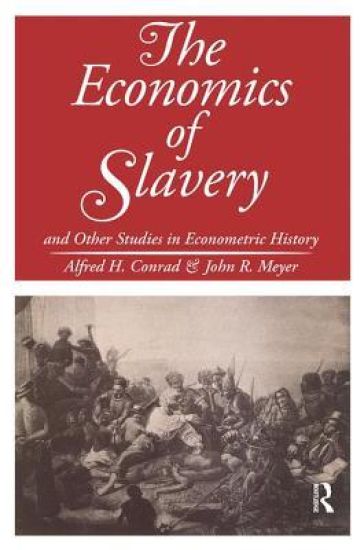
The Economics of Slavery

The Economics of Slavery

John R. Meyer

Routledge
2017
sidottu
How are economists and historians to explain what happened in history? What statistical inferences can be drawn from historical data? The authors believe that explanation in history can be identified with the problems of prediction in a probabilistic universe. Using this approach, the historian can act upon his a priori information and his judgment of what is unique and particular in each past event, even with data hitherto considered to be intractable for statistical treatment. In essence, the book is an argument for and a demonstration of the point of view that the restricted approach of "measurement without theory" is not necessary in history, or at least not necessary in economic history.After two chapters of theoretical introduction, the authors explore the meanings and implications of evidence, explanation and proof in history by applying econometric methods to the analysis of three major problems in 19th century economic history--the profitability of slavery in the antebellum South, income growth and development in the United States during the 1800's, and The Great Depression in the British economy; also included is a postscript on growth reassessing some current arguments in the light of the findings of these papers.The book presents an original and provocative approach to historical problems that have long plagued economists and historians and provides the reader with a new approach to these and similar questions.
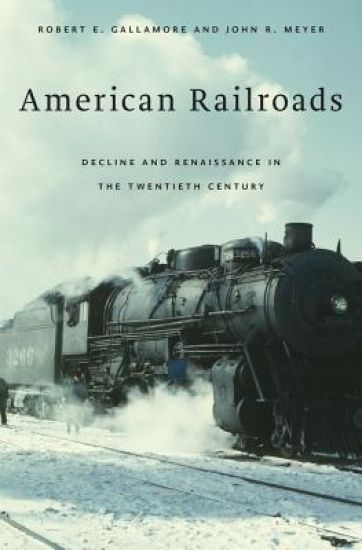
American Railroads

American Railroads

Robert E. Gallamore; John R. Meyer

Harvard University Press
2016
nidottu
Once an icon of American industry, railroads fell into a long decline beginning around the turn of the twentieth century. Overburdened with regulation and often displaced by barge traffic on government-maintained waterways, trucking on interstate highways, and jet aviation, railroads measured their misfortune in lost market share, abandoned track, bankruptcies, and unemployment. Today, however, as Robert Gallamore and John Meyer demonstrate, rail transportation is reviving, rescued by new sources of traffic and advanced technology, as well as less onerous bureaucracy.In 1970, Congress responded to the industry's plight by consolidating most passenger rail service nationwide into Amtrak. But private-sector freight service was left to succeed or fail on its own. The renaissance in freight traffic began in 1980 with the Staggers Rail Act, which allowed railroad companies to contract with customers for services and granted freedom to set most rates based on market supply and demand. Railroads found new business hauling low-sulfur coal and grain long distances in redesigned freight cars, while double-stacked container cars moved a growing volume of both international and domestic goods. Today, trains have smaller crews, operate over better track, and are longer and heavier than ever before.Near the end of the twentieth century, after several difficult but important mergers, privately owned railroads increased their investments in safe, energy-efficient, environmentally friendly freight transportation. American Railroads tells a riveting story about how this crucial U.S. industry managed to turn itself around.
The Economics of Slavery

The Economics of Slavery

John R. Meyer

AldineTransaction
2007
nidottu
How are economists and historians to explain what happened in history? What statistical inferences can be drawn from historical data? The authors believe that explanation in history can be identified with the problems of prediction in a probabilistic universe. Using this approach, the historian can act upon his a priori information and his judgment of what is unique and particular in each past event, even with data hitherto considered to be intractable for statistical treatment. In essence, the book is an argument for and a demonstration of the point of view that the restricted approach of "measurement without theory" is not necessary in history, or at least not necessary in economic history.After two chapters of theoretical introduction, the authors explore the meanings and implications of evidence, explanation and proof in history by applying econometric methods to the analysis of three major problems in 19th century economic history--the profitability of slavery in the antebellum South, income growth and development in the United States during the 1800's, and The Great Depression in the British economy; also included is a postscript on growth reassessing some current arguments in the light of the findings of these papers.The book presents an original and provocative approach to historical problems that have long plagued economists and historians and provides the reader with a new approach to these and similar questions.

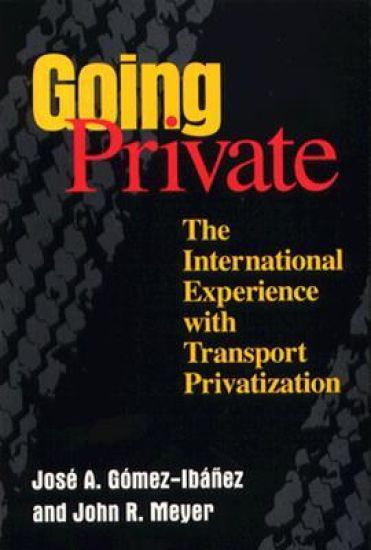
Going Private

Going Private

Jose A. Gomez-Ibanez; John R. Meyer

Brookings Institution
1994
nidottu
"In the last decade many countries turned to private sources to provide services formerly offered by public agencies. Europeans, particularly the British and the French, were leaders in this movement. Developing countries also experimented extensively with privatization in the 1980s, with varying degrees of success. Because governments around the world are heavily involved in transportation, it is a natural focus of privatization experiments and in many ways has been at the cutting edge. Going Private examines the diverse privatization experiences of transportation services and facilities. Cases are drawn from the United States, Asia, Europe, and Latin America. Since almost every country has experimented to some degree with highway and bus privatization, the authors focus particularly on these services, although they also discuss urban rail transit and airports. Highways and buses, they explain, encompass all three of the most common and basic forms of privatization: the sale of an existing state-owned enterprise; use of private, rather than public, financing and management for new infrastructure development; and contracting out to private vendors public services previously provided by government employees.After thoroughly examining these services and discussing the motives for, and objections to, privatization, the authors look at the prospects for privatization in other sectors and industries. They assess those circumstances in which privatization is most likely to succeed and those in which it is most likely to fail, for political as well as economic reasons.The authors conclude that privatization involves many political and social as well as economic dimensions. Privatization is usually not simply a matter of efficiency improvements or capital augmentation but also involves such deeply imbedded societal concerns as equity, income transfers, environmental problems, and attitudes toward taxation and the role of government."
Values Education

Values Education

John R. Meyer

Wilfrid Laurier University Press
1975
nidottu
Valuesâthose intangible guidepostsâserve as standards and perceptual screens which assist us in selecting our priorities for reflection and action. Our quest is to clarify, compare, and form values expressed in defensible and consistent value judgements and actions.
Values Education

Values Education

John R. Meyer

Wilfrid Laurier University Press
1975
sidottu
Valuesâthose intangible guidepostsâserve as standards and perceptual screens which assist us in selecting our priorities for reflection and action. Our quest is to clarify, compare, and form values expressed in defensible and consistent value judgements and actions.