Kirjojen hintavertailu. Mukana 12 290 054 kirjaa ja 12 kauppaa.

Kirjailija

John R. Ross

Kirjat ja teokset yhdessä paikassa: 2 kirjaa, julkaisuja vuosilta 2000-2014, suosituimpien joukossa Tronnies: The Source of the Coulomb Force. Vertaile teosten hintoja ja tarkista saatavuus suomalaisista kirjakaupoista.

2 kirjaa

Kirjojen julkaisuhaarukka 2000-2014.

Tronnies: The Source of the Coulomb Force
Mr. Ross has identified for the first time the single particle and its anti-particle that everything in our Universe is made of. It is a point particle with no mass and no volume, but it has a charge of plus e or minus e which means these particles carry the Coulomb force. Mr. Ross has named these particles "TRONNIES". Tronnies are self-propelled by their own Coulomb forces at speeds of (pi)/2 times the speed of light and they always travel in perfect circles in threesomes and twosomes. The threesomes are electrons and positrons and the twosomes are entrons (also first identified by Mr. Ross). Mr. Ross shows for the first time the internal structure of electrons and positrons, and their sizes to be about 2 X 10-18 m. The sizes of entrons range from about 1 X 10-18 m to about 10 cm (about 100 million-billion times larger). One entron provides the energy and mass for each photon. The same entron that provides the gravity of galaxies provides almost all of the mass of each proton. Three entrons combine to make an electron and a positron. So electrons, positrons and entrons are made from tronnies. Everything else is made from entrons or entrons, electrons and positrons. By "everything" we mean everything: photons, protons, atoms, molecules, plants, animals, people, moons, planets, stars, galaxies, electricity, magnetism, gravity and anti-gravity. Mr. Ross reveals to the general public for the first time how to build universes from these points of charge and how universes are created and recycled.
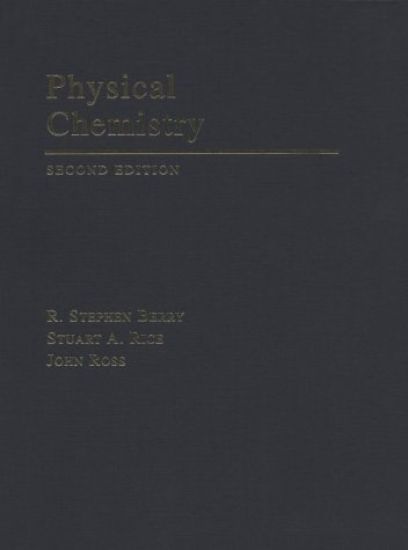
Physical Chemistry

Physical Chemistry

R. Stephen Berry; Stuart A. Rice; John R. Ross

Oxford University Press Inc
2000
sidottu
The authors' goal is the presentation of the three major areas of physical chemistry: molecular structure, the equilibrium properties of systems, and the kinetics of transformations of systems. The theoretical foundations of these subjects are, respectively, quantum mechanics, thermodynamics and equilibrium statistical mechanics, and chemical kinetics and kinetic theory. These theories, firmly based on experimental findings, constitute the structure required for the understanding of past accomplishments and the basis for recognition and development of significant new areas in physical chemistry. The presentation of the theories of physical chemistry requires careful discussions at several levels of exposition. The authors' approach aims toward depth of understanding of fundamentals more than toward breadth of recognition of the multitude of activities that go on under the name of physical chemistry. The organization of the book, with its three principal sections, should make this clear. The mathematical level begins with elementary calculus, and rises to the use of simple properties of partial differential equations and the special functions that enter into their solutions. The authors' intention is to keep the reader's mind on the scienc rather than on the mathematics, especially at the beginning. This procedure also corresponds to the pattern, followed by many students, of taking physical chemistry and advanced calculus concurrently. Appendices develop the details of the mathematical tools as they are needed. The text discussion contains more material than can be covered in the traditional one-year physical chemistry sequence; it is designed to fulfill the dual purpose of providing a clear and incisive treatment of fundamental principles at a level accessible to all students while broadening the perspectives and challenging the minds of the best students. Individual instructors will wish to make their own selections of material for inclusion and exclusion, respectively.