
Kirjailija
John S. Kloppenborg
Kirjat ja teokset yhdessä paikassa: 17 kirjaa, julkaisuja vuosilta 1987-2027, suosituimpien joukossa Associations. Vertaile teosten hintoja ja tarkista saatavuus suomalaisista kirjakaupoista.
Mukana myös kirjoitusasut: John S Kloppenborg
17 kirjaa
Kirjojen julkaisuhaarukka 1987-2027.
Associations in the Greco-Roman World
Richard S. Ascough; Philip A. Harland; John S. Kloppenborg
Baylor University Press
2024
pokkari
Associations in the Greco-Roman World provides students and scholars with a clear and readable resource for greater understanding of the social, cultural, and religious life across the ancient Mediterranean. The authors provide new translations of inscriptions and papyri from hundreds of associations, alongside descriptions of more than two dozen archaeological remains of building sites. Complemented by a substantial annotated bibliography and accompanying images, this sourcebook fills many gaps and allows for future exploration in studies of the Greco-Roman religious world, particularly the nature of Judean and Christian groups at that time.
Like other volumes in the New Testament Guides series, James offers a concise and accessible introduction to a New Testament text, in this case aimed specifically at undergraduate-level students. Kloppenborg introduces the reader to a series of critical issues bearing on the reading of James and provides a balanced presentation and assessment of the range of scholarly views, with guidance for further reading and research.

James offers a concise and accessible introduction to a New Testament text, in this case aimed specifically at undergraduate-level students. John S. Kloppenborg introduces the reader to a series of critical issues bearing on the reading of James and provides a balanced presentation and assessment of the range of scholarly views, with guidance for further reading and research.

Private associations organized around a common cult, occupation, ethnic identity, neighborhood or family were among the principal means of organizing social and economic life in the ancient Mediterranean. They offered opportunities for sociability, cultic activities, mutual support and contexts in which to display and recognize virtuous achievement. This volume collects 140 inscriptions and papyri from Ptolemaic and early Roman Egypt, along with translations, notes, commentary, and analytic indices. The dossier of association-related documents substantially enhances our knowledge of the extent, activities, and importance of private associations in the ancient Mediterranean, since papyri, unavailable from most other locations in the Mediterranean, preserve a much wider range of data than epigraphical monuments. The dossier from Egypt includes not only honorific decrees, membership lists, bylaws, dedications, and funerary monuments, but monthly accounts of expenditures and income, correspondence between guild secretaries and local officials, price and tax declarations, records of legal actions concerning associations, loan documents, petitions to local authorities about associations, letters of resignation, and many other papyrological genres. These documents provide a highly variegated picture of the governance structures and practices of associations, membership sizes and profiles, and forms of interaction with the State.
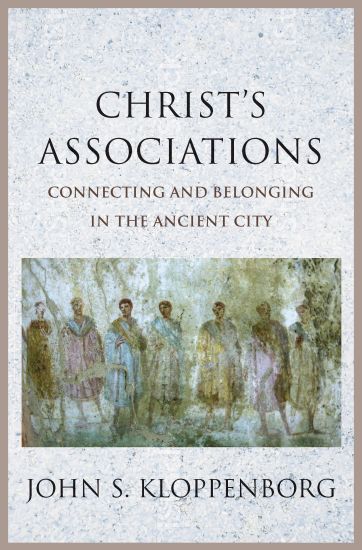
A groundbreaking investigation of early Christ groups in the ancient Mediterranean As an urban movement, the early groups of Christ followers came into contact with the many small groups in Greek and Roman antiquity. Organized around the workplace, a deity, a diasporic identity, or a neighborhood, these associations gathered in small face-to-face meetings and provided the principal context for cultic and social interactions for their members. Unlike most other groups, however, about which we have data on their rules of membership, financial management, and organizational hierarchy, we have very little information about early Christ groups. Drawing on data about associative practices throughout the ancient world, this innovative study offers new insight into the structure and mission of the early Christ groups. John S. Kloppenborg situates the Christ associations within the broader historical context of the ancient Mediterranean and reveals that they were probably smaller than previously believed and did not have a uniform system of governance, and that the attraction of Christ groups was based more on practice than theological belief.

This volume contains a collection of twenty-one essays of John S. Kloppenborg, with four foci: conceptual and methodological issues in the Synoptic Problem; the Sayings Gospel Q; the Gospel of Mark; and the Parables of Jesus. Kloppenborg, a major contributor to the Synoptic Problem, is especially interested in how one constructs synoptic hypotheses, always aware of the many gaps in our knowledge, the presence of competing hypotheses, and the theological and historical entailments in any given hypothesis. Common to the essays in the remaining three sections is the insistence that the literature, thought and practices of the early Jesus movement must be treated with a deep awareness of their social, literary, and intellectual contexts. The context of the early Jesus movement is illumined not simply by resort to the literary and historical sources produced by Greek and Roman elites but, more importantly, by data gathered from documentary sources available in non-literary papyri.
Associations in the Greco-Roman World
Richard S. Ascough; Philip A. Harland; John S. Kloppenborg
Baylor University Press
2012
pokkari
Associations in the Greco-Roman World provides students and scholars with a clear and readable resource for greater understanding of the social, cultural, and religious life across the ancient Mediterranean. The authors provide new translations of inscriptions and papyri from hundreds of associations, alongside descriptions of more than two dozen archaeological remains of building sites. Complemented by a substantial annotated bibliography and accompanying images, this sourcebook fills many gaps and allows for future exploration in studies of the Greco-Roman religious world, particularly the nature of Judean and Christian groups at that time.

Attica, Central Greece, Macedonia, Thrace
John S. Kloppenborg; Richard S. Ascough
De Gruyter
2011
sidottu
Private associations organized around a common cult, profession, ethnic identity, neighbourhood or family were common throughout the Greco-Roman antiquity, offering opportunities for sociability, cultic activities, mutual support and a context in which to display and recognize virtuous achievement. This volume collects a representative selection of inscriptions from associations in Attica, Central Greece, Macedonia, Thrace, published with English translations, brief explanatory notes, commentaries and full indices. This volume is essential for several areas of study: ancient patterns of social organization; the organization of diasporic communities in the ancient Mediterranean; models for the structure of early Christian groups; and forms of sociability, status-displays, and the vocabularies of virtue.
Estimated to date back to the very early Jesus movement, the lost Gospel known as Q offers a distinct and remarkable picture of Jesus and his significance--and one that differs markedly from that offered by its contemporary, the apostle Paul.Q presents Jesus as a prophetic critic of unbelief and a sage with the wisdom that can transform. In Q, the true meaning of the "kingdom of God" is the fulfillment of a just society through the transformation of the human relationships within it.Though this document has never been found, John Kloppenborg offers a succinct account of why scholars maintain it existed in the first place and demonstrates how they have been able to reconstruct its contents and wording from the two later Gospels that used it as a source: Matthew and Luke. Presented here in its entirety, as developed by the International Q Project, this Gospel reveals a very different portrait of Jesus than in much of the later canonical writings, challenging the way we think of Christian origins and the very nature and mission of Jesus Christ.

John S. Kloppenborg gives a detailed analysis of one of the most difficult of Jesus' parables, the parable of the Tenants (Mark 12:1-12; Gospel of Thomas 65). He examines the ways in which Christians have typically read and mis-read the parable, and places the parable firmly in the context of the practices of ancient viticulture. The author models a new approach to the interpretation of the parables of Jesus. First, he critically engages the history of interpretation of the text, inquiring into the ideological interests that the parable has engaged during the history of its use in Christian churches and in political discourse. Second, he reconstructs the social world in which the parable was first told, in particular the economic, social, and legal aspects of ancient viticulture. He demonstrates that the parable of the Tenants has mostly been interpreted from the standpoint of those who wield social and political power, a strange irony considering the social status of the Jesus of history and the literary uses of the parable. All of the features common to the parable as it is told by Mark and the Gospel of Thomas make it a perfectly realistic story. It is only Mark's editing of the story that takes it beyond the realistic idiom characteristic of Jesus' other parables. The book concludes with a dossier of 58 papyrus documents relating to various aspects of viticulture and agrarian conflict.It was awarded the 2007 Francis W. Beare Book Award by the Canadian Society of Biblical Studies.
In this tour de force, the author offers a comprehensive introduction to the study of Q, the collection of Jesus' sayings long hypothesized as the source for the canonical gospels of Matthew and Luke. Part I deals with the methods for studying Q, their presuppositions, and a survey of current research. Part II addresses more theological and theoretical issues relevant to the Synoptic Problem, Q as a document, its redaction, and its social setting.
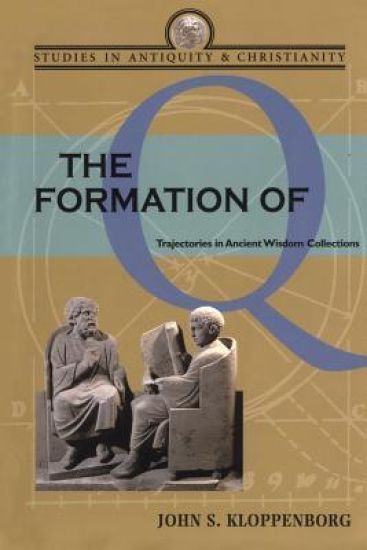
The Formation of Q
John S. Kloppenborg
Continuum International Publishing Group - Trinity
2000
nidottu
In this groundbreaking study, John Kloppenborg traces the literary evolution of Q as a document of primitive Christianity by considering it within the context of ancient literary genres. He argues that Q is composed of three compositional layers, or strata, each of which reflects certain stages of development in the Q community. The earliest formative layer reflects the influence of ancient sapiential sayings: the second layer suggests the influence of the prophetic literature of judgment and contains prophetic oracles and many Son-of-Man sayings. The third layer contains a temptation story, moving the document from a chriae collection in the direction of a biography.
The best and most readable one-volume introduction available to the Sayings Gospel Q and the Gospel of Thomas-the very earliest collections of the sayings and parables of Jesus. The Q-Thomas Reader includes new translations, lucid commentary by leading scholars, suggested readings and a comprehensive glossary. This is essential reading for anyone wanting to learn more about "the gospels before the gospels."