Kirjojen hintavertailu. Mukana 12 390 323 kirjaa ja 12 kauppaa.

Kirjailija

John Seely Brown

Kirjat ja teokset yhdessä paikassa: 12 kirjaa, julkaisuja vuosilta 2004-2018, suosituimpien joukossa Design Unbound: Designing for Emergence in a White Water World. Vertaile teosten hintoja ja tarkista saatavuus suomalaisista kirjakaupoista.

12 kirjaa

Kirjojen julkaisuhaarukka 2004-2018.

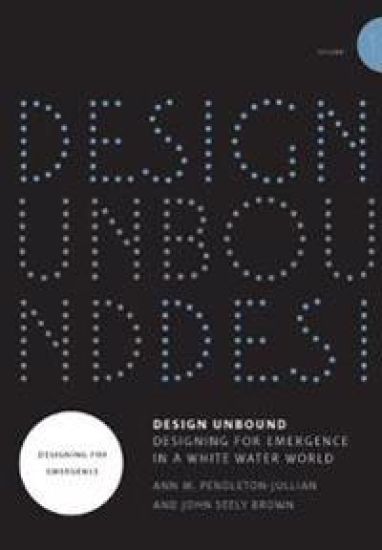
Design Unbound: Designing for Emergence in a White Water World

Design Unbound: Designing for Emergence in a White Water World

Ann M. Pendleton-Jullian; John Seely Brown

MIT Press
2018
pokkari
Tools for navigating today's hyper-connected, rapidly changing, and radically contingent white water world.Design Unbound presents a new tool set for having agency in the twenty-first century, in what the authors characterize as a white water world-rapidly changing, hyperconnected, and radically contingent. These are the tools of a new kind of practice that is the offspring of complexity science, which gives us a new lens through which to view the world as entangled and emerging, and architecture, which is about designing contexts. In such a practice, design, unbound from its material thingness, is set free to design contexts as complex systems.In a world where causality is systemic, entangled, in flux, and often elusive, we cannot design for absolute outcomes. Instead, we need to design for emergence. Design Unbound not only makes this case through theory but also presents a set of tools to do so. With case studies that range from a new kind of university to organizational, and even societal, transformation, Design Unbound draws from a vast array of domains: architecture, science and technology, philosophy, cinema, music, literature and poetry, even the military. It is presented in five books, bound as two volumes. Different books within the larger system of books will resonate with different reading audiences, from architects to people reconceiving higher education to the public policy or defense and intelligence communities. The authors provide different entry points allowing readers to navigate their own pathways through the system of books.
Design Unbound

Design Unbound

Ann M. Pendleton-Jullian; John Seely Brown

MIT Press
2018
pokkari
Tools for navigating today's hyper-connected, rapidly changing, and radically contingent white water world.Design Unbound presents a new tool set for having agency in the twenty-first century, in what the authors characterize as a white water world-rapidly changing, hyperconnected, and radically contingent. These are the tools of a new kind of practice that is the offspring of complexity science, which gives us a new lens through which to view the world as entangled and emerging, and architecture, which is about designing contexts. In such a practice, design, unbound from its material thingness, is set free to design contexts as complex systems.In a world where causality is systemic, entangled, in flux, and often elusive, we cannot design for absolute outcomes. Instead, we need to design for emergence. Design Unbound not only makes this case through theory but also presents a set of tools to do so. With case studies that range from a new kind of university to organizational, and even societal, transformation, Design Unbound draws from a vast array of domains: architecture, science and technology, philosophy, cinema, music, literature and poetry, even the military. It is presented in five books, bound as two volumes. Different books within the larger system of books will resonate with different reading audiences, from architects to people reconceiving higher education to the public policy or defense and intelligence communities. The authors provide different entry points allowing readers to navigate their own pathways through the system of books.
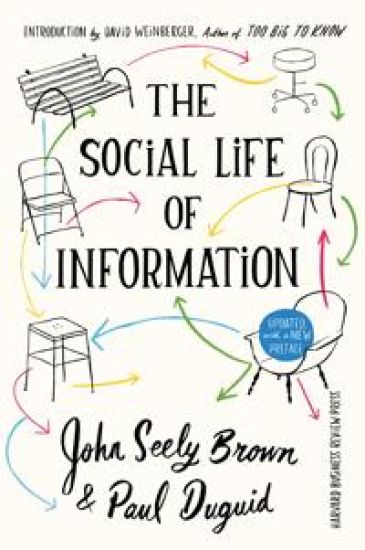
The Social Life of Information

The Social Life of Information

John Seely Brown; Paul Duguid

Harvard Business Review Press
2017
sidottu
"Should be read by anyone interested in understanding the future," The Times Literary Supplement raved about the original edition of The Social Life of Information. We're now living in that future, and one of the seminal books of the Internet Age is more relevant than ever. The future was a place where technology was supposed to empower individuals and obliterate social organizations. Pundits predicted that information technology would obliterate the need for almost everything--from mass media to bureaucracies, universities, politics, and governments. Clearly, we are not living in that future. The Social Life of Information explains why. John Seely Brown and Paul Duguid show us how to look beyond mere information to the social context that creates and gives meaning to it. Arguing elegantly for the important role that human sociability plays, even--perhaps especially--in the digital world, The Social Life of Information gives us an optimistic look beyond the simplicities of information and individuals. It shows how a better understanding of the contribution that communities, organizations, and institutions make to learning, working, and innovating can lead to the richest possible use of technology in our work and everyday lives. With a new introduction by David Weinberger and reflections by the authors on developments since the book's first publication, this new edition is essential reading for anyone seeking to understand the human place in a digital world.
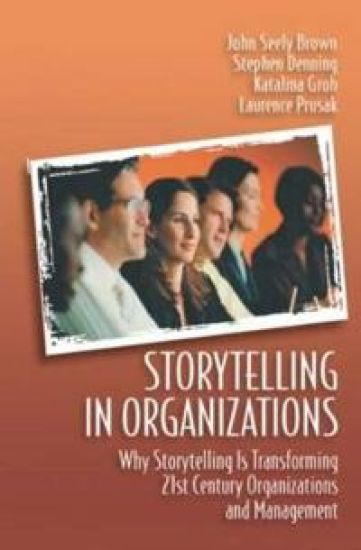
Storytelling in Organizations

Storytelling in Organizations

Laurence Prusak; Katalina Groh; Stephen Denning; John Seely Brown

Routledge
2016
sidottu
This book is the story of how four busy executives, from different backgrounds and different perspectives, were surprised to find themselves converging on the idea of narrative as an extraordinarily valuable lens for understanding and managing organizations in the twenty-first century. The idea that narrative and storytelling could be so powerful a tool in the world of organizations was initially counter-intuitive. But in their own words, John Seely Brown, Steve Denning, Katalina Groh, and Larry Prusak describe how they came to see the power of narrative and storytelling in their own experience working on knowledge management, change management, and innovation strategies in organizations such as Xerox, the World Bank, and IBM. Storytelling in Organizations lays out for the first time why narrative and storytelling should be part of the mainstream of organizational and management thinking. This case has not been made before. The tone of the book is also unique. The engagingly personal and idiosyncratic tone comes from a set of presentations made at a Smithsonian symposium on storytelling in April 2001. Reading it is as stimulating as spending an evening with Larry Prusak or John Seely Brown. The prose is probing, playful, provocative, insightful and sometime profound. It combines the liveliness and freshness of spoken English with the legibility of a ready-friendly text. Interviews will all the authors done in 2004 add a new dimension to the material, allowing the authors to reflect on their ideas and clarify points or highlight ideas that may have changed or deepened over time.
En ny lärandekultur : att odla fantasin för en ständigt föränderlig värld

En ny lärandekultur : att odla fantasin för en ständigt föränderlig värld

Douglas Thomas; John Seely Brown

Bokförlaget Daidalos
2013
nidottu
»Det lärande som kommer att definiera det tjugoförsta århundradet äger inte rum i klassrum ? i alla fall inte i dagens klassrum. Istället äger det rum överallt omkring oss. Vi kallar detta fenomen för den nya lärandekulturen, och den bottnar i en väldigt enkel fråga: Vad händer med lärandet när vi går från 1900-talets stabila infrastruktur till 2000-talets flytande infrastruktur, där ny teknologi hela tiden genererar, och förhåller sig till, förändring? ?Svaret är överraskande enkelt. Den obevekligt snabba förändring som har fått oss att mista fotfästet är ironiskt nog också vårt största hopp. En växande digital och nätverksbaserad infrastruktur stärker vår förmåga att använda oss av nästan obegränsade resurser och otroliga verktyg, samtidigt som vi får kontakt med andra människor.» Så skriver Douglas Thomas och John Seely Brown i inledningen till denna inspirerande bok om en ny lärandekultur. En lärandekultur som framför allt baserar sig på en ständigt förnyelsebar mänsklig resurs: fantasin.
The Power of Pull

The Power of Pull

John Hagel; John Seely Brown; Lang Davison

Basic Books
2012
pokkari
In a radical break with the past, information now flows like water, and we must learn how to tap into its stream. Individuals and companies can no longer rely on the stocks of knowledge that they've carefully built up and stored away. Information now flows like water, and we must learn how to tap into the stream. But many of us remain stuck in old practices- practices that could undermine us as we search for success and meaning. In this revolutionary book, three doyens of the Internet age, whose path-breaking work has made headlines around the world, reveal the adjustments we must make if we take these changes seriously. In a world of increasing risk and opportunity, we must understand the importance of pull . Understood and used properly, the power of pull can draw out the best in people and institutions by connecting them in ways that increase understanding and effectiveness. Pull can turn uncertainty into opportunity, and enable small moves to achieve outsized impact. Drawing on pioneering research, The Power of Pull shows how to apply its principles to unlock the hidden potential of individuals and organizations, and how to use it as a force for social change and the development of creative talent. The authors explore how to use the power of pull to: Access new sources of information Attract likeminded individuals from around the world Shape serendipity to increase the likelihood of positive chance encounters Form creation spaces to drive you and your colleagues to new heights Transform your organization to adapt to the flow of knowledge The Power of Pull is essential reading for entrepreneurs, managers, and anybody interested in understanding and harnessing the shifting forces of our networked world.
Opening Up Education

Opening Up Education

John Seely Brown

MIT Press
2010
pokkari
Experts discuss the potential for open education tools, resources, and knowledge to transform the economics and ecology of education.Given the abundance of open education initiatives that aim to make educational assets freely available online, the time seems ripe to explore the potential of open education to transform the economics and ecology of education. Despite the diversity of tools and resources already available-from well-packaged course materials to simple games, for students, self-learners, faculty, and educational institutions-we have yet to take full advantage of shared knowledge about how these are being used, what local innovations are emerging, and how to learn from and build on the experiences of others. Opening Up Education argues that we must develop not only the technical capability but also the intellectual capacity for transforming tacit pedagogical knowledge into commonly usable and visible knowledge: by providing incentives for faculty to use (and contribute to) open education goods, and by looking beyond institutional boundaries to connect a variety of settings and open source entrepreneurs. These essays by leaders in open education describe successes, challenges, and opportunies they have found in a range of open education initiatives. They approach-from both macro and micro perspectives-the central question of how open education tools, resources, and knowledge can improve the quality of education. The contributors (from leading foundations, academic institutions, associations, and projects) discuss the strategic underpinnings of their efforts first in terms of technology, then content, and finally knowledge. They also address the impact of their projects, and how close they come to achieving a vision of sustainable, transformative educational opportunities that amounts to much more than pervasive technology.Through the support of the Carnegie Foundation for the Advancement of Teaching, an electronic version of this book is openly available under a Creative Commons license at The MIT Press Web site, http://mitpress.mit.edu. ContributorsRichard Baraniuk, Randy Bass, Trent Batson, Dan Bernstein, John Seely Brown, Barbara Cambridge, Tom Carey, Catherine Casserly, Bernadine Chuck Fong, Ira Fuchs, Richard Gale, Mia Garlick, Gerard Hanley, Diane Harley, Mary Huber, Pat Hutchings, Toru Iiyoshi, David Kahle, M. S. Vijay Kumar, Andy Lane, Diana Laurillard, Stuart Lee, Steve Lerman, Marilyn Lombardi, Phil Long, Clifford Lynch, Christopher Mackie, Anne Margulies, Owen McGrath, Flora McMartin, Shigeru Miyagawa, Diana Oblinger, Neeru Paharia, Cheryl Richardson, Marshall Smith, Candace Thille, Edward Walker, David Wiley
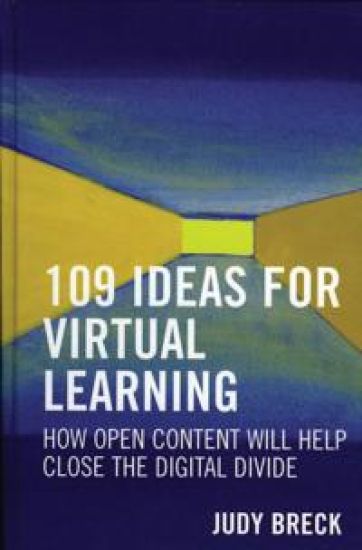
109 Ideas for Virtual Learning

109 Ideas for Virtual Learning

Judy Breck; John Seely Brown

Rowman Littlefield Education
2005
sidottu
109 IDEAS For Virtual Learning reveals the online knowledge venue that today's generation uses to learn while playing along at school to receive promotions, diplomas, and degrees. Calling that venue "the virtual knowledge ecology", Judy Breck describes the networking of open content for learning online where knowledge is fresher, authoritative, and more compelling than at school. In this book, she provides her eyewitness account of the decade-long, ongoing cascade of what is known by humankind from traditional resources into the Internet and explains the network mechanisms that interconnect the knowledge once it gets online. Breck says the resulting virtual knowledge ecology is causing students worldwide literally to study from the same virtual page. The author forewarns readers to expect emerging good news as the virtual knowledge ecology opens the way for a global golden age of education in which students learn more and teachers are respected professionals. Breck contends that literacy and learning follow naturally from the Internet interfacing what humankind knows. A boy or girl's hands can now hold a wireless device mirroring enlightenment from a new virtual venue into his or her mind.
109 Ideas for Virtual Learning

109 Ideas for Virtual Learning

Judy Breck; John Seely Brown

Rowman Littlefield Education
2005
nidottu
109 IDEAS For Virtual Learning reveals the online knowledge venue that today's generation uses to learn while playing along at school to receive promotions, diplomas, and degrees. Calling that venue 'the virtual knowledge ecology', Judy Breck describes the networking of open content for learning online where knowledge is fresher, authoritative, and more compelling than at school. In this book, she provides her eyewitness account of the decade-long, ongoing cascade of what is known by humankind from traditional resources into the Internet and explains the network mechanisms that interconnect the knowledge once it gets online. Breck says the resulting virtual knowledge ecology is causing students worldwide literally to study from the same virtual page. The author forewarns readers to expect emerging good news as the virtual knowledge ecology opens the way for a global golden age of education in which students learn more and teachers are respected professionals. Breck contends that literacy and learning follow naturally from the Internet interfacing what humankind knows. A boy or girl's hands can now hold a wireless device mirroring enlightenment from a new virtual venue into his or her mind.
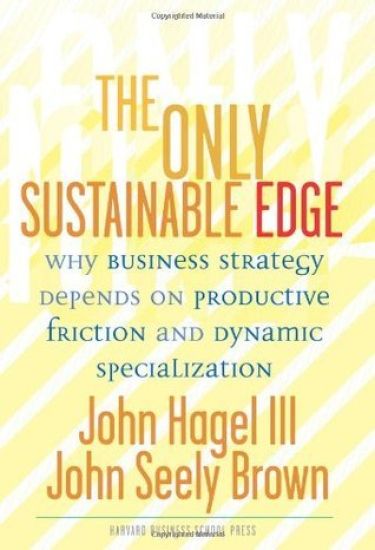
The Only Sustainable Edge

The Only Sustainable Edge

John Hagel; John Seely Brown

Harvard Business Review Press
2005
sidottu
Offshoring and outsourcing have generated substantial savings and often controversial news coverage for many companies. But these technologies aren't even close to being the real story. Two of business' leading strategy thinkers argue that the only sustainable advantage will come not from using technology to cut costs - but to get better faster than rivals. The authors identity two key forces - dynamic specialisation and productive friction that will dramatically reshape the competitive landscape and show what firms must do to understand, build and exploit these forces before their competitors do.
Storytelling in Organizations

Storytelling in Organizations

Laurence Prusak; Katalina Groh; Stephen Denning; John Seely Brown

Butterworth-Heinemann Ltd
2004
nidottu
This book is the story of how four busy executives, from different backgrounds and perspectives, were surprised to find themselves converging on the idea of narrative as a valuable lens for understanding and managing organizations. The authors describe the power of narrative and storytelling in their own experience working on knowledge management, change management, and innovation strategies in organizations such as Xerox, the World Bank, and IBM. Storytelling in Organizations lays out for the first time why narrative and storytelling should be part of the mainstream of organizational and management thinking.