Kirjojen hintavertailu. Mukana 12 595 353 kirjaa ja 12 kauppaa.

Kirjailija

John Stachurski

Kirjat ja teokset yhdessä paikassa: 6 kirjaa, julkaisuja vuosilta 2016-2025, suosituimpien joukossa Economic Dynamics, second edition. Vertaile teosten hintoja ja tarkista saatavuus suomalaisista kirjakaupoista.

6 kirjaa

Kirjojen julkaisuhaarukka 2016-2025.

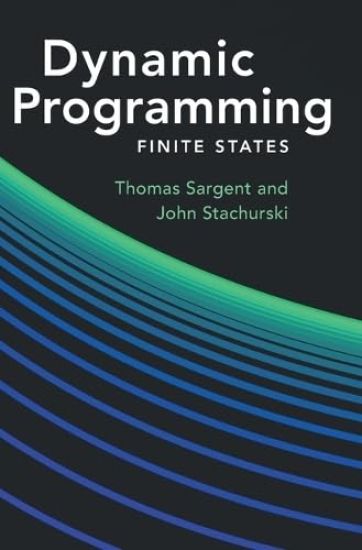
Dynamic Programming

Dynamic Programming

Thomas J Sargent; John Stachurski

Cambridge University Press
2025
pokkari
Dynamic programming (DP) is a sub-field of optimization concerned with sequential decision making over time. The essential ideas of DP have been adopted in many applications, from robotics and AI to the sequencing of DNA. It is used around the world to control aircraft, route shipping, test products, recommend information on media platforms and solve major research problems. Dynamic Programming: Finite States treats the theory of dynamic programming and its applications in economics, finance, and operations research. It contains classical results on dynamic programming as well as extensions created by researchers and practitioners as they wrestle with formulating and solving dynamic models that can explain patterns observed in data. Adopting an abstract framework that provides great generality, this book facilitates rapid progress to the research frontier by combining rigorous theory with numerous applications, many solved exercises, and detailed open-source computer code.
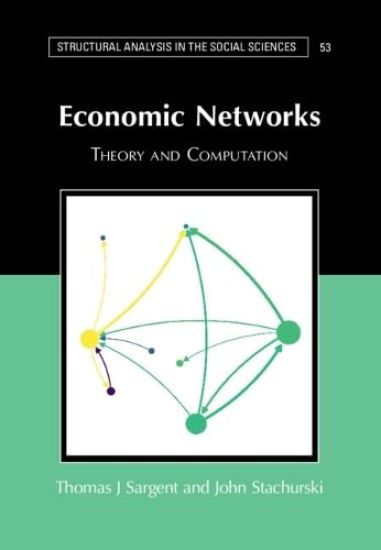
Economic Networks

Economic Networks

Thomas J. Sargent; John Stachurski

Cambridge University Press
2024
sidottu
It has become increasingly clear that economies can fruitfully be viewed as networks, consisting of millions of nodes (households, firms, banks, etc.) connected by business, social, and legal relationships. These relationships shape many outcomes that economists often measure. Over the past few years, research on production networks has flourished, as economists try to understand supply-side dynamics, default cascades, aggregate fluctuations, and many other phenomena. Economic Networks provides a brisk introduction to network analysis that is self-contained, rigorous, and illustrated with many figures, diagrams and listings with computer code. Network methods are put to work analyzing production networks, financial networks, and other related topics (including optimal transport, another highly active research field). Visualizations using recent data bring key ideas to life.
Economic Networks

Economic Networks

Thomas J. Sargent; John Stachurski

Cambridge University Press
2024
pokkari
It has become increasingly clear that economies can fruitfully be viewed as networks, consisting of millions of nodes (households, firms, banks, etc.) connected by business, social, and legal relationships. These relationships shape many outcomes that economists often measure. Over the past few years, research on production networks has flourished, as economists try to understand supply-side dynamics, default cascades, aggregate fluctuations, and many other phenomena. Economic Networks provides a brisk introduction to network analysis that is self-contained, rigorous, and illustrated with many figures, diagrams and listings with computer code. Network methods are put to work analyzing production networks, financial networks, and other related topics (including optimal transport, another highly active research field). Visualizations using recent data bring key ideas to life.
Economic Dynamics, second edition

Economic Dynamics, second edition

John Stachurski

MIT PRESS LTD
2022
nidottu
The second edition of a rigorous and example-driven introduction to topics in economic dynamics that emphasizes techniques for modeling dynamic systems. This text provides an introduction to the modern theory of economic dynamics, with emphasis on mathematical and computational techniques for modeling dynamic systems. Written to be both rigorous and engaging, the book shows how sound understanding of the underlying theory leads to effective algorithms for solving real-world problems. The material makes extensive use of programming examples to illustrate ideas, bringing to life the abstract concepts in the text. Key topics include algorithms and scientific computing, simulation, Markov models, and dynamic programming. Part I introduces fundamentals and part II covers more advanced material. This second edition has been thoroughly updated, drawing on recent research in the field. New for the second edition: "Programming-language agnostic" presentation using pseudocode.New chapter 1 covering conceptual issues concerning Markov chains such as ergodicity and stability.New focus in chapter 2 on algorithms and techniques for program design and high-performance computing.New focus on household problems rather than optimal growth in material on dynamic programming.Solutions to many exercises, code, and other resources available on a supplementary website.
A Primer in Econometric Theory

A Primer in Econometric Theory

John Stachurski

MIT Press
2016
sidottu
A concise treatment of modern econometrics and statistics, including underlying ideas from linear algebra, probability theory, and computer programming.This book offers a cogent and concise treatment of econometric theory and methods along with the underlying ideas from statistics, probability theory, and linear algebra. It emphasizes foundations and general principles, but also features many solved exercises, worked examples, and code listings. After mastering the material presented, readers will be ready to take on more advanced work in different areas of quantitative economics and to understand papers from the econometrics literature. The book can be used in graduate-level courses on foundational aspects of econometrics or on fundamental statistical principles. It will also be a valuable reference for independent study.One distinctive aspect of the text is its integration of traditional topics from statistics and econometrics with modern ideas from data science and machine learning; readers will encounter ideas that are driving the current development of statistics and increasingly filtering into econometric methodology. The text treats programming not only as a way to work with data but also as a technique for building intuition via simulation. Many proofs are followed by a simulation that shows the theory in action. As a primer, the book offers readers an entry point into the field, allowing them to see econometrics as a whole rather than as a profusion of apparently unrelated ideas.