Kirjojen hintavertailu. Mukana 12 089 418 kirjaa ja 12 kauppaa.

Kirjailija

John Stillwell

Kirjat ja teokset yhdessä paikassa: 33 kirjaa, julkaisuja vuosilta 1992-2026, suosituimpien joukossa The Four Pillars of Geometry. Vertaile teosten hintoja ja tarkista saatavuus suomalaisista kirjakaupoista.

33 kirjaa

Kirjojen julkaisuhaarukka 1992-2026.

Naive Lie Theory

Naive Lie Theory

John Stillwell

Springer-Verlag New York Inc.
2008
sidottu
In this new textbook, acclaimed author John Stillwell presents a lucid introduction to Lie theory suitable for junior and senior level undergraduates. In order to achieve this, he focuses on the so-called "classical groups'' that capture the symmetries of real, complex, and quaternion spaces. These symmetry groups may be represented by matrices, which allows them to be studied by elementary methods from calculus and linear algebra. This naive approach to Lie theory is originally due to von Neumann, and it is now possible to streamline it by using standard results of undergraduate mathematics. To compensate for the limitations of the naive approach, end of chapter discussions introduce important results beyond those proved in the book, as part of an informal sketch of Lie theory and its history. John Stillwell is Professor of Mathematics at the University of San Francisco. He is the author of several highly regarded books published by Springer, including The Four Pillars of Geometry (2005), Elements of Number Theory (2003), Mathematics and Its History (Second Edition, 2002), Numbers and Geometry (1998) and Elements of Algebra (1994).
The Four Pillars of Geometry

The Four Pillars of Geometry

John Stillwell

Springer-Verlag New York Inc.
2005
sidottu
Many people think there is only one “right” way to teach geometry. For two millennia, the “right” way was Euclid’s way, and it is still good in many respects. But in the 1950s the cry “Down with triangles!” was heard in France and new geometry books appeared, packed with linear algebra but with no diagrams. Was this the new “right” way, or was the “right” way something else again, perhaps transformation groups? In this book, I wish to show that geometry can be developed in four fundamentally different ways, and that all should be used if the subject is to be shown in all its splendor. Euclid-style construction and axiomatics seem the best way to start, but linear algebra smooths the later stages by replacing some tortuous arguments by simple calculations. And how can one avoid projective geometry? It not only explains why objects look the way they do; it also explains why geometry is entangled with algebra. Finally, one needs to know that there is not one geometry, but many, and transformation groups are the best way to distinguish between them. Two chapters are devoted to each approach: The ?rst is concrete and introductory, whereas the second is more abstract. Thus, the ?rst chapter on Euclid is about straightedge and compass constructions; the second is about axioms and theorems. The ?rst chapter on linear algebra is about coordinates; the second is about vector spaces and the inner product.
Roads to Infinity

Roads to Infinity

John Stillwell

TAYLOR FRANCIS LTD
2024
nidottu
Winner of a CHOICE Outstanding Academic Title Award for 2011!This book offers an introduction to modern ideas about infinity and their implications for mathematics. It unifies ideas from set theory and mathematical logic, and traces their effects on mainstream mathematical topics of today, such as number theory and combinatorics. The treatment is historical and partly informal, but with due attention to the subtleties of the subject. Ideas are shown to evolve from natural mathematical questions about the nature of infinity and the nature of proof, set against a background of broader questions and developments in mathematics. A particular aim of the book is to acknowledge some important but neglected figures in the history of infinity, such as Post and Gentzen, alongside the recognized giants Cantor and Gödel.
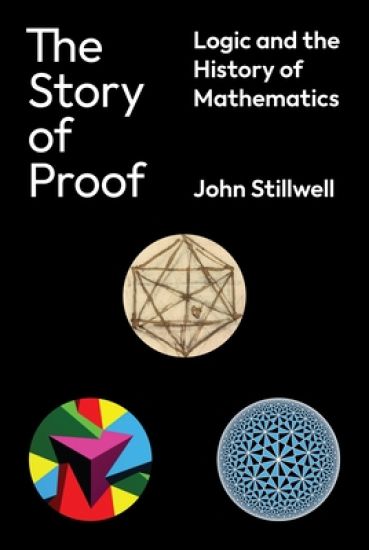
The Story of Proof

The Story of Proof

John Stillwell

PRINCETON UNIVERSITY PRESS
2022
sidottu
How the concept of proof has enabled the creation of mathematical knowledgeThe Story of Proof investigates the evolution of the concept of proof—one of the most significant and defining features of mathematical thought—through critical episodes in its history. From the Pythagorean theorem to modern times, and across all major mathematical disciplines, John Stillwell demonstrates that proof is a mathematically vital concept, inspiring innovation and playing a critical role in generating knowledge.Stillwell begins with Euclid and his influence on the development of geometry and its methods of proof, followed by algebra, which began as a self-contained discipline but later came to rival geometry in its mathematical impact. In particular, the infinite processes of calculus were at first viewed as “infinitesimal algebra,” and calculus became an arena for algebraic, computational proofs rather than axiomatic proofs in the style of Euclid. Stillwell proceeds to the areas of number theory, non-Euclidean geometry, topology, and logic, and peers into the deep chasm between natural number arithmetic and the real numbers. In its depths, Cantor, Gödel, Turing, and others found that the concept of proof is ultimately part of arithmetic. This startling fact imposes fundamental limits on what theorems can be proved and what problems can be solved.Shedding light on the workings of mathematics at its most fundamental levels, The Story of Proof offers a compelling new perspective on the field’s power and progress.
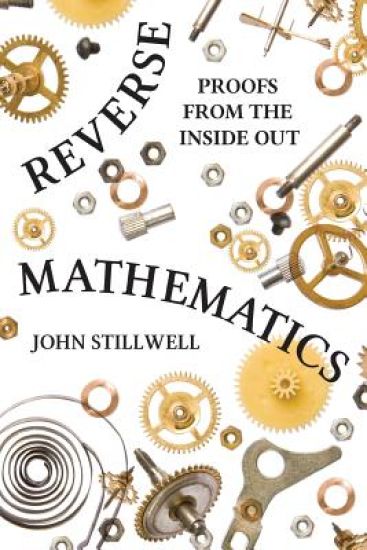
Reverse Mathematics

Reverse Mathematics

John Stillwell

Princeton University Press
2019
pokkari
The first book surveying the history and ideas behind reverse mathematicsReverse mathematics is a new field that seeks to find the axioms needed to prove given theorems. In Reverse Mathematics, John Stillwell offers a historical and representative view, emphasizing basic analysis and giving a novel approach to logic. By using a minimum of mathematical logic in a well-motivated way, Reverse Mathematics will engage advanced undergraduates and all mathematicians interested in the foundations of mathematics.
A Concise History of Mathematics for Philosophers

A Concise History of Mathematics for Philosophers

John Stillwell

Cambridge University Press
2019
pokkari
This Element aims to present an outline of mathematics and its history, with particular emphasis on events that shook up its philosophy. It ranges from the discovery of irrational numbers in ancient Greece to the nineteenth- and twentieth-century discoveries on the nature of infinity and proof. Recurring themes are intuition and logic, meaning and existence, and the discrete and the continuous. These themes have evolved under the influence of new mathematical discoveries and the story of their evolution is, to a large extent, the story of philosophy of mathematics.
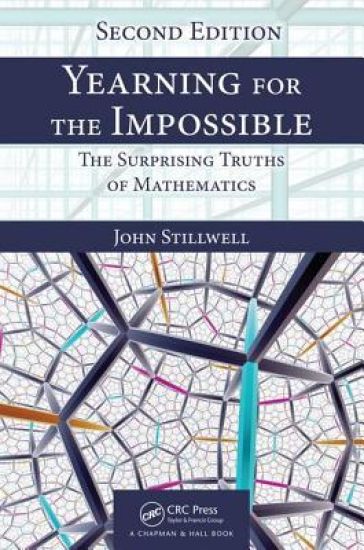
Yearning for the Impossible

Yearning for the Impossible

John Stillwell

CRC Press
2018
sidottu
Yearning for the Impossible: The Surprising Truth of Mathematics, Second Edition explores the history of mathematics from the perspective of the creative tension between common sense and the "impossible" as the author follows the discovery or invention of new concepts that have marked mathematical progress. The author puts these creations into a broader context involving related "impossibilities" from art, literature, philosophy, and physics. This new edition contains many new exercises and commentaries, clearly discussing a wide range of challenging subjects.
Yearning for the Impossible

Yearning for the Impossible

John Stillwell

CRC Press
2018
nidottu
Yearning for the Impossible: The Surprising Truth of Mathematics, Second Edition explores the history of mathematics from the perspective of the creative tension between common sense and the "impossible" as the author follows the discovery or invention of new concepts that have marked mathematical progress. The author puts these creations into a broader context involving related "impossibilities" from art, literature, philosophy, and physics. This new edition contains many new exercises and commentaries, clearly discussing a wide range of challenging subjects.
Reverse Mathematics

Reverse Mathematics

John Stillwell

PRINCETON UNIVERSITY PRESS
2018
sidottu
This book presents reverse mathematics to a general mathematical audience for the first time. Reverse mathematics is a new field that answers some old questions. In the two thousand years that mathematicians have been deriving theorems from axioms, it has often been asked: which axioms are needed to prove a given theorem? Only in the last two hundred years have some of these questions been answered, and only in the last forty years has a systematic approach been developed. In Reverse Mathematics, John Stillwell gives a representative view of this field, emphasizing basic analysis--finding the "right axioms" to prove fundamental theorems--and giving a novel approach to logic. Stillwell introduces reverse mathematics historically, describing the two developments that made reverse mathematics possible, both involving the idea of arithmetization. The first was the nineteenth-century project of arithmetizing analysis, which aimed to define all concepts of analysis in terms of natural numbers and sets of natural numbers. The second was the twentieth-century arithmetization of logic and computation. Thus arithmetic in some sense underlies analysis, logic, and computation. Reverse mathematics exploits this insight by viewing analysis as arithmetic extended by axioms about the existence of infinite sets. Remarkably, only a small number of axioms are needed for reverse mathematics, and, for each basic theorem of analysis, Stillwell finds the "right axiom" to prove it. By using a minimum of mathematical logic in a well-motivated way, Reverse Mathematics will engage advanced undergraduates and all mathematicians interested in the foundations of mathematics.
Elements of Mathematics

Elements of Mathematics

John Stillwell

Princeton University Press
2017
pokkari
Elements of Mathematics takes readers on a fascinating tour that begins in elementary mathematics--but, as John Stillwell shows, this subject is not as elementary or straightforward as one might think. Not all topics that are part of today's elementary mathematics were always considered as such, and great mathematical advances and discoveries had to occur in order for certain subjects to become "elementary." Stillwell examines elementary mathematics from a distinctive twenty-first-century viewpoint and describes not only the beauty and scope of the discipline, but also its limits. From Gaussian integers to propositional logic, Stillwell delves into arithmetic, computation, algebra, geometry, calculus, combinatorics, probability, and logic. He discusses how each area ties into more advanced topics to build mathematics as a whole. Through a rich collection of basic principles, vivid examples, and interesting problems, Stillwell demonstrates that elementary mathematics becomes advanced with the intervention of infinity. Infinity has been observed throughout mathematical history, but the recent development of "reverse mathematics" confirms that infinity is essential for proving well-known theorems, and helps to determine the nature, contours, and borders of elementary mathematics. Elements of Mathematics gives readers, from high school students to professional mathematicians, the highlights of elementary mathematics and glimpses of the parts of math beyond its boundaries.
Elements of Mathematics

Elements of Mathematics

John Stillwell

PRINCETON UNIVERSITY PRESS
2016
sidottu
Elements of Mathematics takes readers on a fascinating tour that begins in elementary mathematics--but, as John Stillwell shows, this subject is not as elementary or straightforward as one might think. Not all topics that are part of today's elementary mathematics were always considered as such, and great mathematical advances and discoveries had to occur in order for certain subjects to become "elementary." Stillwell examines elementary mathematics from a distinctive twenty-first-century viewpoint and describes not only the beauty and scope of the discipline, but also its limits. From Gaussian integers to propositional logic, Stillwell delves into arithmetic, computation, algebra, geometry, calculus, combinatorics, probability, and logic. He discusses how each area ties into more advanced topics to build mathematics as a whole. Through a rich collection of basic principles, vivid examples, and interesting problems, Stillwell demonstrates that elementary mathematics becomes advanced with the intervention of infinity. Infinity has been observed throughout mathematical history, but the recent development of "reverse mathematics" confirms that infinity is essential for proving well-known theorems, and helps to determine the nature, contours, and borders of elementary mathematics. Elements of Mathematics gives readers, from high school students to professional mathematicians, the highlights of elementary mathematics and glimpses of the parts of math beyond its boundaries.
Naive Lie Theory

Naive Lie Theory

John Stillwell

Springer-Verlag New York Inc.
2010
nidottu
In this new textbook, acclaimed author John Stillwell presents a lucid introduction to Lie theory suitable for junior and senior level undergraduates. In order to achieve this, he focuses on the so-called "classical groups'' that capture the symmetries of real, complex, and quaternion spaces. These symmetry groups may be represented by matrices, which allows them to be studied by elementary methods from calculus and linear algebra. This naive approach to Lie theory is originally due to von Neumann, and it is now possible to streamline it by using standard results of undergraduate mathematics. To compensate for the limitations of the naive approach, end of chapter discussions introduce important results beyond those proved in the book, as part of an informal sketch of Lie theory and its history. John Stillwell is Professor of Mathematics at the University of San Francisco. He is the author of several highly regarded books published by Springer, including The Four Pillars of Geometry (2005), Elements of Number Theory (2003), Mathematics and Its History (Second Edition, 2002), Numbers and Geometry (1998) and Elements of Algebra (1994).
The Four Pillars of Geometry

The Four Pillars of Geometry

John Stillwell

Springer-Verlag New York Inc.
2010
nidottu
Many people think there is only one “right” way to teach geometry. For two millennia, the “right” way was Euclid’s way, and it is still good in many respects. But in the 1950s the cry “Down with triangles!” was heard in France and new geometry books appeared, packed with linear algebra but with no diagrams. Was this the new “right” way, or was the “right” way something else again, perhaps transformation groups? In this book, I wish to show that geometry can be developed in four fundamentally different ways, and that all should be used if the subject is to be shown in all its splendor. Euclid-style construction and axiomatics seem the best way to start, but linear algebra smooths the later stages by replacing some tortuous arguments by simple calculations. And how can one avoid projective geometry? It not only explains why objects look the way they do; it also explains why geometry is entangled with algebra. Finally, one needs to know that there is not one geometry, but many, and transformation groups are the best way to distinguish between them. Two chapters are devoted to each approach: The ?rst is concrete and introductory, whereas the second is more abstract. Thus, the ?rst chapter on Euclid is about straightedge and compass constructions; the second is about axioms and theorems. The ?rst chapter on linear algebra is about coordinates; the second is about vector spaces and the inner product.
Numbers and Geometry

Numbers and Geometry

John Stillwell

Springer-Verlag New York Inc.
1997
sidottu
NUMBERS AND GEOMETRY is a beautiful and relatively elementary account of a part of mathematics where three main fields--algebra, analysis and geometry--meet. The aim of this book is to give a broad view of these subjects at the level of calculus, without being a calculus (or a pre-calculus) book. Its roots are in arithmetic and geometry, the two opposite poles of mathematics, and the source of historic conceptual conflict. The resolution of this conflict, and its role in the development of mathematics, is one of the main stories in the book. The key is algebra, which brings arithmetic and geometry together, and allows them to flourish and branch out in new directions. Stillwell has chosen an array of exciting and worthwhile topics and elegantly combines mathematical history with mathematics. He believes that most of mathematics is about numbers, curves and functions, and the links between these concepts can be suggested by a thorough study of simple examples, such as the circle and the square. This book covers the main ideas of Euclid--geometry, arithmetic and the theory of real numbers, but with 2000 years of extra insights attached. NUMBERS AND GEOMETRY presupposes only high school algebra and therefore can be read by any well prepared student entering university. Moreover, this book will be popular with graduate students and researchers in mathematics because it is such an attractive and unusual treatment of fundamental topics. Also, it will serve admirably in courses aimed at giving students from other areas a view of some of the basic ideas in mathematics. There is a set of well-written exercises at the end of each section, so new ideas can be instantly tested and reinforced.
Classical Topology and Combinatorial Group Theory

Classical Topology and Combinatorial Group Theory

John Stillwell

Springer-Verlag New York Inc.
1993
sidottu
In recent years, many students have been introduced to topology in high school mathematics. Having met the Mobius band, the seven bridges of Konigsberg, Euler's polyhedron formula, and knots, the student is led to expect that these picturesque ideas will come to full flower in university topology courses. What a disappointment "undergraduate topology" proves to be! In most institutions it is either a service course for analysts, on abstract spaces, or else an introduction to homological algebra in which the only geometric activity is the completion of commutative diagrams. Pictures are kept to a minimum, and at the end the student still does nr~ understand the simplest topological facts, such as the rcason why knots exist. In my opinion, a well-balanced introduction to topology should stress its intuitive geometric aspect, while admitting the legitimate interest that analysts and algebraists have in the subject. At any rate, this is the aim of the present book. In support of this view, I have followed the historical development where practicable, since it clearly shows the influence of geometric thought at all stages. This is not to claim that topology received its main impetus from geometric recreations like the seven bridges; rather, it resulted from the l'isualization of problems from other parts of mathematics-complex analysis (Riemann), mechanics (Poincare), and group theory (Dehn). It is these connec­ tions to other parts of mathematics which make topology an important as well as a beautiful subject.
Geometry of Surfaces

Geometry of Surfaces

John Stillwell

Springer-Verlag New York Inc.
1992
nidottu
Geometry used to be the basis of a mathematical education; today it is not even a standard undergraduate topic. Much as I deplore this situation, I welcome the opportunity to make a fresh start. Classical geometry is no longer an adequate basis for mathematics or physics-both of which are becoming increasingly geometric-and geometry can no longer be divorced from algebra, topology, and analysis. Students need a geometry of greater scope, and the fact that there is no room for geometry in the curriculum un­ til the third or fourth year at least allows us to assume some mathematical background. What geometry should be taught? I believe that the geometry of surfaces of constant curvature is an ideal choice, for the following reasons: 1. It is basically simple and traditional. We are not forgetting euclidean geometry but extending it enough to be interesting and useful. The extensions offer the simplest possible introduction to fundamentals of modem geometry: curvature, group actions, and covering spaces. 2. The prerequisites are modest and standard. A little linear algebra (mostly 2 x 2 matrices), calculus as far as hyperbolic functions, ba­ sic group theory (subgroups and cosets), and basic topology (open, closed, and compact sets).
The Story of Proof

The Story of Proof

John Stillwell

PRINCETON UNIVERSITY PRESS
2026
pokkari
How the concept of proof has enabled the creation of mathematical knowledge The Story of Proof investigates the evolution of the concept of proof—one of the most significant and defining features of mathematical thought—through critical episodes in its history. From the Pythagorean theorem to modern times, and across all major mathematical disciplines, John Stillwell demonstrates that proof is a mathematically vital concept, inspiring innovation and playing a critical role in generating knowledge. Stillwell begins with Euclid and his influence on the development of geometry and its methods of proof, followed by algebra, which began as a self-contained discipline but later came to rival geometry in its mathematical impact. In particular, the infinite processes of calculus were at first viewed as “infinitesimal algebra,” and calculus became an arena for algebraic, computational proofs rather than axiomatic proofs in the style of Euclid. Stillwell proceeds to the areas of number theory, non-Euclidean geometry, topology, and logic, and peers into the deep chasm between natural number arithmetic and the real numbers. In its depths, Cantor, Gödel, Turing, and others found that the concept of proof is ultimately part of arithmetic. This startling fact imposes fundamental limits on what theorems can be proved and what problems can be solved. Shedding light on the workings of mathematics at its most fundamental levels, The Story of Proof offers a compelling new perspective on the field’s power and progress.
Relay Race To Infinity, The: Developments In Mathematics From Euclid To Fermat

Relay Race To Infinity, The: Developments In Mathematics From Euclid To Fermat

Derek Allan Holton; John Stillwell

WORLD SCIENTIFIC PUBLISHING CO PTE LTD
2024
nidottu
Why were most historically important mathematicians wealthy? Why were they often lawyers and many had pastors for fathers? Why were original results sometimes discovered by two mathematicians independently within a short time of each other? Why did the Italian Fibonacci, speak Arabic?It all began a couple of years ago, when one of the authors started to write short biographies of important historical mathematicians for the teaching journal Australian Primary Mathematics Classroom. It was felt that teachers generally knew very little about the way the subject developed or the people who developed it. And it was felt that historical knowledge would help them see how the subject progressed and enable them to fit in with the historical episodes that would be of interest to students.Clearly, the book that developed contains mathematics up to the 17th century, but we are keen to set the subject in those times, to try to give short biographies of the people involved, as well as provide a perspective of the events that led up to the times and led up to the mathematics. Importantly, it is shown that the maths enterprise was not undertaken by a small few, but worked like a relay race. One or a few might take up an idea and develop it, but it often gets only so far. Later, others would take up the idea, the baton, and the relay race to find results continues.
Relay Race To Infinity, The: Developments In Mathematics From Euclid To Fermat

Relay Race To Infinity, The: Developments In Mathematics From Euclid To Fermat

Derek Allan Holton; John Stillwell

WORLD SCIENTIFIC PUBLISHING CO PTE LTD
2024
sidottu
Why were most historically important mathematicians wealthy? Why were they often lawyers and many had pastors for fathers? Why were original results sometimes discovered by two mathematicians independently within a short time of each other? Why did the Italian Fibonacci, speak Arabic?It all began a couple of years ago, when one of the authors started to write short biographies of important historical mathematicians for the teaching journal Australian Primary Mathematics Classroom. It was felt that teachers generally knew very little about the way the subject developed or the people who developed it. And it was felt that historical knowledge would help them see how the subject progressed and enable them to fit in with the historical episodes that would be of interest to students.Clearly, the book that developed contains mathematics up to the 17th century, but we are keen to set the subject in those times, to try to give short biographies of the people involved, as well as provide a perspective of the events that led up to the times and led up to the mathematics. Importantly, it is shown that the maths enterprise was not undertaken by a small few, but worked like a relay race. One or a few might take up an idea and develop it, but it often gets only so far. Later, others would take up the idea, the baton, and the relay race to find results continues.
Algebraic Number Theory for Beginners

Algebraic Number Theory for Beginners

John Stillwell

Cambridge University Press
2022
sidottu
This book introduces algebraic number theory through the problem of generalizing 'unique prime factorization' from ordinary integers to more general domains. Solving polynomial equations in integers leads naturally to these domains, but unique prime factorization may be lost in the process. To restore it, we need Dedekind's concept of ideals. However, one still needs the supporting concepts of algebraic number field and algebraic integer, and the supporting theory of rings, vector spaces, and modules. It was left to Emmy Noether to encapsulate the properties of rings that make unique prime factorization possible, in what we now call Dedekind rings. The book develops the theory of these concepts, following their history, motivating each conceptual step by pointing to its origins, and focusing on the goal of unique prime factorization with a minimum of distraction or prerequisites. This makes a self-contained easy-to-read book, short enough for a one-semester course.