Kirjojen hintavertailu. Mukana 12 595 353 kirjaa ja 12 kauppaa.

Kirjailija

John Toye

Kirjat ja teokset yhdessä paikassa: 11 kirjaa, julkaisuja vuosilta 1978-2022, suosituimpien joukossa Keynes on Population. Vertaile teosten hintoja ja tarkista saatavuus suomalaisista kirjakaupoista.

11 kirjaa

Kirjojen julkaisuhaarukka 1978-2022.

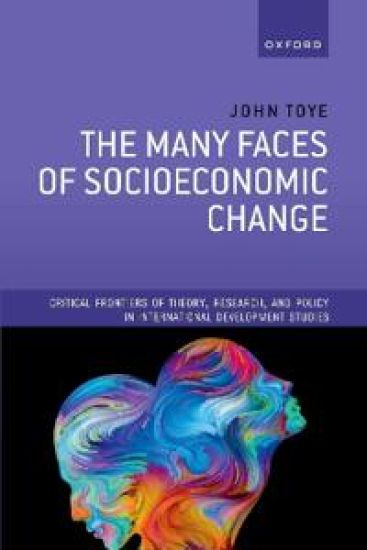
The Many Faces of Socioeconomic Change

The Many Faces of Socioeconomic Change

John Toye

Oxford University Press
2022
nidottu
Development is not a purely economic phenomenon; it also has a strong sociological element. The Many Faces of Socioeconomic Change explores how economic socio-cultural and political aspects of human progress have been studied since the time of Adam Smith. Surveying narratives of how development occurs, from early evolutionary models to recent types of development theory, it outlines the main long-term changes in how socioeconomic development has been envisaged through time. The Many Faces of Socioeconomic Change presents the argument that socioeconomic development emerged with the creation of grand evolutionary sequences of social progress that were the products of Enlightenment and mid-Victorian thinkers. By the middle of the twentieth century, when interest in accelerating development gave the topic a new impetus its scope narrowed to a set of economically based strategies. After 1960, however, faith in such strategies began to wane, in the face of indifferent results and a general faltering of confidence in economists' boasts of scientific expertise. In the twenty first century, development research is being pursued using research methods that generate disconnected results. As a result, it seems unlikely that any grand narrative will be created in the future and that Neo-liberalism will be the last of this particular kind of socioeconomic theory. With a broad scope of content and clear exposition of academic thinking this book guides the reader through the way in which the policy adopted as a consequence of modern theories has been less effective because of the neglect or a misunderstanding of the social context within which they operate.

The Many Faces of Socioeconomic Change

The Many Faces of Socioeconomic Change

John Toye

Oxford University Press
2017
sidottu
Development is not a purely economic phenomenon; it also has a strong sociological element. The Many Faces of Socioeconomic Change explores how economic socio-cultural and political aspects of human progress have been studied since the time of Adam Smith. Surveying narratives of how development occurs, from early evolutionary models to recent types of development theory, it outlines the main long-term changes in how socioeconomic development has been envisaged through time. The Many Faces of Socioeconomic Change presents the argument that socioeconomic development emerged with the creation of grand evolutionary sequences of social progress that were the products of Enlightenment and mid-Victorian thinkers. By the middle of the twentieth century, when interest in accelerating development gave the topic a new impetus its scope narrowed to a set of economically based strategies. After 1960, however, faith in such strategies began to wane, in the face of indifferent results and a general faltering of confidence in economists' boasts of scientific expertise. In the twenty first century, development research is being pursued using research methods that generate disconnected results. As a result, it seems unlikely that any grand narrative will be created in the future and that Neo-liberalism will be the last of this particular kind of socioeconomic theory. With a broad scope of content and clear exposition of academic thinking this book guides the reader through the way in which the policy adopted as a consequence of modern theories has been less effective because of the neglect or a misunderstanding of the social context within which they operate.
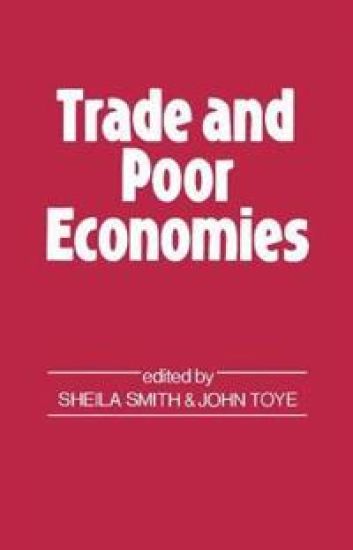
Trade and Poor Economies

Trade and Poor Economies

John Toye

Routledge
2017
sidottu
First Published in 1979. Development economists, when they discuss the role played by international trade in a country’s economic development, tend to tell one of three types of story. The first shows how the welfare of both (and by easy extension, all) countries which engage in trade is increased, even when one country is absolutely very rich and the other is absolutely very poor. The second, is a dull and detailed story about the way in which differences in economic structure between countries bias the gains from trade in favour of the rich, technologically advanced and industrialised economies and against the poor, low-technology agricultural economies. The third story asserts that trade and economic specialisation have actually caused the underdevelopment of the periphery of the world by the very same processes that have developed the capitalist metropolis. This volume brings together nine pieces of work that look trade and the poor economies of Ghana, Nigeria, Mexico, Brazil, Central America, Jute stocks and Third World Trade Trends and prospects.
Does Aid Work in India?

Does Aid Work in India?

Michael Lipton; John Toye

Routledge
2013
nidottu
Much about India's economy and aid flows has changed in the last two decades. India's growth rate has quickened since economic liberalisation, the poverty head count has fallen and the volume and composition of its aid have changed as new issues of climate change and the environment have emerged..Yet Does Aid Work in India?, first published in 1990, remains of great interest as a study of aid effectiveness in India's pre-liberalisation era. It identifies those sectors where aid-funded interventions succeeded, and where they failed. It explains how India avoided problems of aid dependence, and managed the political tensions that are associated with aid policy dialogue. More generally, it contains a useful commentary on and criticism of donors' aid evaluation procedures at that time and it highlights donor efforts in the difficult area of institution building. Despite the passage of time, many of the insights from India's earlier experience remain highly relevant to key issues of development assistance today.
Does Aid Work in India?

Does Aid Work in India?

Michael Lipton; John Toye

Routledge
2010
sidottu
Much about India's economy and aid flows has changed in the last two decades. India's growth rate has quickened since economic liberalisation, the poverty head count has fallen and the volume and composition of its aid have changed as new issues of climate change and the environment have emerged..Yet Does Aid Work in India?, first published in 1990, remains of great interest as a study of aid effectiveness in India's pre-liberalisation era. It identifies those sectors where aid-funded interventions succeeded, and where they failed. It explains how India avoided problems of aid dependence, and managed the political tensions that are associated with aid policy dialogue. More generally, it contains a useful commentary on and criticism of donors' aid evaluation procedures at that time and it highlights donor efforts in the difficult area of institution building. Despite the passage of time, many of the insights from India's earlier experience remain highly relevant to key issues of development assistance today.
The UN and Global Political Economy

The UN and Global Political Economy

John Toye; Richard Toye

Indiana University Press
2004
pokkari
Against the backdrop of a 20-year revolt against free trade orthodoxy by economists inside the UN and their impact on policy discussions since the 1960s, the authors show how the UN both nurtured and inhibited creative and novel intellectual contributions to the trade and development debate. Presenting a stirring account of the main UN actors in this debate, The UN and Global Political Economy focuses on the accomplishments and struggles of UN economists and the role played by such UN agencies as the Department of Economic (and Social) Affairs, the United Nations Commission on Trade and Development, and the Economic Commission for Latin America (and the Caribbean). It also looks closely at the effects of the Latin American debt crisis of the 1980s, the growing strength of the World Trade Organization (WTO) in the 1990s, and the lessons to be drawn from these and other recent developments.
Keynes on Population

Keynes on Population

John Toye

Oxford University Press
2000
sidottu
The topic of population is treated only lightly in the major modern biographies of John Maynard Keynes, yet Keynes himself had strong - if varying - views on the subject. For many years he maintained a neo-Malthusian view of population, based on a postulated link between population growth and deteriorating terms of trade. This led him to take up a militant stance towards 'overpopulated' countries, notably India, China, and Egypt. Keynes on Population publishes two of John Maynard Keynes's manuscripts not published in the Collected Writings: his Cambridge lectures on population and 1914 Oxford lecture on 'Population'. It provides a detailed commentary on the text of 'Population' and discusses the extent of Keynes's engagement with the Social Darwinist doctrine of the 'rapid multiplication of the unfit' and with eugenics. It then traces the subsequent vicissitudes of his views on population and his interventions in the contemporary politics of population. These include his part in the 1920s campaign for birth control, the reversal of his neo-Malthusianism, and his eventual support for family allowances.
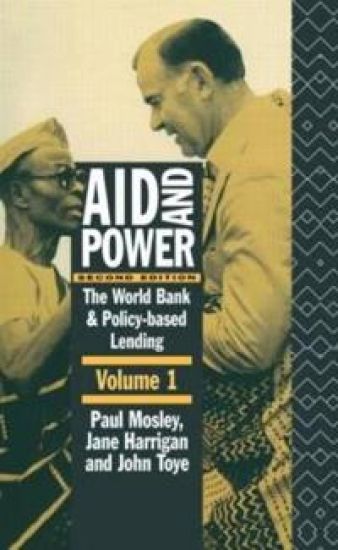
Aid and Power - Vol 1

Aid and Power - Vol 1

Jane Harrigan; Paul Mosley; John Toye

Routledge
1995
sidottu
When the major aid organizations made flows of aid conditional on changes in policy, they prompted an extensive debate in development circles. Aid and Power has made one of the most significant and influential contributions to that debate. This edition has been revised to take account of changes within the World Bank itself and the extension of policy based lending to the formerly socialist economies of east and central Europe.
Aid and Power - Vol 1

Aid and Power - Vol 1

Jane Harrigan; Paul Mosley; John Toye

Routledge
1995
nidottu
When the major aid organizations made flows of aid conditional on changes in policy, they prompted an extensive debate in development circles. Aid and Power has made one of the most significant and influential contributions to that debate. This edition has been revised to take account of changes within the World Bank itself and the extension of policy based lending to the formerly socialist economies of east and central Europe.
Trade and Poor Economies

Trade and Poor Economies

John Toye

Routledge
1979
nidottu
First Published in 1979. Development economists, when they discuss the role played by international trade in a country’s economic development, tend to tell one of three types of story. The first shows how the welfare of both (and by easy extension, all) countries which engage in trade is increased, even when one country is absolutely very rich and the other is absolutely very poor. The second, is a dull and detailed story about the way in which differences in economic structure between countries bias the gains from trade in favour of the rich, technologically advanced and industrialised economies and against the poor, low-technology agricultural economies. The third story asserts that trade and economic specialisation have actually caused the underdevelopment of the periphery of the world by the very same processes that have developed the capitalist metropolis. This volume brings together nine pieces of work that look trade and the poor economies of Ghana, Nigeria, Mexico, Brazil, Central America, Jute stocks and Third World Trade Trends and prospects.
Taxation and Economic Development
First published in 1978. The tax system is one of the instruments said to be available to translate development policy objectives into practice. The wide-ranging papers collected together in this volume, first published in 1978, explore different aspects of the link between national development objectives and the tax system. Attention is particularly focused on traditional aims such as growth, fair distribution and economic stabilisation and development. Articles written by distinguished experts in the fields of public finance and economic development clarify the concepts of taxable capacity and tax effort, and examine the connections between growth and changes within the tax system.