Kirjojen hintavertailu. Mukana 12 152 606 kirjaa ja 12 kauppaa.

Kirjailija

John W. Head

Kirjat ja teokset yhdessä paikassa: 12 kirjaa, julkaisuja vuosilta 1993-2025, suosituimpien joukossa Head, J: Reports of Cases argued and determined in the Supre. Vertaile teosten hintoja ja tarkista saatavuus suomalaisista kirjakaupoista.

Mukana myös kirjoitusasut: John W Head

12 kirjaa

Kirjojen julkaisuhaarukka 1993-2025.

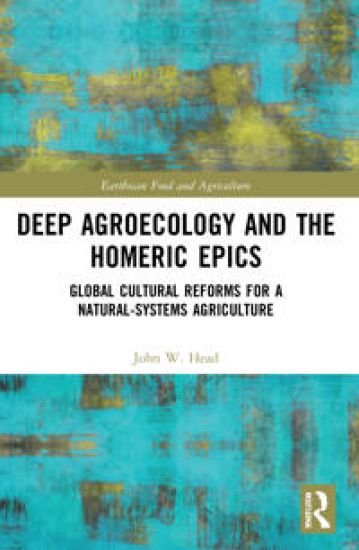
Deep Agroecology and the Homeric Epics

Deep Agroecology and the Homeric Epics

John W. Head

TAYLOR FRANCIS LTD
2023
nidottu
Drawing on the Homeric epics, this multidisciplinary work reveals the cultural transformations which need to take place in order to transition from today’s modern extractive agricultural system to a sustainable natural-systems agriculture. In order to provide an imaginative foundation on which to build such a cultural transformation, the author draws on the oldest and most pervasive pair of literary works in the Western canon: the Iliad and the Odyssey. He uses themes from those foundational literary works to critique the concept of state sovereignty and to explain how innovative federalism structures around the world already show momentum building toward changes in global environmental governance. The book proposes a dramatic expansion on those innovations, to create eco-states responsible for agroecological management. Drawing from many years of experience in international institutions, the author proposes a system of coordination by which an international agroecology-focused organization would simultaneously (i) avoid the shortcomings of the world’s current family of powerful global institutions and (ii) help create and implement a reformed system of local landscape-based agriculture wholly consistent with ecological principles. Acknowledging the difficulty of achieving reforms such as these, the author suggests that a new cultural-conceptual narrative can be constructed drawing on values set forth 2,700 years ago in the Homeric epics. He explains how these values can be reimagined to drive forward our efforts in addressing today’s the climate and agricultural crises in ways that reflect, not reject, the natural processes and relationships that make the Earth a living planet. This book will be of great interest to students, academics and policymakers addressing issues of agrarian values, environmental and agricultural law, environmental restoration, agroecology, and global institutional reform.
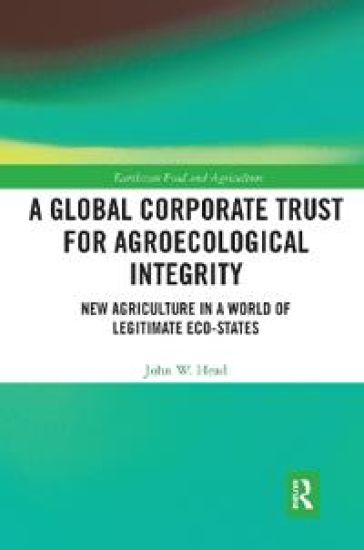
A Global Corporate Trust for Agroecological Integrity
This book examines global environmental governance and how legal, institutional, and conceptual reform can facilitate a transformation to a new ‘natural-systems’ form of agriculture. Profound global climate disruption makes it essential that we replace our current agricultural system – described in this book as a fossil-carbon-dependent ‘modern extractive agriculture’ – with a natural-systems agriculture featuring perennial grains growing in polycultures, thereby mimicking the natural grassland and forest ecosystems that modern extractive agriculture has largely destroyed. After examining relevant international legal and conceptual foundations (sovereignty, federalism, global governance) and existing international organizations focusing on agriculture, the book explores legal and institutional opportunities to facilitate dramatic agricultural reform and ecological restoration. Among other things, it explains how innovative federalism structures around the world provide patterns for reorienting global environmental governance, including what the book calls eco-states that would, through exercise of pluralistic sovereignty, be responsible for agroecological management. Drawing from his experience working in international institutions, the author provides detailed global-governance proposals for facilitating the type of agricultural reform that can help avoid ecological collapse, especially through soil degradation and climate change. This book will be of great interest to students and scholars of international law, agroecology, climate change, ecological restoration, sustainable development, and global governance, as well as policy-makers and practitioners working in these fields.
Deep Agroecology and the Homeric Epics
Drawing on the Homeric epics, this multidisciplinary work reveals the cultural transformations which need to take place in order to transition from today’s modern extractive agricultural system to a sustainable natural-systems agriculture. In order to provide an imaginative foundation on which to build such a cultural transformation, the author draws on the oldest and most pervasive pair of literary works in the Western canon: the Iliad and the Odyssey. He uses themes from those foundational literary works to critique the concept of state sovereignty and to explain how innovative federalism structures around the world already show momentum building toward changes in global environmental governance. The book proposes a dramatic expansion on those innovations, to create eco-states responsible for agroecological management. Drawing from many years of experience in international institutions, the author proposes a system of coordination by which an international agroecology-focused organization would simultaneously (i) avoid the shortcomings of the world’s current family of powerful global institutions and (ii) help create and implement a reformed system of local landscape-based agriculture wholly consistent with ecological principles. Acknowledging the difficulty of achieving reforms such as these, the author suggests that a new cultural-conceptual narrative can be constructed drawing on values set forth 2,700 years ago in the Homeric epics. He explains how these values can be reimagined to drive forward our efforts in addressing today’s the climate and agricultural crises in ways that reflect, not reject, the natural processes and relationships that make the Earth a living planet. This book will be of great interest to students, academics and policymakers addressing issues of agrarian values, environmental and agricultural law, environmental restoration, agroecology, and global institutional reform.
A Global Corporate Trust for Agroecological Integrity
This book examines global environmental governance and how legal, institutional, and conceptual reform can facilitate a transformation to a new ‘natural-systems’ form of agriculture. Profound global climate disruption makes it essential that we replace our current agricultural system – described in this book as a fossil-carbon-dependent ‘modern extractive agriculture’ – with a natural-systems agriculture featuring perennial grains growing in polycultures, thereby mimicking the natural grassland and forest ecosystems that modern extractive agriculture has largely destroyed. After examining relevant international legal and conceptual foundations (sovereignty, federalism, global governance) and existing international organizations focusing on agriculture, the book explores legal and institutional opportunities to facilitate dramatic agricultural reform and ecological restoration. Among other things, it explains how innovative federalism structures around the world provide patterns for reorienting global environmental governance, including what the book calls eco-states that would, through exercise of pluralistic sovereignty, be responsible for agroecological management. Drawing from his experience working in international institutions, the author provides detailed global-governance proposals for facilitating the type of agricultural reform that can help avoid ecological collapse, especially through soil degradation and climate change. This book will be of great interest to students and scholars of international law, agroecology, climate change, ecological restoration, sustainable development, and global governance, as well as policy-makers and practitioners working in these fields.

International Law and Agroecological Husbandry
Remarkable advances are being made in life science and agricultural research to reform the methods of food production, particularly with regard to staple grain and legume crops, in ways that will better reflect ecological realities. However, advances in science may be insufficient to ensure that these possibilities for agricultural reform are realized in practice and in a sustainable way. This book shows how these can only be achieved through changes in legal norms and institutions at the global level. Interdisciplinary in character, the book draws from a range of issues involving agricultural innovation, international legal history and principles, treaty commitments, global institutions, and environmental challenges, such as climate change, to propose broad legal changes for transforming global agriculture. It first shows how modern extractive agriculture is unsustainable on economic, environmental, and social grounds. It then examines the potential for natural-systems agriculture (especially perennial-polyculture systems) for overcoming the deficiencies of modern extractive agriculture, especially to offset climate change. Finally it analyses closely the legal innovations that can be adopted at national and international levels to facilitate a transition from modern extractive agriculture to a system based more on ecological principles. In particular the author argues for the creation of a Global Convention on Agroecology.
International Law and Agroecological Husbandry
Remarkable advances are being made in life science and agricultural research to reform the methods of food production, particularly with regard to staple grain and legume crops, in ways that will better reflect ecological realities. However, advances in science may be insufficient to ensure that these possibilities for agricultural reform are realized in practice and in a sustainable way. This book shows how these can only be achieved through changes in legal norms and institutions at the global level. Interdisciplinary in character, the book draws from a range of issues involving agricultural innovation, international legal history and principles, treaty commitments, global institutions, and environmental challenges, such as climate change, to propose broad legal changes for transforming global agriculture. It first shows how modern extractive agriculture is unsustainable on economic, environmental, and social grounds. It then examines the potential for natural-systems agriculture (especially perennial-polyculture systems) for overcoming the deficiencies of modern extractive agriculture, especially to offset climate change. Finally it analyses closely the legal innovations that can be adopted at national and international levels to facilitate a transition from modern extractive agriculture to a system based more on ecological principles. In particular the author argues for the creation of a Global Convention on Agroecology.
Preventing Financial Chaos: An International Guide to Legal Rules and Operational Procedures for Handling Insolvent Banks
There is a fundamental reason, the authors of this text contend, why national financial systems falter and collapse: the failure of central banks and other supervisory authorities to deal promptly and decisively with insolvent banks. In "Preventing Financial Chaos" Ramsey and Head, both well-known to the international banking community for their restructuring services in developing and transitional economies, take a no-nonsense attitude and show exactly how to usher a problem bank out of the financial system in any country. Their clearly defined rules and procedures build disciplined, competent action that activates political will and successfully curtails systemic chaos.
Introducing and Managing Academic Library Automation Projects

Introducing and Managing Academic Library Automation Projects

John W. Head; Gerard B. McCabe

Libraries Unlimited Inc
1996
sidottu
Though computers have become more common, many academic libraries still lack automation of any kind. With the growing importance of the Internet and the proliferation of electronic databases, automation is likely to be an important part of the future of every library. Fortunately, enough libraries have implemented automated systems so that their experiences can inform those libraries only about to engage in automation projects. This professional reference is a guide to the forecasting, planning, implementing, and monitoring necessary for the successful management of academic library automation.While novices will benefit from this book, the volume will be of special interest to librarians presently engaged in automation projects. The authors of the book's chapters come from all types of academic libraries and offer a wide range of experience and perspectives. The volume focuses on two major areas of librarianship, public service and technical services; and contributors stress the importance of planning, teamwork, and clear objectives. Each chapter cites sources of additional information, and the volume closes with two bibliographic essays.
Insider's Guide to Library Automation

Insider's Guide to Library Automation

John W. Head; Gerard B. McCabe

Praeger Publishers Inc
1993
sidottu
Libraries are becoming increasingly automated. Many libraries have already become automated, and librarians have had to confront a new set of problems in their jobs. Many other libraries are not yet automated, but will soon be acquiring new technology and new problems. This book provides detailed techniques for coping with the problems inherent in automation. While other works offer thorough coverage of the library automation process, this volume provides case studies of the personal experiences of librarians who have had to solve problems related to automation. Included are case studies from large academic libraries, special libraries, public libraries, and smaller libraries.The first section of the book includes chapters on locally developed library automation systems and how those systems have adapted to change. The second section contains chapters on selecting, buying, and installing automation systems. The third section includes chapters on the sharing of automated systems by different libraries. The fourth section, on database maintenance and conversion, contains chapters important to all librarians. The fifth section discusses the management of automated systems. The book concludes with a bibliographic essay that overviews developments in library automation technology and lists sources for further information.