

Kirjailija
John W Miller
Kirjat ja teokset yhdessä paikassa: 16 kirjaa, julkaisuja vuosilta 1997-2025, suosituimpien joukossa President Mckinley and American Imperialism. Vertaile teosten hintoja ja tarkista saatavuus suomalaisista kirjakaupoista.
Mukana myös kirjoitusasut: John W. Miller
16 kirjaa
Kirjojen julkaisuhaarukka 1997-2025.



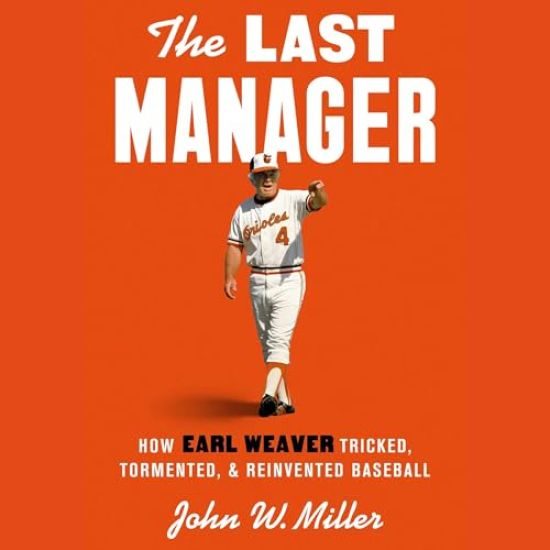
The Last Manager: How Earl Weaver Tricked, Tormented, and Reinvented Baseball
John W. Miller
Simon Schuster Audio
2025
cd
The first major biography of legendary Baltimore Orioles manager Earl Weaver--who has been described as "the Copernicus of baseball" and "the grandfather of the modern game"--The Last Manager is a wild, thrilling, and hilarious ride with baseball's most underappreciated genius, and one of its greatest characters.Long before the Moneyball-era, the Earl of Baltimore reigned over baseball. History's feistiest and most colorful manager, Earl Weaver transformed the sport by collecting and analyzing data in visionary ways, ultimately winning more games than anybody else during his time running the Orioles from 1968-1982.When Weaver was hired by the Orioles, managers were still seen as coaches and inspirational leaders, more teachers of the game than strategists. Weaver invented new ways of building baseball teams, prioritizing on-base average, elite defense, and strike throwing. Weaver was the first manager to use a modern radar gun, and he pioneered the use of analytical data. By moving 6'4" Cal Ripken, Jr. to shortstop, Weaver paved the way for a generation of plus-sized superstar shortstops, including Alex Rodriguez and Derek Jeter. He foreshadowed almost everything that Bill James, Billy Beane, Theo Epstein, and hundreds of other big brain baseball types would later present as innovation.Beyond being a great baseball mind, Weaver was a rare baseball character. Major League Baseball is show business, and Weaver understood how much of his job was entertainment. Weaver's outbursts offered players cathartic relief from their own frustration, signaled his concern for the team, and fired up fans. In his frequent arguments with umpires, he hammed it up for the crowds, faked heart attacks, ripped bases out of the ground, and pretended to toss umpires out of the game. Weaver also fought with his players, especially Jim Palmer, but that creative tension contributed to a stunning success, and a hilarious clubhouse. During his tenure as major league manager, the Orioles won the American League pennant in 1969, 1970, 1971, and 1979, each time winning over 100 games.The Last Manager uncovers the story of Weaver's St. Louis childhood with a mobster uncle, his years of minor league heartbreak, and his unlikely road to becoming a big league manager, while tracing the evolution of the game from the old-time baseball of cross-country trains and "desk contracts" to the modern era of free agency, video analysis, and powerful player agents. Weaver's career is a critical juncture in baseball history. He was the only manager to hold a job during the five years leading up to, and five years after, free agency upended baseball in 1976.Weaver was inducted into the Baseball Hall of Fame in 1996. In his retirement, he even admitted that "if he had been an umpire, he would have thrown himself out of more games than he actually was." Belligerent, genius, infamous--The Last Manager tells the story of one man who left his mark on the game for generations.

The Last Manager: How Earl Weaver Tricked, Tormented, and Reinvented Baseball
John W. Miller
Avid Reader Press / Simon Schuster
2025
sidottu
NEW YORK TIMES BESTSELLER "Baseball books don't get any better than this...Earl Weaver has at last been given his due." --George F. Will "Vivid...Most sports books are pop flies to the infield. Miller's is a screaming triple into the left field corner." --Dwight Garner, The New York Times The first major biography of legendary Baltimore Orioles manager Earl Weaver--who has been described as "the Copernicus of baseball" and "the grandfather of the modern game"--The Last Manager is a wild, thrilling, and hilarious ride with baseball's most underappreciated genius, and one of its greatest characters. Long before the Moneyball Era, the Earl of Baltimore reigned over baseball. History's feistiest and most colorful manager, Earl Weaver transformed the sport by collecting and analyzing data in visionary ways, ultimately winning more games than anybody else during his time running the Orioles from 1968 to 1982. When Weaver was hired by the Orioles, managers were still seen as coaches and inspirational leaders, more teachers of the game than strategists. Weaver invented new ways of building baseball teams, prioritizing on-base average, elite defense, and strike throwing. Weaver was the first manager to use a modern radar gun, and he pioneered the use of analytical data. By moving six-foot four-inch Cal Ripken Jr. to shortstop, Weaver paved the way for a generation of plus-sized superstar shortstops, such as Alex Rodriguez and Derek Jeter. He foreshadowed almost everything that Bill James, Billy Beane, Theo Epstein, and hundreds of other big-brain baseball types would later present as innovations. Beyond being a great baseball mind, Weaver was a rare baseball character. Major League Baseball is show business, and Weaver understood how much of his job was entertainment. Weaver's legendary outbursts offered players cathartic relief from their own frustration, signaled his concern for the team, and fired up fans. In his frequent arguments with umpires, he hammed it up for the crowds, faked heart attacks, ripped bases out of the ground, and pretended to toss umpires out of the game. Weaver also fought with his players, especially Jim Palmer, but that creative tension contributed to stunning success and a hilarious clubhouse. During his tenure as major-league manager, the Orioles won the American League pennant in 1969, 1970, 1971, and 1979, each time winning more than 100 games. The Last Manager uncovers the story of Weaver's St. Louis childhood with a mobster uncle, his years of minor-league heartbreak, and his unlikely road to becoming a big-league manager, while tracing the evolution of the game from the old-time baseball of cross-country trains and "desk contracts" to the modern era of free agency, video analysis, and powerful player agents. Weaver's career is a critical juncture in baseball history. He was the only manager to hold a job during the five years leading up to and the five years after free agency upended the sport in 1976. Weaver was inducted into the Baseball Hall of Fame in 1996. "No manager belongs there more," wrote Tom Boswell. "Weaver encapsulates the fire, the humor, the brains, the childishness, the wisdom and the goofy fun of baseball." The Last Manager tells the story of one man--belligerent, genius, infamous--who left his mark on the game for generations.

Designed specifically for graduate students in social work, African American Perspectives: Matters of Consideration for Social Work Practice helps readers investigate and explore issues faced by African American clients. Over the course of nine chapters complex topics are examined in depth. Topics include education, mental health, incarceration and the criminal justice system, economic oppression, religion and spirituality, families, and class. Each chapter features questions and responses from African Americans as they discuss these topics and how their own lives have been impacted by these things. African American Perspectives is designed for graduate level social work, sociology, and psychology courses. For those with limited knowledge of the subject matter the book provides both detail and scope. Those in practice with African American clients will benefit from the current information. John W. Miller Jr. holds a Ph.D. in social work from the University of Tennessee. Since 2007 Dr. Miller has taught at the University of Arkansas, Little Rock where he serves as an associate professor of social work and teaches in the Master of Social Work Program. He has published in the Journal of Human Behavior in the Social Environment, Adult Development and Well-Being, Race, Gender, and Class, andThe School Community Journal. Currently his research is focused on suicidal ideation among African American youth. In addition to teaching, Dr. Miller is a licensed Master Social Worker in the state of Arkansas.

International literacy assessments have provided ample data for ranking nations, charting growth, and casting blame. Summarizing the findings of these assessments, which afford a useful vantage from which to view world literacy as it evolves, this book examines literate behavior worldwide, in terms of both the ability of populations from a wide variety of nations to read and the practice of literate behavior in those nations. Drawing on The World’s Most Literate Nations, author Jack Miller’s internationally released study, emerging trends in world literacy and their relationships to political, economic, and social factors are explored. Literacy, and in particular the practice of literate behaviors, is used as a lens through which to view countries’ economic development, gender equality, resource utilization, and ethnic discrimination. Above all, this book is about trajectories. It begins with historical contexts, described in terms of support for literate cultures. Based on a variety of data sources, these trends are traced to the present and then projected ahead. The literate futures of nations are discussed and how these relate to their economic and sociocultural development. This book is unique in providing a broader perspective on an intractable problem, a vantage point that offers useful insights to inform policy, and in bringing together an array of relevant data sources not typically associated with literacy status.

International literacy assessments have provided ample data for ranking nations, charting growth, and casting blame. Summarizing the findings of these assessments, which afford a useful vantage from which to view world literacy as it evolves, this book examines literate behavior worldwide, in terms of both the ability of populations from a wide variety of nations to read and the practice of literate behavior in those nations. Drawing on The World’s Most Literate Nations, author Jack Miller’s internationally released study, emerging trends in world literacy and their relationships to political, economic, and social factors are explored. Literacy, and in particular the practice of literate behaviors, is used as a lens through which to view countries’ economic development, gender equality, resource utilization, and ethnic discrimination. Above all, this book is about trajectories. It begins with historical contexts, described in terms of support for literate cultures. Based on a variety of data sources, these trends are traced to the present and then projected ahead. The literate futures of nations are discussed and how these relate to their economic and sociocultural development. This book is unique in providing a broader perspective on an intractable problem, a vantage point that offers useful insights to inform policy, and in bringing together an array of relevant data sources not typically associated with literacy status.





The Christian Way is a study manual for persons or groups who are seeking a fuller understanding of the way of life represented in the teachings of Jesus. It is based on the collection of Jesus's words found in the so-called Sermon on the Mount (Matthew 5-7), a document that biblical scholars believe functioned in the early church as a catechism. The manual is not intended primarily as a textual commentary, but focuses rather on the significance of Jesus's words for our own time. It will achieve its purpose if it encourages those who use it to walk in the way in which Jesus points us in his teachings. It is hoped that it will also contribute to a revival of the use of the Sermon on the Mount as a catechetical resource in Christian churches.

The uniqueness of this commentary is its detailed, first-time uncovering of evidence that there were two editions of Proverbs, the first in the time of Solomon and the second in support of King Hezekiah's historic religious reforms. In this light heretofore puzzling features of the book's design, purpose, and message are clarified in this light and the book's relevance for its time and ours greatly enhanced. 352 Pages.
