Kirjojen hintavertailu. Mukana 12 595 353 kirjaa ja 12 kauppaa.

Kirjailija

John W. O'Malley

Kirjat ja teokset yhdessä paikassa: 12 kirjaa, julkaisuja vuosilta 1995-2019, suosituimpien joukossa Vatican I Lib/E: The Council and the Making of the Ultramontane Church. Vertaile teosten hintoja ja tarkista saatavuus suomalaisista kirjakaupoista.

Mukana myös kirjoitusasut: John W O'Malley

12 kirjaa

Kirjojen julkaisuhaarukka 1995-2019.

When Bishops Meet

When Bishops Meet

John W. O'Malley

The Belknap Press
2019
sidottu
From one of our foremost church historians comes an overarching analysis of the three modern Catholic councils—an assessment of what Catholicism was and has become today.Catholic councils are meetings of bishops. In this unprecedented comparison of the three most recent meetings, John O’Malley traverses more than 450 years of Catholic history and examines the councils’ most pressing and consistent concerns: questions of purpose, power, and relevance in a changing world. By offering new, sometimes radical, even troubling perspectives on these convocations, When Bishops Meet analyzes the evolution of the church itself.The Catholic Church today is shaped by the historical arc starting from Trent in the sixteenth century to Vatican II. The roles of popes, the laity, theologians, and others have varied from the bishop-centered Trent, to Vatican I’s declaration of papal infallibility, to a new balance of power in the mid-twentieth century. At Trent, lay people had direct influence on proceedings. By Vatican II, their presence was token. At each gathering, fundamental issues recurred: the relationship between bishops and the papacy, the very purpose of a council, and doctrinal change. Can the teachings of the church, by definition a conservative institution, change over time?Councils, being ecclesiastical as well as cultural institutions, have always reflected and profoundly influenced their times. Readers familiar with John O’Malley’s earlier work as well as those with no knowledge of councils will find this volume an indispensable guide for essential questions: Who is in charge of the church? What difference did the councils make, and will there be another?
Vatican I Lib/E: The Council and the Making of the Ultramontane Church
The enduring influence of the Catholic Church has many sources-its spiritual and intellectual appeal, missionary achievements, wealth, diplomatic effectiveness, and stable hierarchy. But in the first half of the nineteenth century, the foundations upon which the church had rested for centuries were shaken. In the eyes of many thoughtful people, liberalism in the guise of liberty, equality, and fraternity was the quintessence of the evils that shook those foundations. At the Vatican Council of 1869-1870, the church made a dramatic effort to set things right by defining the doctrine of papal infallibility.In Vatican I: The Council and the Making of the Ultramontane Church, John W. O'Malley draws us into the bitter controversies over papal infallibility that at one point seemed destined to rend the church in two. Archbishop Henry Manning was the principal driving force for the definition, and Lord Acton was his brilliant counterpart on the other side. But they shrink in significance alongside Pope Pius IX, whose zeal for the definition was so notable that it raised questions about the very legitimacy of the council. Entering the fray were politicians such as Gladstone and Bismarck. The growing tension in the council played out within the larger drama of the seizure of the Papal States by Italian forces and its seemingly inevitable consequence, the conquest of Rome itself.Largely as a result of the council and its aftermath, the Catholic Church became more pope-centered than ever before. In the terminology of the period, it became ultramontane.
Vatican I: The Council and the Making of the Ultramontane Church
The enduring influence of the Catholic Church has many sources-its spiritual and intellectual appeal, missionary achievements, wealth, diplomatic effectiveness, and stable hierarchy. But in the first half of the nineteenth century, the foundations upon which the church had rested for centuries were shaken. In the eyes of many thoughtful people, liberalism in the guise of liberty, equality, and fraternity was the quintessence of the evils that shook those foundations. At the Vatican Council of 1869-1870, the church made a dramatic effort to set things right by defining the doctrine of papal infallibility.In Vatican I: The Council and the Making of the Ultramontane Church, John W. O'Malley draws us into the bitter controversies over papal infallibility that at one point seemed destined to rend the church in two. Archbishop Henry Manning was the principal driving force for the definition, and Lord Acton was his brilliant counterpart on the other side. But they shrink in significance alongside Pope Pius IX, whose zeal for the definition was so notable that it raised questions about the very legitimacy of the council. Entering the fray were politicians such as Gladstone and Bismarck. The growing tension in the council played out within the larger drama of the seizure of the Papal States by Italian forces and its seemingly inevitable consequence, the conquest of Rome itself.Largely as a result of the council and its aftermath, the Catholic Church became more pope-centered than ever before. In the terminology of the period, it became ultramontane.
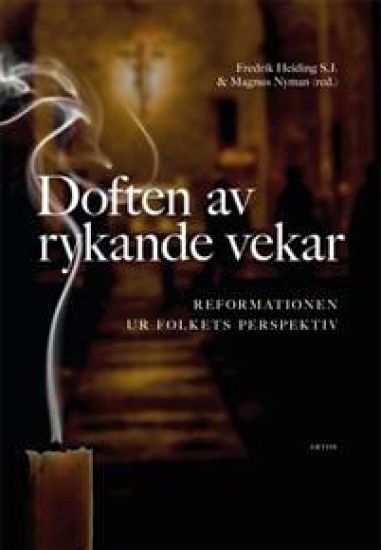
Doften av rykande vekar : reformationen ur folkets perspektiv

Doften av rykande vekar : reformationen ur folkets perspektiv

Fredrik Heiding; Magnus Nyman; Martin Berntson; Stina Fallberg Sundmark; Ingela Hedström; Ritwa Herjulfsdotter; John W O'Malley; Anders Piltz; Elisabet Regner; Syster M. Patricia; Per Åkerlund

Artos Norma Bokförlag
2016
nidottu
Reformationen i Sverige var en kulturrevolution som genomfördes gradvis och mot folkflertalets önskan, en kulturrevolution i bemärkelsen att många centrala aspekter i tidigare generationers liv förändrades i grunden. Bokens titel Doften av rykande vekar antyder att det som tilldrog sig fick vittgående konsekvenser: gillenas, klostrens och den äldre vardagsfromhetens lågor släcktes. Det sinnliga och kroppsliga trängdes undan till förmån för en mer abstrakt religiös tro. Pilgrimsvandringar blev olagliga och utbildningsväsendet nedprioriterades. Hur upplevde folket i socknar och städer allt det nya? Men lågan slocknade inte för alltid. Mycket av det som då förbjöds ses i dag som något självklart över hela kristenheten, varför det är motiverat att tala om en »katolsk återkomst« i vår tid.
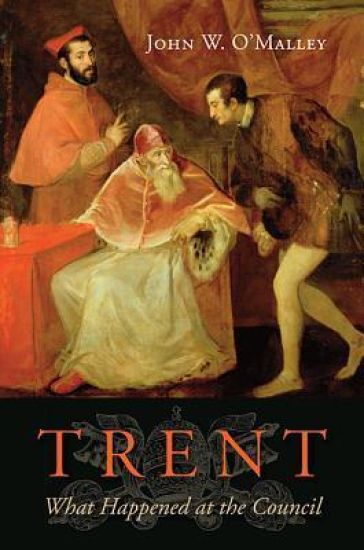
Trent

Trent

John W. O'Malley

The Belknap Press
2013
sidottu
Winner of the John Gilmary Shea PrizeThe Council of Trent (1545–1563), the Catholic Church’s attempt to put its house in order in response to the Protestant Reformation, has long been praised and blamed for things it never did. Now, in this first full one-volume history in modern times, John W. O’Malley brings to life the volatile issues that pushed several Holy Roman emperors, kings and queens of France, and five popes—and all of Europe with them—repeatedly to the brink of disaster.During the council’s eighteen years, war and threat of war among the key players, as well as the Ottoman Turks’ onslaught against Christendom, turned the council into a perilous enterprise. Its leaders declined to make a pronouncement on war against infidels, but Trent’s most glaring and ironic silence was on the authority of the papacy itself. The popes, who reigned as Italian monarchs while serving as pastors, did everything in their power to keep papal reform out of the council’s hands—and their power was considerable. O’Malley shows how the council pursued its contentious parallel agenda of reforming the Church while simultaneously asserting Catholic doctrine.Like What Happened at Vatican II, O’Malley’s Trent: What Happened at the Council strips mythology from historical truth while providing a clear, concise, and fascinating account of a pivotal episode in Church history. In celebration of the 450th anniversary of the council’s closing, it sets the record straight about the much misunderstood failures and achievements of this critical moment in European history.
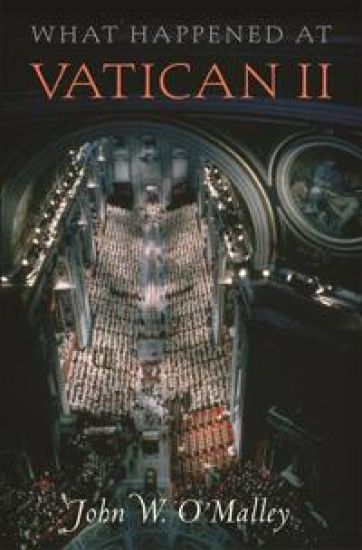
What Happened at Vatican II

What Happened at Vatican II

John W. O'Malley

The Belknap Press
2010
nidottu
During four years in session, Vatican Council II held television audiences rapt with its elegant, magnificently choreographed public ceremonies, while its debates generated front-page news on a near-weekly basis. By virtually any assessment, it was the most important religious event of the twentieth century, with repercussions that reached far beyond the Catholic church. Remarkably enough, this is the first book, solidly based on official documentation, to give a brief, readable account of the council from the moment Pope John XXIII announced it on January 25, 1959, until its conclusion on December 8, 1965; and to locate the issues that emerge in this narrative in their contexts, large and small, historical and theological, thereby providing keys for grasping what the council hoped to accomplish.What Happened at Vatican II captures the drama of the council, depicting the colorful characters involved and their clashes with one another. The book also offers a new set of interpretive categories for understanding the council’s dynamics—categories that move beyond the tired “progressive” and “conservative” labels. As we approach the fiftieth anniversary of the calling of the council, this work reveals in a new way the spirit of Vatican II. A reliable, even-handed introduction to the council, the book is a critical resource for understanding the Catholic church today, including the pontificate of Benedict XVI.
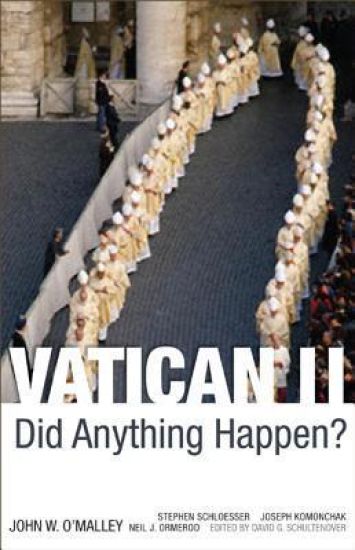
Vatican II

Vatican II

John W. O'Malley; Joseph Komonchak; Neil J. Ormerod; Stephen Schloesser

Continuum International Publishing Group Ltd.
2008
nidottu
For 40 years a battle has been waged over Vatican II between conservatives and liberals, between those who want to go "back to the sources" and those who champion "the spirit of the council." Benedict XVI is clearly one of those who started out as a liberal only to end up in the conservative camp. "Vatican II: Did Anything Happen?" is clearly on the side of those who think something unprecedented happened, that a genie was let out of the bottle that will never be stuffed back.Comprised mainly of a collection of articles, mostly but not all from Theological Studies, that are without qualification some of the best analysis of the council ever written, this book is a long overdue look at one of the most controversial and revolutionary chapters in the history of the Catholic Church.
The First Jesuits

The First Jesuits

John W. O'Malley

Harvard University Press
1995
nidottu
John W. O’Malley gives us the most comprehensive account ever written of the Society of Jesus in its founding years, one that heightens and transforms our understanding of the Jesuits in history and today. Following the Society from 1540 through 1565, O’Malley shows how this sense of mission evolved. He looks at everything—the Jesuits’ teaching, their preaching, their casuistry, their work with orphans and prostitutes, their attitudes toward Jews and “New Christians,” and their relationship to the Reformation. All are taken in by the sweep of O’Malley’s story as he details the Society’s manifold activities in Europe, Brazil, and India.
Vatican I

Vatican I

John W. O'Malley

The Belknap Press
2019
nidottu
In 1869, some seven hundred Catholic bishops traveled to Rome to participate in the first church-wide council in three hundred years. The French Revolution had shaken the foundations of the church. Pope Pius IX was determined to set things right through a declaration by the council that the pope was infallible.John W. O’Malley brings to life the bitter, schism-threatening conflicts that erupted at Vatican I. The pope’s zeal in pressing for infallibility raised questions about the legitimacy of the council, at the same time as Italian forces under Garibaldi seized the Papal States and were threatening to take control of Rome itself. Gladstone and Bismarck entered the fray. As its temporal dominion shrank, the Catholic Church became more pope-centered than ever before, with lasting consequences.“O’Malley’s account of the debate over infallibility is masterful.”—Commonweal“[O’Malley] excels in describing the ways in which the council initiated deep changes that still affect the everyday lives of Catholics.”—First Things“An eminent scholar of modern Catholicism…O’Malley…invit[es] us to see Catholicism’s recent history as profoundly shaped by and against the imposing legacy of Pius IX.”—Wall Street Journal“Gripping…O’Malley continues to engage us with a past that remains vitally present.”—The Tablet“The worldwide dean of church historians has completed his trinity of works on church councils…[A] masterclass in church history…telling us as much about the church now as then.”—America
Saints or Devils Incarnate?

Saints or Devils Incarnate?

John W. O'Malley

BRILL
2013
sidottu
Almost from the moment the Jesuits were founded in 1540 by Ignatius of Loyola and his companions they suffered from misunderstanding, some positive, much of it negative. Myth and misinformation abounded. The Society of Jesus, the Jesuits' official name, was a society of saints or of devils incarnate. Not until the mid-twentieth century did historians begin to dispel some of the myths, but only with John O'Malley's The First Jesuits (1993) did a new era open in the study of the Society. Since then the Jesuits have attracted great attention from scholars of all disciplines on an international basis. O'Malley has continued to write about Saint Ignatius and the subsequent history of the Jesuits. This volume contains a number of such studies and presses forward the trajectory he launched two decades ago with his book.
Four Cultures of the West

Four Cultures of the West

John W. O'Malley

The Belknap Press
2006
nidottu
The workings of Western intelligence in our day--whether in politics or the arts, in the humanities or the church--are as troubling as they are mysterious, leading to the questions: Where are we going? What in the world were we thinking? By exploring the history of four "cultures" so deeply embedded in Western history that we rarely see their instrumental role in politics, religion, education, and the arts, this timely book provides a broad framework for addressing these questions in a fresh way.The cultures considered here originated in the ancient world, took on Christian forms, and manifest themselves today in more secular ways. These are, as John W. O'Malley identifies them: the prophetic culture that proclaims the need for radical change in the structures of society (represented by, for example, Jeremiah, Martin Luther, and Martin Luther King, Jr.); the academic culture that seeks instead to understand those structures (Aristotle, Aquinas, the modern university); the humanistic culture that addresses fundamental human issues and works for the common good of society (Cicero, Erasmus, and Eleanor Roosevelt); and the culture of art and performance that celebrates the mystery of the human condition (Phidias, Michelangelo, Balanchine).By showing how these cultures, as modes of activity and discourse in which Western intelligence has manifested itself through the centuries and continues to do so, O'Malley produces an essay that especially through the history of Christianity brilliantly illuminates the larger history of the West.
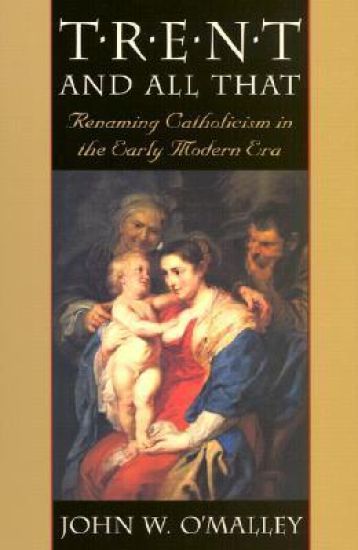
Trent and All That

Trent and All That

John W. O'Malley

Harvard University Press
2002
nidottu
Counter Reformation, Catholic Reformation, the Baroque Age, the Tridentine Age, the Confessional Age: why does Catholicism in the early modern era go by so many names? And what political situations, what religious and cultural prejudices in the nineteenth and twentieth centuries gave rise to this confusion? Taking up these questions, John W. O’Malley works out a remarkable guide to the intellectual and historical developments behind the concepts of Catholic reform, the Counter Reformation, and, in his felicitous term, Early Modern Catholicism. The result is the single best overview of scholarship on Catholicism in early modern Europe, delivered in a pithy, lucid, and entertaining style. Although its subject is fundamental to virtually all other issues relating to sixteenth- and seventeenth-century Europe, there is no other book like this in any language.More than a historiographical review, Trent and All That makes a compelling case for subsuming the present confusion of terminology under the concept of Early Modern Catholicism. The term indicates clearly what this book so eloquently demonstrates: that Early Modern Catholicism was an aspect of early modern history, which it strongly influenced and by which it was itself in large measure determined. As a reviewer commented, O’Malley’s discussion of terminology ‘opens up a different way of conceiving of the whole history of Catholicism between the Reformation and the French Revolution.”