Kirjojen hintavertailu. Mukana 12 595 353 kirjaa ja 12 kauppaa.

Kirjailija

John W. Payne

Kirjat ja teokset yhdessä paikassa: 5 kirjaa, julkaisuja vuosilta 1993-2003, suosituimpien joukossa The Adaptive Decision Maker. Vertaile teosten hintoja ja tarkista saatavuus suomalaisista kirjakaupoista.

5 kirjaa

Kirjojen julkaisuhaarukka 1993-2003.

Punitive Damages

Punitive Damages

Cass R. Sunstein; Reid Hastie; John W. Payne; David A. Schkade; W. Kip Viscusi

University of Chicago Press
2003
nidottu
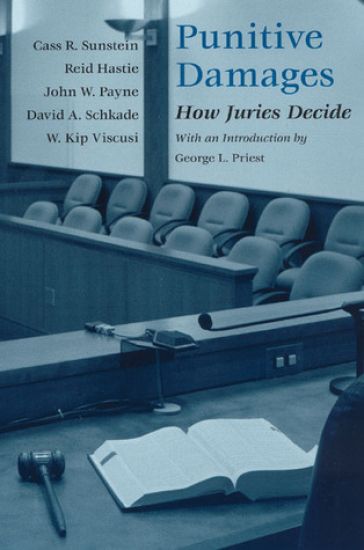
Over the past two decades, the United States has seen a dramatic increase in the number and magnitude of punitive damages verdicts rendered by juries in civil trials. Probably the most extraordinary example is the July 2000 award of $144.8 billion in the Florida class action lawsuit brought against the cigarette manufacturers. More puzzling were two recent verdicts against the auto manufacturer BMW in Alabama. In identical cases, argued in the same court before the same judge, one jury awarded $4 million in punitive damages, while the other awarded no punitive damages at all. In cases involving accidents, civil rights and the environment, multimillion dollar punitive awards have been a subject of intense controversy. But how do juries actually make decisions about punitive damages? To find out, the authors - specialists in psychology, economics and the law - present the results of controlled experiments with over 600 mock juries involving the responses of more than 8,000 jury-eligible citizens. They find that although juries tended to agree in their moral judgements about the defendant's conduct, they rendered erratic and unpredictable dollar awards. Jurors also tended to ignore instructions from the judges; showed "hindsight bias", believing that what happened should have been foreseen; and penalized corporations that had based their decisions on careful cost-benefit analyses. While judges made many of the same errors, they performed better in some areas, suggesting that judges (or other specialists) may be better equipped than juries to decide punitive damages. With a wealth of new data and a host of provocative findings, this book documents a wide range of systematic bias in jury behaviour and should be valuable for anyone interested in punitive damages, jury behaviour, human psychology and the theory of punishment.
Punitive Damages

Punitive Damages

Cass R. Sunstein; Reid Hastie; John W. Payne; David A. Schkade; W. Kip Viscusi

University of Chicago Press
2002
sidottu
Over the past two decades, the United States has seen a dramatic increase in the number and magnitude of punitive damages verdicts rendered by juries in civil trials. Probably the most extraordinary example is the July 2000 award of $144.8 billion in the Florida class action lawsuit brought against the cigarette manufacturers. More puzzling were two recent verdicts against the auto manufacturer BMW in Alabama. In identical cases, argued in the same court before the same judge, one jury awarded $4 million in punitive damages, while the other awarded no punitive damages at all. In cases involving accidents, civil rights and the environment, multimillion dollar punitive awards have been a subject of intense controversy. But how do juries actually make decisions about punitive damages? To find out, the authors - specialists in psychology, economics and the law - present the results of controlled experiments with over 600 mock juries involving the responses of more than 8,000 jury-eligible citizens. They find that although juries tended to agree in their moral judgements about the defendant's conduct, they rendered erratic and unpredictable dollar awards. Jurors also tended to ignore instructions from the judges; showed "hindsight bias", believing that what happened should have been foreseen; and penalized corporations that had based their decisions on careful cost-benefit analyses. While judges made many of the same errors, they performed better in some areas, suggesting that judges (or other specialists) may be better equipped than juries to decide punitive damages. With a wealth of new data and a host of provocative findings, this book documents a wide range of systematic bias in jury behaviour and should be valuable for anyone interested in punitive damages, jury behaviour, human psychology and the theory of punishment.
Emotional Decisions

Emotional Decisions

Mary Frances Luce; James R. Bettman; John W. Payne

University of Chicago Press
2001
nidottu
Decision-making can be difficult and often results in necessary trade-offs, eg. safety versus prices in the purchasing of an automobile. This work provides a model of trade-off difficulty, focusing on its antecedents and consequences. The authors advance a new framework for the integration of the emotional and cognitive aspects of decision-making and argue that consumers perceive and appraise their choices in light of their goals and potential coping strategies.
The Adaptive Decision Maker

The Adaptive Decision Maker

John W. Payne; James R. Bettman; Eric J. Johnson

Cambridge University Press
1993
sidottu
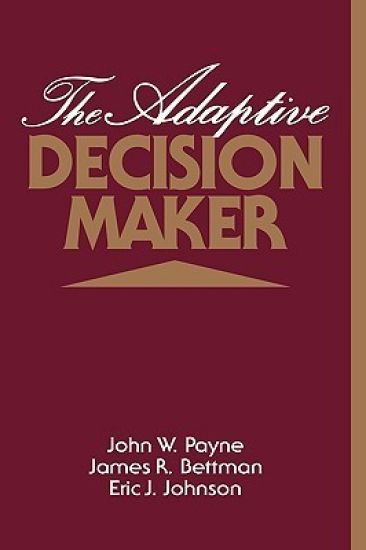
The Adaptive Decision Maker argues that people use a variety of strategies to make judgments and choices. The authors introduce a model that shows how decision makers balance effort and accuracy considerations and predicts which strategy a person will use in a given situation. A series of experiments testing the model are presented, and the authors analyse how the model can lead to improved decisions and opportunities for further research.
The Adaptive Decision Maker

The Adaptive Decision Maker

John W. Payne; James R. Bettman; Eric J. Johnson

Cambridge University Press
1993
pokkari
The Adaptive Decision Maker argues that people use a variety of strategies to make judgments and choices. The authors introduce a model that shows how decision makers balance effort and accuracy considerations and predicts which strategy a person will use in a given situation. A series of experiments testing the model are presented, and the authors analyse how the model can lead to improved decisions and opportunities for further research.